
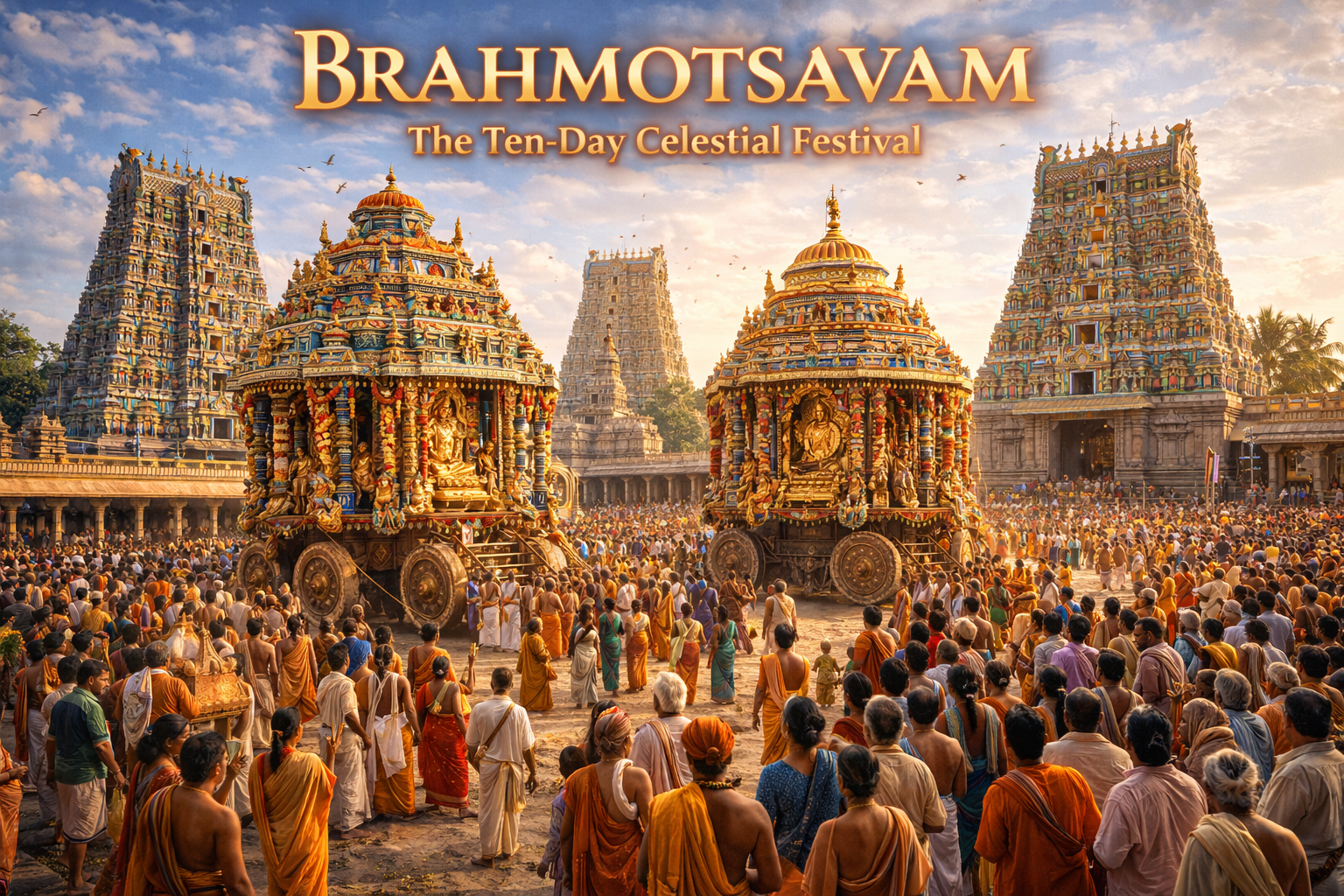
Brahmotsavam: The Ten-Day Celestial Festival of South Indian Temples
How ten days of divine procession, sacred music and Agamic ritual transform entire cities into living acts of worship — and why Brahmotsavam remains the beating heart of South Indian Hindu temple culture.
Once a year, in temples across Tamil Nadu and Andhra Pradesh, the divine descends into the streets. The festival image of the deity — adorned with silks, jewels and flowers — is placed on magnificent vahanas (celestial vehicles) and carried through the temple precincts and surrounding streets in a procession that can draw hundreds of thousands of devotees. The air fills with Nadaswaram and Thavil, with Vedic chanting, with the fragrance of camphor and jasmine. This is Brahmotsavam — the festival of Brahma, the grandest of all Hindu temple celebrations.
The word itself tells the story: Brahma (the supreme divine reality, or the creator deity) + utsavam (festival, celebration, joy). Brahmotsavam is not merely a human occasion for festivity — it is understood in the Agamic tradition as a celebration initiated and attended by the celestial beings themselves, with humans as privileged witnesses and participants.
Origins: When Brahma Himself Celebrated
The theological origin of Brahmotsavam is narrated in the Vaishnava Agamas and temple Sthala Puranas (sacred histories). According to these texts, the first Brahmotsavam was performed not by humans but by Brahma, the creator deity, in honour of Lord Vishnu's manifestation at a particular sacred site. When Brahma himself descends to conduct the festival, the celestial beings — devas, gandharvas, apsaras and the divine sages — join in celebration, making the occasion cosmically significant beyond any human gathering.
The implication is profound: in Brahmotsavam, the temporal world aligns with the celestial one. The priest does not perform the festival for the deity — he performs it alongside the unseen celestial participants who are believed to be invisibly present throughout the ten days. This is why the ritual purity requirements for priests during Brahmotsavam are at their most exacting, and why the festival traditionally begins with the Ankurarpana — the planting of nine sacred grains in nine pots — which serves as a formal invitation to the celestial assembly.
"During Brahmotsavam, the boundary between the visible and invisible worlds becomes thin. The devotee who attends with sincerity is not watching a performance — they are participating in a cosmic event that has been occurring since the beginning of time." — Sri Vaishnavite scholar, Srirangam
The Structure of Brahmotsavam: Day by Day
While each temple has its own variations shaped by its Agamic tradition and local custom, the structure of Brahmotsavam follows a broadly consistent pattern across major South Indian temples. The Tirumala Brahmotsavam — the most attended in the world — provides the clearest example of the full form:
| Day | Vahana / Event | Significance |
|---|---|---|
| Day 1 | Dhwajarohanam — Flag Hoisting | The Garuda flag is hoisted on the flag staff (Dhwajasthambha), formally announcing the festival to the celestial world. Brahma's invitation is considered accepted. |
| Day 2 | Chinna Sesha Vahana | The deity is carried on the divine serpent Adisesha in miniature form — the intimate, protective aspect of the divine. |
| Day 3 | Hamsa Vahana (Swan) & Simha Vahana (Lion) | The swan represents transcendent wisdom; the lion represents divine power and protection. Two processions on the same day. |
| Day 4 | Pearls Palanquin & Kalpa Vriksha Vahana | The divine wish-fulfilling tree — devotees believe that witnessing this vahana grants the fulfilment of sincere desires. |
| Day 5 | Mohini Avatar & Garuda Seva | The most sacred day. Lord Vishnu appears as Mohini (the enchantress) in the evening. Garuda Seva — the eagle vehicle — draws the largest crowds of the festival. |
| Day 6 | Hanumanta Vahana | Lord Hanuman carries the deity — representing perfect devotion (bhakti) as the vehicle of the divine. |
| Day 7 | Swarnavimana (Golden Chariot) & Chakrasnanam | The golden chariot procession, followed by the ceremonial bath of the Sudarshana Chakra (divine discus) — one of the most visually spectacular moments. |
| Day 8 | Asta Dik Palas & Chappan Bhog | Worship of the guardians of the eight directions; offering of 56 sacred food items to the deity. |
| Day 9 | Chakra Snanam & Dolotsavam | The divine swing festival — the deity rocks gently on a jewelled swing, an intimate, tender image of the divine at rest. |
| Day 10 | Dhwaja Avarohanam — Flag Lowering | The Garuda flag is ceremonially lowered, formally closing the festival and releasing the celestial assembly. |
The Vahanas: A Theology in Motion
The vahanas — the divine vehicles on which the festival deity is carried — are far more than decorative floats. Each vahana is a theological statement, a visible teaching about the nature of the divine. In the Agamic understanding, the deity choosing a particular vehicle for a particular occasion reveals an aspect of divine nature that is otherwise invisible in the sanctum image.
Garuda: The King of Vahanas
The eagle Garuda is Vishnu's primary vehicle and the vahana most associated with Brahmotsavam. Garuda represents the Vedas themselves — the wings of Garuda are the two wings of the Sama Veda. When Lord Vishnu mounts Garuda, he is seated upon the Vedic knowledge that carries him between the human and divine worlds. The Garuda Seva day at Tirumala is the single most attended religious gathering in the Hindu calendar — upwards of 500,000 devotees assemble to witness the twenty-minute procession.
The Significance of Each Vahana
- Sesha (Serpent) — eternity, the divine resting upon infinite time
- Hamsa (Swan) — discrimination (viveka), the ability to separate truth from illusion
- Simha (Lion) — sovereignty, the divine as the ruler of all creation
- Hanuman — perfect devotion as the means of divine grace
- Kalpa Vriksha (Wish-fulfilling tree) — divine abundance, the inexhaustible generosity of the divine
- Swarnavimana (Golden chariot) — the divine as the universal sovereign, carried in state through his own creation
"A devotee who witnesses all nine vahanas in a single Brahmotsavam is said to receive the spiritual merit of nine separate pilgrimages to Tirumala. The vahanas are not repetition — each is a different darshan, a different face of the same infinite reality." — Tirumala Tirupati Devasthanams, Festival Commentary
Brahmotsavam at Tirumala: The World's Largest Annual Religious Gathering
The annual Brahmotsavam at the Sri Venkateswara Temple, Tirumala, is held in the Tamil month of Purattasi (September–October) and lasts nine days. It is, by attendance, the largest annual religious gathering of any faith on earth. During the nine days of Brahmotsavam, the Tirumala hills — normally receiving 60,000–80,000 devotees daily — receive between 300,000 and 700,000 devotees per day.
The logistics are staggering: the Tirumala Tirupati Devasthanams (TTD) deploys over 10,000 staff, operates 24-hour free feeding (annadanam) serving over 100,000 meals daily, and coordinates transport, accommodation and crowd management across the entire Tirupati urban agglomeration. The festival generates significant revenue for the TTD — which in turn funds over 100 educational institutions, hospitals and cultural organisations across Andhra Pradesh and Telangana.
Tirumala Venkateswara — September/October, 9 days. World's largest attendance.
Madurai Meenakshi — Chithirai (April/May), 10 days. Culminates in the celestial marriage of Meenakshi and Sundareswarar.
Srirangam Ranganathaswamy — Margazhi (December/January), 21-day Vaikunta Ekadashi festival. The Paramapada Vasal (gate of liberation) is opened once a year.
Palani Murugan — Thai Poosam (January/February). Kavadi bearers arrive from across Tamil Nadu and the global diaspora.
Chidambaram Nataraja — Two Brahmotsavams per year (Thai Poosam and Aani Thirumanjanam), each 10 days.
The Chithirai Festival of Madurai: A Brahmotsavam Like No Other
The Chithirai Festival at the Meenakshi Amman Temple, Madurai, is unique among Brahmotsavams in that its central event is not a procession of vahanas but a divine wedding. The festival celebrates the marriage of Goddess Meenakshi (Parvati) to Lord Sundareswarar (Shiva) — an event that the Sthala Purana of Madurai describes as having been attended by all the gods, and witnessed by the three-eyed Shiva himself.
The Chithirai festival lasts ten days and draws over one million pilgrims to Madurai — transforming the ancient city, already defined by its temple, into a single vast sacred space. On the ninth day, the divine couple's wedding is re-enacted in the temple with full Agamic ceremony, presided over by priests following the same ritual sequence that has been followed for over a millennium. On the tenth day, Lord Vishnu — depicted as Meenakshi's brother — gives her away in marriage, crossing the Vaigai River in a procession that the entire city turns out to witness.
The Role of Music in Brahmotsavam
Brahmotsavam is inseparable from music. The Agamas specify that the processional deity must always be accompanied by the Pancha Vadyam — the five sacred instruments: Nadaswaram, Thavil, Ottu, Udukkai and Kurnalam. Of these, the Nadaswaram and Thavil are the defining sonic identity of Tamil temple festivals.
The Nadaswaram — a double-reed wind instrument of extraordinary power and sweetness — is one of the loudest acoustic instruments ever developed, capable of projecting its sound across entire temple precincts. It is considered mangala vadyam — an auspicious instrument whose sound itself is a form of divine blessing. The playing of Nadaswaram at the vahana processions is not background music — it is an act of worship, a sonic offering to the deity passing in procession.
In addition to the traditional instruments, major Brahmotsavams also feature recitations of the Divya Prabandham — the 4,000 Tamil devotional hymns of the Alvars — which are sung in the presence of the processional deity. The Divya Prabandham recitation at Brahmotsavam is one of the oldest continuous literary-religious traditions in the world, linking the devotees of today directly to the Tamil poet-saints of the 6th to 9th centuries CE.
The Aandaal Project's Hindu Temple Pillar lists temples across Tamil Nadu and the diaspora — including their upcoming festivals and events. Register your temple or discover one near you.
Brahmotsavam in the Diaspora: Carrying the Festival Abroad
One of the most remarkable cultural achievements of the Tamil Hindu diaspora has been the transplantation of full Brahmotsavams to temples outside India. The Sri Venkateswara Temple in Pittsburgh (est. 1976), the Murugan Temple in London (est. 1978), the Meenakshi Temple in Houston (est. 1977) and dozens of others now conduct annual Brahmotsavams with full Agamic ceremony, specially crafted vahanas, qualified Nadaswaram artists flown in from Tamil Nadu, and crowds of devotees who have grown up knowing only the diaspora form of the festival.
These diaspora Brahmotsavams serve a function beyond religious observance. For communities living far from their ancestral homes, the festival is an annual reaffirmation of identity — a visible statement that Tamil Hindu culture is not a private or domestic matter but a public, communal, joyful presence in whatever country the community has made its home. The Pittsburgh Brahmotsavam, held each year in the Appalachian autumn, draws devotees from across the eastern United States and Canada, and the Garuda Seva procession — carried through the streets of Penn Hills, Pennsylvania — is an image that would have been unimaginable to the first generation of Tamil immigrants who arrived in America in the 1960s and 1970s.
Attending Brahmotsavam: A Practical Guide for Devotees
Planning Your Visit
- Garuda Seva day at Tirumala is the most attended single day — arrive 24–36 hours early if possible, or view from the outer precincts where crowds are more manageable
- Morning processions (typically 5–7 AM) are far less crowded than evening ones and are more intimate
- Book accommodation in the TTD cottages or local guesthouses at least 3 months in advance for Tirumala Brahmotsavam
- For Madurai Chithirai, the celestial wedding day (9th day) and the Vishnu procession (10th day) are the peak days
- Wear traditional attire — veshti for men, saree or salwar for women — as a mark of respect and as required at the inner precincts
What to Watch For
- The Dhwajarohanam (flag hoisting) on Day 1 — a surprisingly moving ceremony that officially opens the divine invitation
- The Ankurarpana — the planting of the nine sacred grains that initiates the festival. This is performed in the inner sanctum and not always visible, but the priests will emerge with the pots
- The moment of Ekanta Seva on the final night — when the deity is put to rest and the curtains close. The silence after days of music and crowds is profound
- The Dhwaja Avarohanam (flag lowering) on the final day — many devotees weep at this moment, experiencing the closing of a window into the divine world
The Deeper Meaning: Why Brahmotsavam Matters Today
In an age of digital distraction and fragmented attention, Brahmotsavam offers something increasingly rare: a sustained, communal, embodied experience of beauty, devotion and shared meaning. The devotee who attends all ten days of a Brahmotsavam does not merely collect religious merit — they inhabit a different relationship to time. The festival creates what the anthropologist Victor Turner called a liminal space — a threshold between ordinary life and something larger, where normal social structures are temporarily suspended and the community experiences itself as a single body of devotion.
The procession through the streets is particularly significant. By bringing the deity out of the enclosed sanctum and into the public streets, Brahmotsavam democratises darshan — the sacred visual encounter with the divine. Every person on the street, regardless of their ability to enter the inner temple, receives the deity's glance as the vahana passes. The festival is, in this sense, the most inclusive moment of the Hindu liturgical year.
The Aandaal Project documents and celebrates Tamil temple festivals, sacred music and living heritage for the global community. Your support helps us preserve Brahmotsavam traditions for future generations — wherever in the world they may be.