
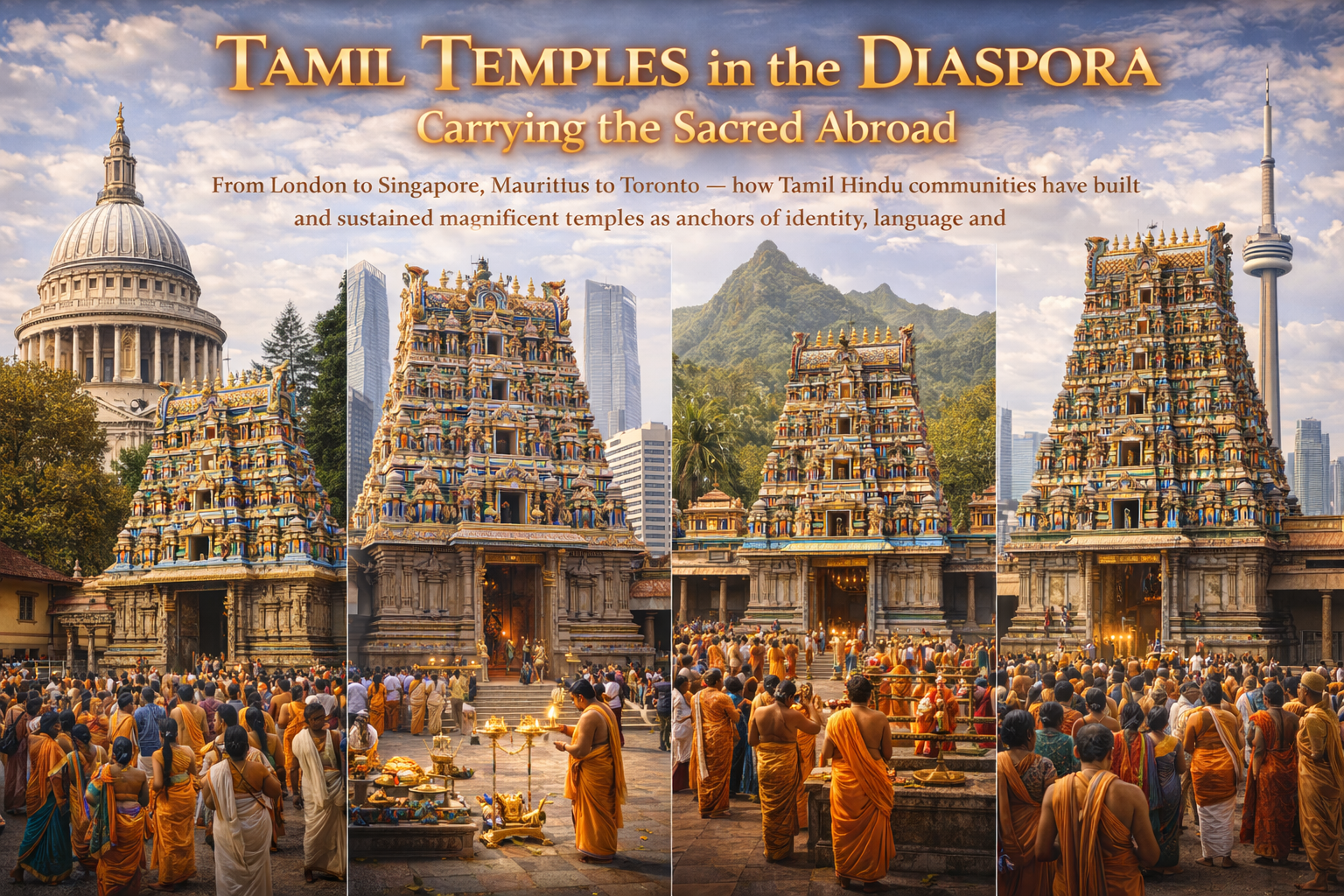
Tamil Temples in the Diaspora: How a Community Carried Its Gods Across the World
From a single Murugan statue placed in a London community hall in 1973, to hundreds of fully consecrated Agamic temples on six continents — the extraordinary story of how Tamil Hindu communities rebuilt their sacred world far from home, and what these temples mean for the future of Tamil identity.
In October 1973, a carefully wrapped statue of Lord Murugan arrived at Heathrow Airport in a Tamil devotee's luggage. It had been specially made in Kumbakonam, Tamil Nadu, and it was placed — with full ritual honours — in a community centre in North London. Within six years, that single act of devotion had grown into the Highgate Hill Murugan Temple: the first permanent Hindu temple established by the Tamil community in the United Kingdom. Over 700 people attended its opening ceremony on 2 December 1979.
That story — a deity carried in a suitcase across continents, a community gathering around a lamp in a borrowed room, years of fundraising, the eventual purchase of a building, the arrival of qualified priests, the first Kumbhabhishekam — has been repeated hundreds of times, in dozens of countries, across the second half of the 20th century and into the 21st. It is one of the most remarkable stories of religious and cultural transplantation in modern history: the carrying of a 3,000-year-old Agamic temple tradition, intact and living, to foreign soils.
The Waves of Tamil Migration: Understanding the Diaspora
To understand the Tamil temple outside India, you must first understand the Tamil diaspora itself — which is not one migration but several, each with its own character, destination and relationship to the homeland.
The first wave — the oldest diaspora — was the colonial labour migration of the 19th century, when the British transported Tamil workers from South India and Sri Lanka to their plantation colonies in Malaya, Fiji, Mauritius, South Africa, Trinidad, Guyana and elsewhere. These communities, predominantly Tamil-speaking Hindus, built the first Tamil temples outside India — modest structures, often without full Agamic consecration, but unmistakably Tamil in their deity choices, their festival calendar and their use of the Tamil language in worship.
The second wave was the professional migration of the 1960s and 70s, particularly to the United Kingdom, the United States and Canada, enabled by the liberalisation of immigration laws in all three countries. These were doctors, engineers, academics and their families — an educated, relatively prosperous community that brought with it the cultural aspiration and financial capacity to build full Agamic temples within a generation of arrival.
The third wave — and the largest driver of Tamil temple-building outside India — was the refugee diaspora created by the Sri Lankan Civil War (1983–2009). The 1983 anti-Tamil pogrom in Sri Lanka triggered a mass exodus; over the following 26 years, more than 500,000 Sri Lankan Tamils sought refuge in Canada, the UK, Germany, France, Switzerland, Norway, Australia and elsewhere. The 1983 communal riots and later civil war in Sri Lanka precipitated the mass exodus of Tamils, with over 500,000 finding refuge in countries including Canada, the UK, Australia, the United States, France and Switzerland. This community — traumatised, displaced, and acutely conscious of what it stood to lose — threw enormous energy into temple-building as an act of cultural and spiritual survival.
"For many Sri Lankan Tamil refugees, the temple was not a luxury or a cultural extra. It was the first thing they built. Before the community centre, before the Tamil school, before anything else — the temple. Because without the temple, you are not a community. You are just a collection of people in the same postcode." — Community elder, Tamil Welfare Association, London
A Timeline of Firsts: Temple-Building Across the World
A Thiruchendur Murugan vigraham specially made in Kumbakonam is brought to London by devotee Sabapathipillai and installed in a community centre. The Britannia Hindu (Saiva) Temple Trust is registered as a charity in 1974. The Highgate Hill Murugan Temple opens at 200A Archway Road on 2 December 1979, becoming the first permanent Tamil Hindu temple in the UK. Its first Kumbhabhishekam is held in June 1986. In 2002, Queen Elizabeth II visits — the first British monarch ever to visit a Hindu temple.
The Sri Venkateswara Temple at Penn Hills, Pittsburgh — built with shilpis (temple craftspeople) brought from Tamil Nadu — becomes one of the first traditionally built Agamic temples in North America. Consecrated in 1977 following full Vaikhanasa Agamic rites, it sets the standard for diaspora temple construction in the United States and draws devotees from across the eastern seaboard. Its annual Brahmotsavam in September becomes one of the most attended Hindu religious gatherings in North America.
The first Hindu temple in Australia, the Sri Mandir Temple, was built in 1977. It was established by three devotees — Dr Prem Shankar, Dr Padmanabhan Shrindhar Prabhu and Dr Anand — who bought an old house in Auburn, NSW, for $12,000 and converted it into a temple. The Tamil-specific temple movement follows in the 1980s and 90s with the formation of the Saiva Manram in 1985 to build the Sydney Murugan Temple at Mays Hill — a site referred to by Tamil devotees as Vaikacik Kunru (the Hill of Vaikasi).
The Meenakshi Temple Society of Houston consecrates the first Meenakshi Amman temple outside India, with priests brought from the original Madurai temple. The Houston temple becomes the spiritual anchor for Tamil Hindus across Texas and the Gulf Coast, and its annual Brahmotsavam — performed with full Agamic rites — draws tens of thousands of devotees.
After inaugural first pooja meetings in Harrington Square, London, in April 1975, and monthly prayers held in various venues, the London Sri Murugan Temple was consecrated in February 1984 on Browning Road in Manor Park. Its annual Thaipusam chariot festival now draws approximately 10,000 visitors through the streets of East London — one of the largest public Hindu processions in the United Kingdom.
Sri Lankan Tamils have continued to migrate to Canada, particularly to the Greater Toronto Area. The GTA now hosts the largest concentration of Sri Lankan Tamils outside Sri Lanka — over 300,000 — and an extraordinary number of Tamil Hindu temples. The Thiru Murugan Temple in Scarborough, the Sri Ayyappan Temple in Etobicoke, and dozens of others serve a community that has reconstituted the full rhythm of Tamil religious life in the Canadian winter.
After decades of fundraising, the London Sri Murugan Temple completes its new building with a full 50-foot granite gopuram tower — the first traditional Dravidian gopuram built in the UK. Craftspeople (shilpis) from Tamil Nadu carve the tower and install the sculptures according to full Agamic specifications. The consecration draws thousands of devotees and marks a new era of architectural ambition for diaspora temples.
The Global Tamil Temple Landscape Today
The Aandaal Project's Temple Pillar connects temples in the diaspora with devotees worldwide. Whether your temple is in Birmingham or Brisbane, Toronto or Tokyo — list it free and help your community find you.
The Agamic Question: Can the Full Tradition Travel?
The most intellectually fascinating question raised by diaspora temple-building is whether the full Agamic tradition — with all its requirements for specific sacred substances, locally sourced flowers, rivers, sacred geography, and qualified priests — can truly be transplanted to foreign soils.
The answer of the tradition has been both principled and pragmatic. The Agamas are clear that the divine can be invoked anywhere in the world. The sankalpam — the statement of intent that opens every ritual — explicitly names the location in both cosmic and geographic terms, situating even a temple in Toronto or Sydney within the sacred geography of Bharata. When a priest in London recites the sankalpam naming the Thames as his local river in the context of the sacred rivers of India, he is performing an act of theological adaptation that the Agamic tradition has always been capable of.
But pragmatic challenges remain. Flowers — a central element of every kala puja — present one of the most poignant. The Agamas specify that Shiva receives bilva leaves, Vishnu receives tulasi, Murugan receives the red lotus and the kadamba flower. In Tamil Nadu, these are available at every temple flower market from dawn. In a Toronto winter, the temple committee may drive two hours to find a supplier of bilva leaves, kept alive in a greenhouse by a Tamil family who planted them specifically for this purpose. These small, determined acts of cultural preservation are invisible to outsiders but central to the life of every diaspora temple.
Priests: The Critical Supply Chain
The most pressing practical challenge for diaspora temples is the supply of qualified Agamic priests. Every full temple requires priests trained in the specific Agamic stream of its principal deity — Shaiva temples need Shaiva Agama-trained archakas; Vaishnava temples need Pancharatra or Vaikhanasa-trained priests. For the first generation of diaspora temples, priests were brought from India on temporary visas — a logistically complex and increasingly expensive arrangement.
By the 1990s, a second model had emerged: the training of diaspora-born young men in Agama patashalas in Tamil Nadu, with the explicit intention of returning to serve overseas temples. Several Tamil Nadu families — particularly from priestly lineages that had emigrated to the UK or Canada — sent their sons back to Chidambaram, Madurai or Kumbakonam for the 8–12 year training, then brought them back to serve the community abroad. This model has produced a remarkable generation of diaspora priests: men who speak fluent Tamil, English and Sanskrit, who were born in Birmingham or Scarborough, who perform the Kalaasanthi abhishekam at dawn with the same precision as their counterparts in Thiruvannamalai, and who can explain the theology of the Agamas in a language their congregation actually understands.
"My grandfather left Jaffna in 1983 with nothing. He walked through the jungle for three days. What he carried in his memory — the ritual sequences, the hymns, the names of all the deities and their correct forms — that could not be destroyed. That knowledge is what we built our temple from." — Temple trustee, Sri Lankan Tamil community, Toronto
The Temple as Community Anchor: More Than a Place of Worship
For diaspora Tamil communities, the temple serves a cluster of functions that extend far beyond religious worship. In contemporary times, the process of building a Hindu temple by emigrants and diasporas from South Asia has served as a process of building a community, a social venue to network, reduce prejudice and seek civil rights together.
The diaspora temple is typically the venue for:
- Life-cycle ceremonies — naming ceremonies (namakarana), thread ceremonies (upanayanam), weddings, and death rites are all conducted by the temple priests according to the full Agamic sequence. For many diaspora families, the temple is the only place where these ceremonies can be performed with authentic ritual completeness.
- Tamil language classes — many diaspora temples also offer "Sunday school" for teaching young children religion and Indian languages. In many temples, these classes are the primary setting in which third-generation Tamil children learn to read and write their ancestral language.
- Festival calendar — the Tamil religious year — Thaipusam, Thai Pongal, Panguni Uthiram, Aadi Perukku, Karthigai Deepam — is anchored to the temple. In the diaspora, these festivals become especially charged occasions, drawing Tamil families from across the city or region for a collective experience of identity and belonging.
- Counselling and welfare — many diaspora temples, particularly those serving Sri Lankan Tamil refugee communities, have developed welfare arms that provide advice on immigration, housing, employment and mental health to newly arrived community members.
- Cultural performance — Bharatanatyam recitals, Carnatic music concerts and Tamil literary events are regularly hosted in temple halls, making the temple the primary cultural institution of the Tamil community in the absence of dedicated arts venues.
The Challenge of the Third Generation
As diaspora Tamil communities enter their third and fourth generations — people born in Birmingham, Toronto or Melbourne, whose grandparents arrived as immigrants — the temples face a challenge of cultural transmission that is both urgent and unresolved.
The first-generation founders built their temples out of homesickness, grief and determination. The second generation — who grew up attending the temple as children — often experienced it as a cultural obligation more than a spiritual need. The third generation — educated in Western schools, fluent in English but perhaps only conversational in Tamil, participants in the cultural landscape of their country of birth — relate to the temple differently again. For some, it is an exotic ancestral relic; for others, it is precisely because of its difference from the surrounding culture that it carries meaning.
The temples that are successfully engaging the third generation are those that have made theological content accessible in English — through published explanations of rituals, English-language talks by knowledgeable priests and elders, and digital content that explains the Agamic tradition in terms that are intellectually engaging to a generation educated in Western universities. The Aandaal Project's Temple Pillar and blog series are part of this effort — making the deep roots of Tamil temple culture visible, searchable and shareable by anyone, anywhere.
Highgate Hill Murugan Temple, London — est. 1979, visited by Queen Elizabeth II in 2002. The oldest Tamil Saiva temple in the UK.
London Sri Murugan Temple, Manor Park — est. 1984, 50ft gopuram completed 2005. Annual Thaipusam chariot festival draws 10,000.
Sri Venkateswara Temple, Pittsburgh PA — est. 1977. One of the first fully Agamic temples in North America; annual Brahmotsavam draws 500,000+.
Meenakshi Temple, Houston TX — est. 1977. First Meenakshi Amman temple outside India; priests from Madurai.
Sri Veeramakaliamman Temple, Singapore — est. 1881. One of the oldest Tamil temples outside India, serving Singapore's Little India district since the colonial era.
Sri Thendayuthapani Temple (Chettiar Temple), Singapore — est. 1859. The oldest surviving Tamil Hindu temple in Singapore; Thaipusam procession a national heritage event.
Sydney Murugan Temple, Mays Hill NSW — est. 1994. The Lord is known as "Sydney Murugan" — a poignant transplantation of the hilltop deity tradition to the suburbs of western Sydney.
Thaipusam in the Diaspora: The Festival That Crossed Continents
No Tamil diaspora festival has travelled further or more dramatically than Thaipusam — the festival of Lord Murugan celebrated in the Tamil month of Thai (January/February) on the day of the Pusam star. In Tamil Nadu, Thaipusam is observed but not the grandest of Murugan festivals (that distinction belongs to Panguni Uthiram). But in the diaspora, Thaipusam has become the defining public expression of Tamil Hindu identity.
The reason lies in the Sri Lankan Tamil diaspora's particular devotion to Murugan, and in the visual drama of the kavadi — the peacock-feather arched frame carried by devotees in fulfilment of vows, sometimes accompanied by vel piercings of the skin, tongue and cheeks as an act of ascetic devotion. In London, Toronto, Sydney and Kuala Lumpur, the Thaipusam procession has become a major civic event, drawing non-Tamil observers and generating both admiration and occasional controversy.
The Thaipusam celebration at Batu Caves, Kuala Lumpur — attended by over a million devotees and featuring a 272-step staircase climb — is the largest Thaipusam gathering in the world and one of the largest Hindu festivals outside India. The Tamil Hindu community in Malaysia, descended from colonial-era plantation workers, has maintained the tradition with extraordinary continuity and scale for over 130 years.
The Digital Temple: Diaspora Communities and New Technology
The COVID-19 pandemic, which closed temples worldwide for months at a time, accelerated a transformation that was already underway: the digitalisation of Tamil temple worship. Virtually every major diaspora temple now livestreams its daily kala puja services on YouTube, Facebook and WhatsApp — allowing devotees working long shifts, elderly community members who cannot travel, and Tamil families in cities without temples to participate in daily darshan from their homes.
This raises the same theological question that the diaspora raised in physical form: does digital darshan carry the same spiritual merit as physical presence? The tradition's answer is nuanced. Physical presence in the consecrated space — receiving the warmth of the arati flame, the touch of the priest's hand, the smell of camphor and flowers — is irreplaceable. But digital darshan of a consecrated image, performed with sincerity, is a genuine act of worship. The Agamas understand the divine image as a locus of real divine presence — and that presence is not cancelled by a camera lens.
The Aandaal Project connects diaspora Tamil temples with their communities worldwide — through the Temple Pillar directory, this blog series, and ongoing cultural documentation. Book ANDAL Coins to support this mission, and list your temple today so that every Tamil, wherever they are in the world, can find the nearest sacred space.