
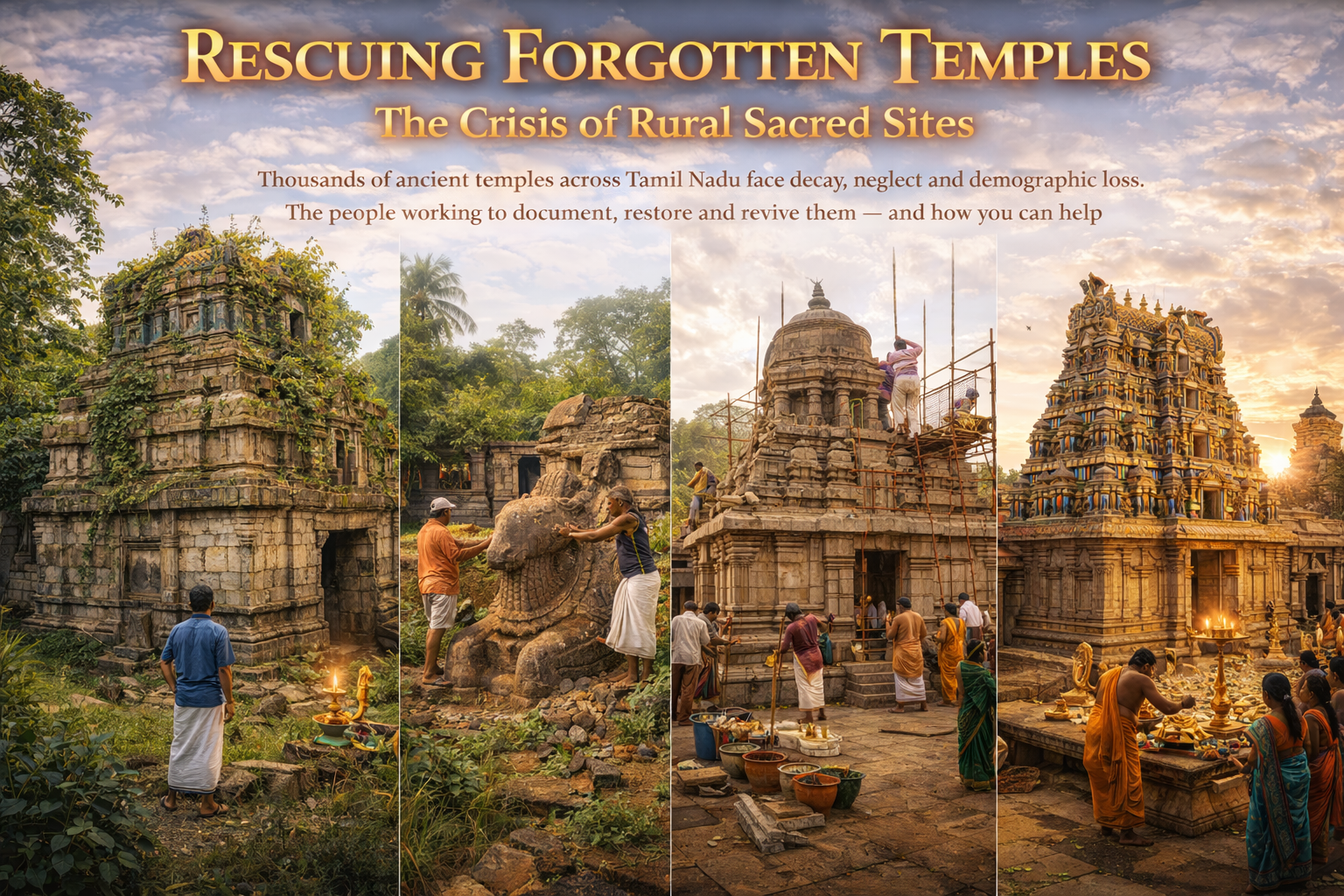
Rescuing Forgotten Temples: The Crisis Facing Tamil Nadu's Rural Sacred Sites
Over 36,000 temples under government administration. Thousands in dangerous states of structural neglect. Temple lands systematically encroached upon. Insensitive restorations erasing thousand-year-old inscriptions. And a remarkable network of ordinary people — engineers, software developers, teachers, retired civil servants — who are spending their weekends rescuing what the system has abandoned.
The Karkadeswarar Temple at Manavur had no roof. Not a damaged roof, not a leaking roof — no roof at all. The inner sanctum walls of this ancient Shiva temple, its stone carved by craftsmen who may have lived a thousand years ago, stood open to the monsoon sky. The Shivalinga inside had been rained upon through uncounted seasons. When a small group of devotee-volunteers from the Arunachaleswara Temple Restoration Trust visited, they found the local villagers had simply stopped coming — not out of indifference but because seeing their ancestral temple in that condition was too painful.
The Karkadeswarar is not an exceptional case. It is representative. Across Tamil Nadu — which possesses the largest concentration of ancient Hindu temples of any state in India — thousands of rural and semi-urban temples are in various stages of neglect, decay, structural failure, or irreversible damage caused by well-intentioned but technically incompetent "restoration." This is one of the great unacknowledged cultural emergencies of our time.
The Scale of the Crisis: What 36,000 Temples Under Government Control Actually Means
The Tamil Nadu Hindu Religious and Charitable Endowments Department (HR&CE) was established in its present form in 1960. It is, by its own description, the world's largest heritage custodian — administering over 36,000 temples, their lands, their staff, their maintenance budgets and their ritual administration. The scale is staggering. No other heritage management body in the world is responsible for so many sites of such antiquity.
The problems with this system are structural, not incidental. The HR&CE administers temples ranging from the great Meenakshi Amman complex in Madurai — which generates enormous revenue from pilgrim donations and is effectively self-funding — to rural temples in remote villages whose annual income from devotee offerings might not exceed a few thousand rupees. The department's budget allocations have historically concentrated on larger, revenue-generating temples, leaving smaller rural ones effectively unattended.
The consequences are well documented. Temple lands — often endowed by medieval kings and wealthy patrons for the specific purpose of funding the temple's perpetual worship — have been systematically encroached upon or transferred. A 1984 report in India Today documented that during DMK rule in 1968, a party functionary in Thanjavur quietly converted some 20 acres of agricultural land belonging to the Thirumangalakkudi Siva temple into house sites; the temple obtained a court injunction to restore the land to agricultural use, but the decree was never executed. This pattern — temple land alienated under political protection, court orders unenforced — has been repeated across Tamil Nadu for decades.
"That HR&CE is not capable of conserving heritage monuments, leave alone conducting the rituals properly, is an established fact in Tamil Nadu. The question is no longer whether there is a problem — the question is who will solve it." — Temple conservation activist, Swarajya Magazine, 2017
Six Ways Temples Are Being Lost
Roofs collapse. Towers crack. Sanctum walls develop dangerous fissures. Without regular maintenance using appropriate materials, the lime-mortar structures of ancient temples deteriorate rapidly — especially in Tamil Nadu's monsoon climate. The smallest rural temples are most vulnerable.
Cement-based repairs applied to lime-mortar structures. Sand-blasting of carved stone surfaces — banned by the Madras High Court in the early 2000s, yet continuing. Modern tiles cemented over thousand-year-old stone floors. Granite walls demolished and rebuilt in concrete. Each "improvement" erases irreplaceable evidence.
The walls of ancient Tamil temples are covered in inscriptions — royal endowments, land grants, records of donations, historical events — that are often the only surviving documentation of medieval Tamil history. Water-washing and sand-blasting, used to "clean" temple walls, destroys these inscriptions permanently.
Temple lands — sometimes hundreds of acres endowed for the perpetual support of temple worship — have been systematically occupied by private parties, government departments and political actors. Lost temple land means lost revenue, which means no funds for maintenance, which means further decay.
Smaller rural temples, without night security or surveillance, are systematically targeted by idol thieves who supply an international black market for ancient Tamil bronzes and stone sculptures. The India Pride Project has identified thousands of stolen temple idols in museum collections and private ownership worldwide.
Trees growing from within temple walls — their roots penetrating and expanding cracks in the masonry — cause structural damage that accelerates over decades. Pipal and banyan trees, considered sacred and therefore left undisturbed, can eventually bring down entire walls from within.
The UNESCO Warning: When the World Took Notice
In 2016, alarmed by a spate of insensitive restorations at major Tamil Nadu temples, the Madras High Court took the extraordinary step of instructing UNESCO to evaluate the conservation activity taking place. UNESCO Delhi commissioned the heritage organisation DRONAH (led by architect Shikha Jain) to conduct a fact-finding mission across ten prominent temples in Tamil Nadu, including the Meenakshi Amman Temple in Madurai.
The findings were damning. At none of the ten temples visited were conservation norms for documenting, assessing and carrying out heritage work followed systematically. The report noted the absence of empanelled conservation experts or qualified heritage contractors for specialised works. At the Meenakshi Amman temple itself, the south and east corridors of the Potramarai (sacred tank) had been demolished and reconstructed — a violation of Agama Shastra (which specifies that old stone must be reused until it has lived its life) and of both national cultural policy and ICOMOS international charters.
The problem extended even to the people calling themselves qualified. "Earlier, only those well-versed in the field of traditional architecture, either through education or through family business, could affix the appellation sthapathi to their name. But now even a local mason or sculptor calls himself a sthapathi," said M. Palanisamy, who owns a temple architecture firm. The dilution of the sthapathi title — once a guarantor of Agamic and technical knowledge — is itself a symptom of the broader crisis in the transmission of temple craft knowledge.
Brihadeswarar Temple, Thanjavur (1987) — Built by Rajaraja Chola I, consecrated 1009–1010 CE. The world's first complete granite temple; the 66m vimana is the tallest inner-sanctum tower (not gopuram) in the world.
Brihadeswarar Temple, Gangaikondacholapuram (2004) — Built by Rajendra Chola I c. 1035 CE to commemorate his conquest of the Ganges valley. Smaller than Thanjavur but arguably more refined in its sculptural programme.
Airavatesvara Temple, Darasuram (2004) — Built by Rajaraja Chola II in the 12th century. The chariot-shaped mandapam is among the finest examples of Chola sculptural imagination.
Group of Monuments, Mahabalipuram (1984) — Pallava-era rock-cut temples, rathas, and reliefs carved in the 7th–8th centuries, including the world's largest open-air bas-relief (the Descent of the Ganges).
The Grassroots Rescuers: Who Is Actually Saving These Temples?
The most heartening dimension of the Tamil Nadu temple conservation story is not the institutional failures — it is the extraordinary grassroots response. Across the state, small groups of volunteers — engineers, IT professionals, teachers, retired civil servants, students — have constituted themselves into temple restoration trusts, begun documenting neglected temples, petitioning the HR&CE for restoration permissions, raising funds from the diaspora, and physically supervising the use of traditional materials and craft methods in restoration work.
| Organisation | Founded | Approach & Scale |
|---|---|---|
| Arunachaleswara Temple Restoration Trust | 2006 | Founded by Sri V. Ramachandran in Tiruvannamalai. Has restored dozens of rural temples across Tamil Nadu using traditional materials. Key principle: involve local villagers in every restoration so they become custodians of their own heritage site. After restoration, daily puja resumes at every temple. |
| Behind Every Temple (BET) | 2018 | Founded by US-based Ananda and Suguna after witnessing temple neglect during a pilgrimage. Partners with Kumbakonam-based Kannan, who has personally overseen the restoration of over 50 temples. Raises awareness and funds from the global diaspora to support ground-level restoration work in Tamil Nadu. |
| India Pride Project | 2013 | Founded by S. Vijay Kumar and focuses specifically on idol theft and recovery. Has identified and helped repatriate stolen Tamil temple bronzes from museums and private collections in the USA, UK, Australia and Europe. Works with Interpol and foreign law enforcement agencies. |
| REACH Foundation | 2000s | Chennai-based NGO with qualified archaeologists and architects. Has successfully taken on major temple restoration projects blending scientific method with traditional Agamic and craft knowledge. Recommended by conservationists as a model for government-commissioned restoration work. |
| Dinamalar Temple Revival Campaign | Ongoing | Tamil-language media house Dinamalar has run sustained editorial campaigns documenting neglected temples and pressuring HR&CE for action. Has helped mobilise public awareness about specific temples facing immediate structural threat. |
"Until one attains the maturity to realise God within oneself, we rely on temples as places to seek God and cultivate spiritual maturity. But today many of our grandest ancient heritage temples have been neglected, almost forgotten. When we reclaim our temples, we also reclaim our rich spiritual knowledge, our traditions, our heritage, and spiritual realisation." — Sri V. Ramachandran, Arunachaleswara Temple Restoration Trust, Tiruvannamalai
What a Good Restoration Looks Like: The Karkadeswarar Story
The Karkadeswarar Temple at Manavur — the roofless Shiva temple described at the opening of this article — offers a case study in what community-led restoration, done correctly, can achieve.
When the Arunachaleswara Trust sought government permission to restore it, the HR&CE initially moved slowly. Permission eventually came, with conditions. The restoration team sourced traditional lime mortar — not cement — for all structural repairs. Local stonemasons from the surviving temple craft communities were engaged. The new roof was built using the techniques documented in the Manasara and Mayamata architectural manuals, adapted to local materials. Local villagers who had not visited the temple for years joined the restoration work — first curious, then invested, then proud.
When the restoration was complete, a Kumbhabhishekam was performed. Daily puja resumed. "The local villagers earlier had been quarreling with others in the nearby villages," Ramachandran notes. "After the temple was restored and puja began again, those conflicts began to subside. The temple is not just a building. It is the moral centre of the community."
The Aandaal Project's Temple Pillar is building the most complete directory of Tamil temples in South India and the diaspora. If you know of a neglected temple — or if your temple has been restored and deserves to be celebrated — list it free today. Visibility is the first step to rescue.
The Idol Theft Crisis: Tamil Bronzes Scattered Across the World
Among the many threats facing Tamil Nadu's temples, idol theft occupies a category of its own — because it involves not merely the loss of a sacred object but the deliberate violation and spiritual emptying of a consecrated space. A consecrated temple idol is not a decorative object. It is, in the Agamic understanding, a vessel of divine presence. Its theft is understood by the community as a form of divine abduction — the forcible removal of their deity from their midst.
The India Pride Project, founded in 2013 by S. Vijay Kumar and colleagues, has documented thousands of Tamil temple bronzes — Chola-period Nataraja figures, Devi images, Nayaka-era processional idols — now in museum collections and private hands across the Western world. Many were acquired through the international art market in the 1970s and 80s, during a period when Tamil Nadu's rural temples were largely unprotected and when the provenance documentation requirements for art dealers were minimal.
High-profile repatriations have followed. The National Gallery of Australia returned a Shiva Nataraja stolen from the Sripuranthan temple in 2014. The Metropolitan Museum of Art in New York, the Museum of Fine Arts in Boston, and the Art Gallery of New South Wales in Sydney have all returned objects identified as stolen. Each return — celebrated with full Agamic consecration ceremony at the temple of origin — is a form of restoration that goes far beyond the physical: it is the return of the deity to the community from whom it was taken.
The Right Way to Restore: Principles from the Tradition Itself
The Agamas are not silent on the question of restoration. The relevant texts — particularly the Mayamata and Manasara — provide explicit guidance on the repair and renewal of temple structures, emphasising that old material should be preserved wherever possible, that new material should match the original in composition and technique, and that the Agamic proportions and iconographic programme of the original must be respected.
These principles map almost exactly onto the modern conservation framework of the Venice Charter (1964) and subsequent ICOMOS guidelines — which emphasise authenticity, minimal intervention, reversibility of repairs, and the use of compatible materials. The convergence is not coincidental: both traditions are responding to the same fundamental truth, that the value of a heritage structure lies precisely in its material continuity with the past.
The Five Principles of Correct Temple Restoration
- Material authenticity — use lime mortar, not cement; use granite and local stone, not brick or tile; use traditional organic additives (jaggery, egg white, plant gums) in mortar mixes as specified in the texts
- Minimal intervention — stabilise and conserve first; replace only what cannot be saved; document everything before touching anything
- Craft continuity — engage sthapathis and silpis from traditional families, not general contractors; the craft knowledge in a skilled hand is as irreplaceable as the stone it shapes
- Iconographic fidelity — any new sculptures must follow the Agamic specifications for deity form, proportion, gesture and iconographic attributes; deviation from these is not artistic licence but ritual error
- Community involvement — local devotees must be involved in the restoration process and must recommit to the temple's ongoing maintenance; a restored temple without a community is vulnerable to the same neglect within a generation
Despite the dominance of Portland cement in modern construction, the traditional materials of temple building are still produced and available in Tamil Nadu — if you know where to look.
Chunam (shell lime) — produced from burned sea shells; finer and more weather-resistant than limestone-derived lime; used in traditional temple plasterwork. Still produced in coastal Tamil Nadu.
Surkhi mortar — lime mixed with crushed brick; the standard mortar for gopuram and temple wall construction. Can be prepared from locally sourced materials by experienced masons.
Kadukkai (myrobalan) — the dried fruit used as a tannin additive in traditional mortar; improves adhesion and weather resistance. Widely available in herb markets.
Vellam (jaggery) — unrefined cane sugar used as an organic binder in traditional mortar mixes. Agricultural product widely available across Tamil Nadu.
Local granite — Tamil Nadu has abundant deposits of the same granite types used in ancient temple construction; sourcing locally is both authentic and economical.
How the Diaspora Can Help: From Awareness to Action
The Tamil diaspora — particularly the Sri Lankan Tamil community in the UK, Canada and Australia — has enormous untapped capacity to support temple conservation in Tamil Nadu and Sri Lanka. The communities that built full Agamic temples in London, Toronto and Sydney in a single generation have demonstrated both organisational ability and genuine commitment to sustaining their heritage. Redirecting even a fraction of that energy toward the rescue of ancestral temples in Tamil Nadu could be transformative.
Several practical channels already exist:
- Behind Every Temple (BET) operates as a US-registered non-profit specifically channelling diaspora donations toward restoration projects in Tamil Nadu, with Kannan's experienced team on the ground to ensure traditional methods are used
- India Pride Project accepts reports of stolen idols identified in foreign collections, and coordinates with international law enforcement for repatriation
- Direct temple support — many restored rural temples now accept online donations directly. A restored temple's annual maintenance costs — which may include just two or three priest salaries and basic upkeep — can sometimes be covered entirely by a single diaspora family
- Listing on the Aandaal Project Temple Pillar — visibility is the first form of protection. A temple that is documented, photographed, and known to a global community of devotees is far harder to neglect or encroach upon than one that exists only in the knowledge of its immediate village
A Final Word: What Is at Stake
When a rural Tamil temple is allowed to collapse — when its roof falls in, its idols are stolen, its land is encroached upon, its inscriptions are sand-blasted into illegibility — what precisely is lost? Stone and lime, yes. But also: the memory of the craftsmen who shaped each sculpture. The names of the medieval donors recorded in those inscriptions. The specific local form of a deity — slightly different from the canonical form, reflecting a regional tradition of iconography that existed nowhere else — that will never be reproduced. The silence of a consecrated space that has held the prayers of a community for a thousand years.
These losses are not recoverable. A cement restoration can be undone — expensively, with effort — and the original fabric beneath sometimes salvaged. But a collapsed wall, a stolen bronze, a sand-blasted inscription: these are permanent. The window in which rescue is still possible closes, for each individual temple, at the moment the structure fails beyond repair or the original fabric is destroyed.
The grassroots rescuers — Ramachandran with his team of volunteers in Tiruvannamalai, Kannan with his 50 restored temples in Kumbakonam, the India Pride Project tracking stolen bronzes across three continents — are working against a closing window. The question for the Tamil diaspora, and for every person who has been moved by the depth and beauty of the tradition described in this blog series, is whether they will join them before that window closes.
The Aandaal Project documents, celebrates and helps connect people with Tamil temples worldwide. Book ANDAL Coins to support our cultural mission — and list your temple today, because a temple that is seen by the world is a temple that the world will help protect.