
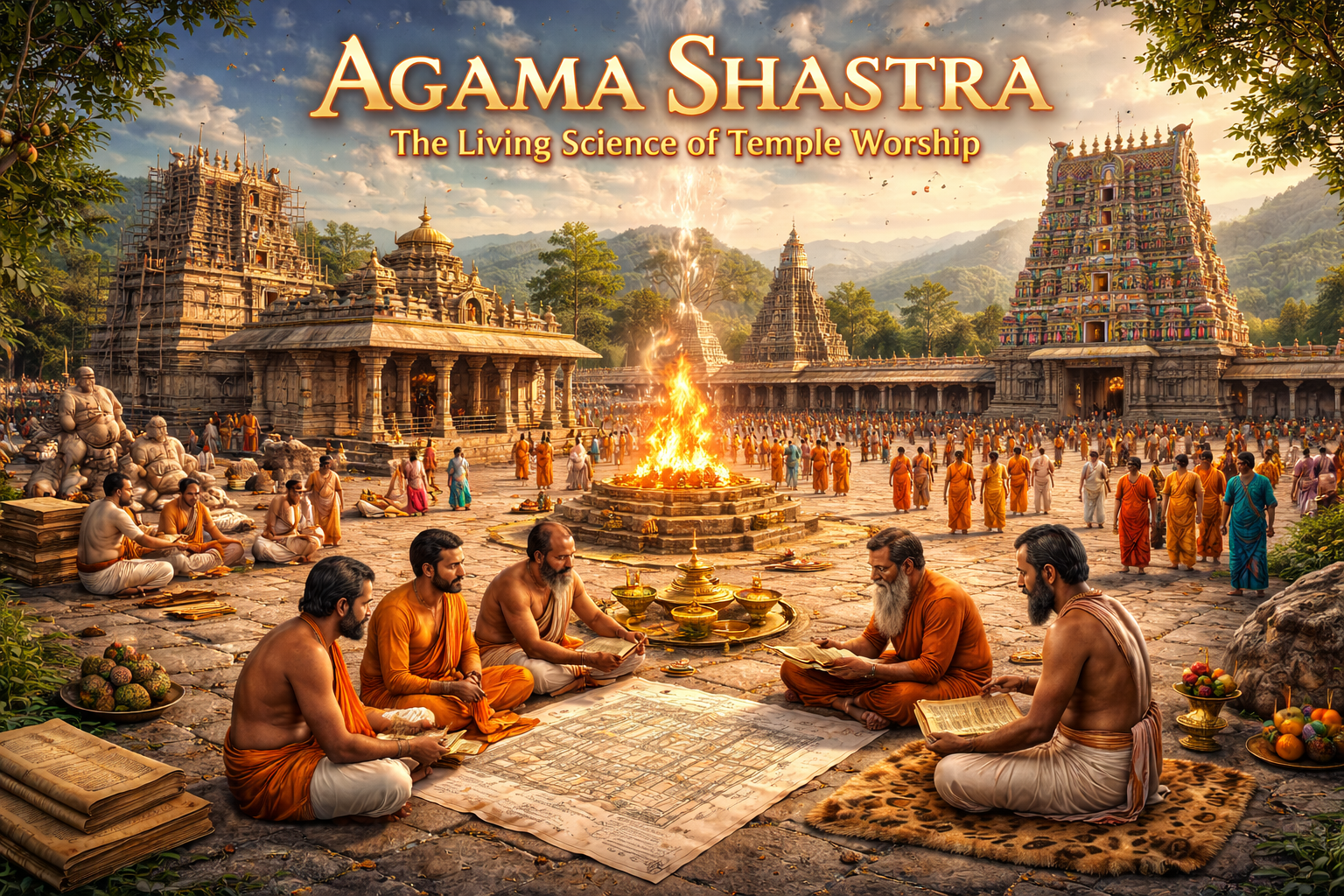
Agama Shastra: The Living Science of Hindu Temple Worship
How ancient Agamic texts govern every aspect of temple construction, consecration, daily worship and festival — and why this 3,000-year-old tradition remains the living heartbeat of South Indian Hindu temples today.
Walk into any great South Indian temple — the soaring gopurams of Madurai, the sacred tank of Chidambaram, the thousand-pillared mandapam of Srirangam — and you are not simply entering a building. You are stepping inside a precisely engineered cosmological diagram, every element of which was placed with mathematical precision according to a body of sacred knowledge called the Agama Shastra.
The Agamas are among the oldest continuous living textual traditions on earth. Unlike the Vedas, which primarily deal with cosmic knowledge and fire sacrifices (yajnas) for open-air settings, the Agamas are specifically dedicated to murti puja — the worship of the divine through consecrated images in enclosed temple structures. They constitute nothing less than the complete operating manual of the Hindu temple.
What Is the Agama Shastra?
The word Agama comes from Sanskrit — ā (towards) + gama (coming, approach) — meaning "that which has come down," indicating a received tradition transmitted from teacher to student across generations. The Agamas are a vast corpus of texts that cover, in exhaustive detail, four interconnected domains:
- Charya — ethical conduct and daily discipline for priests and devotees
- Kriya — ritual practice: construction of temples, installation of deities, daily worship and festivals
- Yoga — internal discipline, meditation and spiritual development
- Jnana — philosophical knowledge: the nature of the divine, the soul and liberation
In South India, three great Agamic traditions developed corresponding to the three principal deities. The Shaiva Agamas (28 in number, with 207 subsidiary Upagamas) govern temples dedicated to Lord Shiva. The Vaishnava Pancharatra Agamas (108 texts) govern the Divya Desams and all temples of Lord Vishnu. The Shakta Agamas (also called Tantras, 64 in number) govern goddess temples. Each tradition developed its own school of priestly knowledge, its own ritual vocabulary, and its own architectural grammar.
"The Agama is not a religion. It is a technology — a precise, tested, reproducible technology for creating conditions in which the divine can be experienced by ordinary human beings." — Dr. S.K. Ramachandra Rao, Indologist and Sanskrit Scholar
The Architecture of the Sacred: Vastu and Mandalas
Before a single stone is laid in a temple, the Agamas prescribe an intricate process of site selection, land purification, and geometric planning. The foundation of Agamic architecture is the Vastu Purusha Mandala — a sacred grid, typically of 8×8 or 9×9 squares, that maps the cosmic body of the Vastu Purusha (the deity of the built environment) onto the temple floor plan.
Every element of the temple corresponds to a position in this mandala, which itself mirrors the structure of the cosmos:
- The Garbhagriha (sanctum sanctorum) — the womb-cave, where the principal deity resides, corresponds to the navel or heart of the cosmic being. It is intentionally small and dark, representing the formless source from which all creation emerges.
- The Antarala — the vestibule between the sanctum and the main hall, a transitional space representing the threshold between the human and divine worlds.
- The Mandapam — the pillared assembly hall where devotees gather, representing the manifest world of human experience.
- The Gopuram — the towering gateway tower, representing the human aspiration towards the divine. The taller the gopuram, the greater the pull — in later Dravidian temples, the gopuram dwarfs the inner sanctum, reflecting the paradox that the approach to the divine is more visible than the divine itself.
- The Pradakshina Patha — the circumambulation path around the sanctum. Walking clockwise around the deity is itself a ritual act, re-enacting the cosmic revolution of time.
In Agamic thought, a consecrated temple is not merely a symbol of the cosmos — it is the cosmos in miniature form. The Kumbhabhishekam (consecration ceremony) does not simply dedicate a building to a deity; it installs divine consciousness into the idol and the structure. After Kumbhabhishekam, the temple is treated as a living being — fed, clothed, bathed, put to rest and awakened each day through the Panchakala Puja.
The Five-Fold Daily Worship: Panchakala Puja
The most visible expression of Agamic knowledge is the daily worship cycle. Major Shaiva temples following the Agamic prescription perform Panchakala Puja — five rounds of worship spread across the day, each corresponding to a cosmic moment:
- Thiruvanandal (Usha Kalam) — Dawn worship, before sunrise. The deity is awakened, bathed with sacred waters and clothed.
- Kalaasanthi (Pratha Kalam) — Morning worship. The full sequence of abhishekam (ritual bathing), alankaram (adornment) and naivedyam (food offering) is performed.
- Uchikalam (Madhyahna Kalam) — Midday worship. A shorter service acknowledging the solar zenith.
- Sayarakshai (Sayam Kalam) — Evening worship. Lamp-waving (deepa aradhana) takes on special significance as night approaches.
- Ardhajama (Ratri Kalam) — Night worship. The processional deity is carried in the temple precincts, and the principal deity is put to rest with the Pavazhamalli and Thirupalliyezhuchi hymns.
Each of these services involves a precise sequence of actions — the number of times a lamp is waved, the specific flowers used for each deity on each day of the week, the exact mantras recited, the order in which abhishekam substances are applied. None of this is improvised. Every detail flows from the relevant Agama text and the oral tradition of the priestly lineage.
The Shaiva Agamas: Governing Shiva Temples
The 28 Shaiva Agamas and their 207 Upagamas form the scriptural basis for all Shaiva temple worship in South India. The most important of these in Tamil Nadu is the Kamika Agama, which is the primary reference text for HR&CE (Hindu Religious and Charitable Endowments) priests throughout the state. Other major Agamas include the Karana, Suprabhedha, Makuta and Vira Agamas.
Tamil Nadu alone has over 38,000 Shiva temples — the largest concentration of Shaiva sacred sites in the world. The great Pancha Bhuta Stalas (five elemental Shiva temples representing earth, water, fire, air and space) — Kanchipuram, Thiruvanaikaval, Thiruvannamalai, Kalahasti and Chidambaram — are among the oldest continuously active Agamic temple sites on earth, some with verified inscriptional histories stretching back to the 7th century CE.
The Dikshitar Community of Chidambaram
Nowhere is the Agamic tradition more dramatically preserved than at the Nataraja temple in Chidambaram, Tamil Nadu. Here, the Chidambaram Dikshitars — a community of approximately 300 priestly families — have maintained continuous Agamic worship for at least 1,000 years. The Dikshitars claim descent from the 3,000 celestial sages who witnessed Shiva's cosmic dance, and they follow a unique form of the Vaikhanasa stream that predates many later Agamic codifications.
Uniquely, the Chidambaram Dikshitars are joint owners of the temple — it has never been taken under government administration — and their right to perform worship and manage the temple has been upheld by Indian courts. They are regarded as living embodiments of the unbroken Agamic tradition.
The Vaishnava Agamas: The Pancharatra and Vaikhanasa Traditions
Vaishnava temple worship in South India is governed by two great Agamic streams. The Pancharatra Agama tradition, with 108 texts (the most important being the Sattvata, Paushkara and Jayakhya Samhitas), is followed in most major Vaishnava temples including the 108 Divya Desams. The Vaikhanasa Agama, believed to be even older and traced to the sage Vikhanas, is followed at several great temples including Tirumala Tirupati — the world's most visited pilgrimage site.
The Pancharatra tradition is particularly notable for its concept of vyuha — the four divine emanations of Vishnu (Vasudeva, Sankarshana, Pradyumna, Aniruddha) — and for its elaborate Utsava Murti (festival image) system, where processional deities are carried through the temple in daily and annual processions to make the divine accessible to devotees who cannot enter the inner sanctum.
"The Vaikhanasa Agama is not merely a ritual manual. It is a complete philosophical system in which every ritual action is an act of ontological significance — a participation in the divine act of creation and sustenance." — Prof. V. Varadachari, Vaishnava Philosophy, University of Madras
Kumbhabhishekam: The Consecration of a Temple
Perhaps the most dramatic expression of Agamic knowledge is the Kumbhabhishekam — the consecration ceremony that brings a new or renovated temple to life, or renews the divine energy of an existing one. Kumbhabhishekam is typically performed every 12 years for major temples (the solar cycle completing one full revolution of Jupiter), though it is mandatory whenever major structural work has been done.
The ceremony is a multi-day event requiring dozens of qualified priests, and proceeds through several stages:
- Bhumi Puja — propitiation of the earth deity
- Punyahavachana — purification of the site and priests
- Vastu Homa — fire ritual to the deity of the built environment
- Nyasa — installation of sacred energy into the idol through touch and mantra
- Kalasha Sthapana — installation of sacred water pots (kalashas) infused with mantric energy over several days
- The Abhishekam of the Kalasha waters — the central moment: consecrated water from the kalashas is poured over the deity and then over the gopuram finial, completing the transfer of divine energy
Hundreds of thousands of devotees gather for major Kumbhabhishekams, understanding that witnessing this moment carries the spiritual merit of a lifetime of worship. The Tamil Nadu government typically declares public holidays for the Kumbhabhishekams of major temples.
Agama Knowledge Under Pressure: The Modern Challenge
Despite its unbroken continuity, the Agamic tradition faces real pressures in the 21st century. The years of study required — typically 8 to 12 years in a traditional Agama Patashala (school), learning Sanskrit, Tamil Prabandham, ritual sequences, astronomy and iconography simultaneously — deter many young people from families that traditionally supplied priests.
The Tamil Nadu HR&CE Department, which administers over 36,000 temples, has made significant efforts to standardise Agamic training through its own schools. However, critics argue that standardisation risks flattening the rich variations between different Agamic streams and priestly lineages. A Dikshitar of Chidambaram and a Brahmin archakar of a new suburban temple may both hold HR&CE certificates, but their knowledge traditions are vastly different in depth and specificity.
Saiva Siddhanta Mahasamajam, Chennai — one of the oldest Agama teaching institutions, publishing and preserving rare Agama manuscripts.
Krishnamacharya Yoga Mandiram, Chennai — bridging Agamic and Yoga traditions.
French Institute of Pondicherry (IFP) — has digitised and critically edited over 150 Agama manuscripts, creating the most comprehensive scholarly archive of Agamic texts outside India.
HR&CE Agama Patashalas — government-run schools producing qualified archakas across Tamil Nadu.
Agama Shastra and the Diaspora Temple
One of the most remarkable stories of the 20th and 21st centuries is the transplantation of full Agamic temple worship to diaspora communities around the world. The Sri Venkateswara Temple in Pittsburg, Pennsylvania (1976), the Murugan Temple in London (1978), the Meenakshi Temple in Houston (1977) — all were built and consecrated by qualified Agamic priests brought from South India, following the full Agamic prescriptions for site selection, construction, murti installation and Kumbhabhishekam.
This global expansion of Agamic temples raises profound questions. How does the Agama — rooted in specific geographical contexts, sacred rivers, particular stones and local temple flowers — translate to foreign soils? The answer of the Agamic tradition has been characteristically flexible within a framework of precision: the sankalpam (statement of intent) at the beginning of every ritual explicitly names the location in cosmic and geographic terms, anchoring the worship wherever in the world it takes place to the sacred geography of Bharata.
The Aandaal Project's Hindu Temple Pillar is building South India's most complete temple directory — connecting devotees worldwide with temples, festivals and sacred history. List your temple free and let thousands of devotees find you.
How Agamic Worship Continues to Evolve
A common misconception about the Agamic tradition is that it is entirely frozen. In fact, the great Agacharyas (Agamic teachers) across history have always applied the principles of the Agamas to new situations. When temple architecture moved from the Pallava period to the Chola, Vijayanagara and Nayaka periods, the scale and complexity of temple structures changed dramatically — but the Agamic principles governing the relationship between deity, priest and devotee remained constant.
Today, new questions are being addressed within the Agamic framework: Can women serve as archakas? (In 2021, the Tamil Nadu government moved to allow women from priestly families to train as archakas at temples administered by HR&CE.) Should non-Brahmin archakas be permitted at Agama temples? (Already the case in many temples, including some major Shaiva ones.) How should digital darshan — live streaming of worship, now watched by millions — be integrated with the Agamic understanding that the deity's presence in the image is a localised divine energy, not a broadcast?
These questions are live and contested. They reflect the vitality, not the decay, of the Agamic tradition — a tradition robust enough to generate internal debate about its own future.
Experiencing Agamic Worship: A Guide for Devotees
What to Expect at a Major Agamic Temple
- Dress code — Traditional attire is expected and often required. Men typically wear dhoti (veshti) and are expected to remove shirts before entering the inner sanctum at Shaiva temples. Women in saree or salwar kameez.
- Timing — Arrive at the start of a kaala puja for the full experience. The upacharas (ritual services) are performed to the deity in sequence and are deeply moving to witness even without understanding every detail.
- Pradakshina — Always circumambulate the sanctum clockwise, silently, barefoot. This is itself a complete act of worship.
- Prasadam — The food or vibhuti (sacred ash) or kumkum offered to you at the end of the puja is not a souvenir — it is the touched grace (prasadam) of the deity. Receive it with both hands.
- Silence — In the inner sanctum, particularly during the waving of lamps, silence is the most appropriate response. The Agamas understand the visual encounter with the deity (darshan) as a two-way act: you see the deity, and the deity sees you.
Supporting the Agamic Tradition
The preservation of Agamic temple worship depends on communities that value and sustain it. Practical ways to support include:
- Visiting and supporting your local Agamic temple regularly, not only during festivals
- Commissioning home rituals from qualified Agamic priests for life events
- Supporting the education of young priests through temple trusts and HR&CE scholarship funds
- Listing your temple on the Aandaal Project's Hindu Temple Pillar to increase its visibility worldwide
- Booking ANDAL Coins to support the Aandaal Project's cultural preservation initiatives
🙏 How to Find a Temple or Register Yours on andal.io
- Visit api.paybook.club/HindutemplesPillar.html
- Search by deity, location or tradition
- Click "Register Your Temple Free" and use your Booking ID to submit a profile
- Temple profiles include deity, address, contact details, next event and history
Every ANDAL Coin booked supports The Aandaal Project's mission to document, preserve and celebrate 4,000 years of Tamil temple heritage. Your support keeps traditions like Agamic worship visible, discoverable and alive for future generations.