
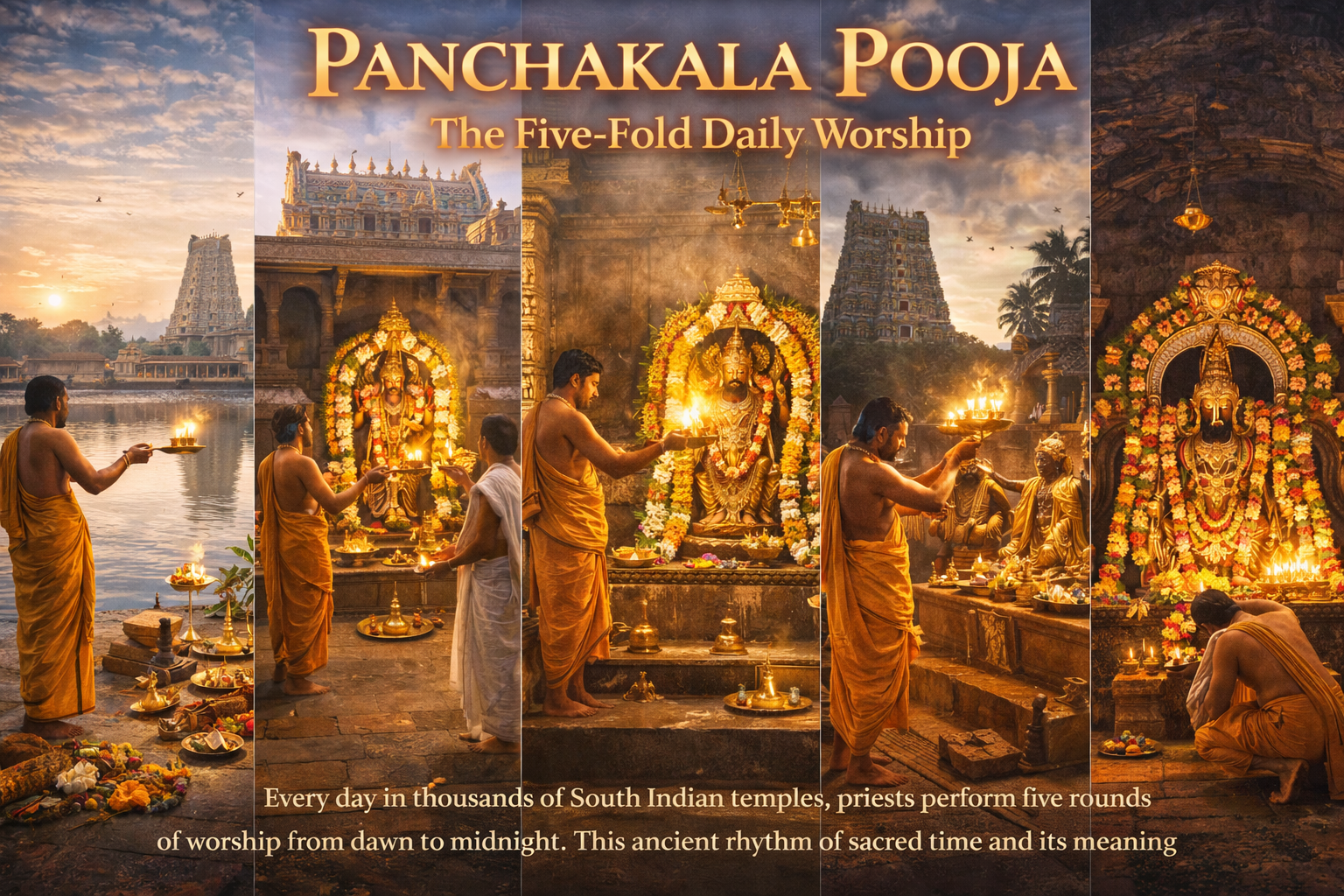
Panchakala Pooja: The Five-Fold Daily Worship of South Indian Temples
How six daily worship services — from the pre-dawn awakening of the deity to the midnight closing — have sustained a living, unbroken conversation between the human and the divine for over three thousand years in the great temples of South India.
The priest arrives before dawn. The temple is still dark, the streets outside silent. He has bathed, recited his morning prayers and dressed in fresh cloth before entering the inner sanctum. He carries flowers, sacred ash, a lamp and the certainty of a tradition ten or more generations deep. What he is about to do — the first of six sacred encounters with the deity on this day, as on every day — is one of the oldest continuously practised ritual sequences on earth. This is the Panchakala Pooja: the five-fold (or six-fold, in many major temples) daily worship that animates the South Indian Hindu temple from first light to midnight.
The word panchakala means "five times" in Sanskrit — referring to the five divisions of the day recognised in the Agamic tradition: dawn, morning, noon, evening and night. In the Pancharatra Vaishnava system, the Panchakala also refers to five daily observances for the devotee: abhigamana (approaching the deity), upadana (gathering worship materials), ijya (performing worship), svadhyaya (sacred study) and yoga (meditation). In the lived reality of most major temples, the five-fold system has expanded to six daily services — but the theological structure, rooted in the movement of the sun through the day, remains unchanged.
The Theology of Daily Worship: Why the Deity Needs to be Served
To the outside observer, the daily ritual services of a South Indian temple can appear puzzling. Why does an omnipotent deity need to be woken up, bathed, dressed, fed, entertained and put to bed? The Agamic tradition addresses this directly, and its answer is philosophically sophisticated.
The Agamas teach that when a deity is installed in a temple through the Kumbhabhishekam consecration, divine consciousness (shakti) is drawn into and permanently inhabits the consecrated image. This is not a metaphor — it is a statement about the actual metaphysical status of the idol. The idol becomes what the Agamas call an archavathara — a descension of the divine into accessible form. In this state, the deity is present in the image in a manner analogous to a royal guest who has accepted the hospitality of the temple and its community.
The daily ritual services are therefore an act of royal hospitality — the shodashopachara (sixteen forms of service) that would be offered to an honoured royal guest: waking them with music, offering water to wash, bathing them, clothing them in fine garments, adorning them with flowers and jewels, offering fragrance, food, entertainment in the form of music and dance, waving of lights, and preparing them for rest. The deity, having accepted this hospitality, is available to devotees throughout the day — accessible, adorned, awake, present.
"The priest who performs the daily puja does not act for himself. He acts as the representative of the entire community — every devotee who cannot be present, every soul in the catchment of this temple. His purity and precision of ritual are their access to the divine." — Agama Shastra Commentary, Saiva Siddhanta Mahasamajam, Chennai
The Six Daily Kala Services: A Complete Guide
In major Shaiva temples of Tamil Nadu — such as the Annamalaiyar Temple at Thiruvannamalai, the Kapaleeshwarar Temple at Mylapore and the Papanasanathar Temple at Papanasam — six kala puja services are performed daily. The following is the full sequence, with the Tamil names, typical timing, and the distinct character of each service.
The first service of the day, performed before sunrise. The inner sanctum is opened in darkness. The priest removes the flowers placed on the idol the previous night (these are considered to have absorbed any negative energies that gathered while the deity slept). The deity is gently awakened with the recitation of the Suprabhatam (morning hymn) or Vedic chants. Water is offered for the deity to wash face and hands. The atmosphere at this hour is extraordinary — intimate, dark, quiet, the lamp the only light. Many devoted worshippers consider Thiruvanandal the most spiritually potent moment of the day.
The principal morning worship, typically the most elaborate of the daily services. The full abhishekam (ritual bathing) sequence is performed with multiple sacred substances. After abhishekam, the idol is dried and clothed in fresh silk garments. The alankaram (adornment) follows — the deity is decorated with fresh flowers, sandal paste, jewels and the sacred marks appropriate to the deity. Naivedyam (food offerings) are prepared and presented. The service concludes with the deepa aradhana — the waving of the camphor lamp before the deity's face. The Nadaswaram plays throughout, filling the temple with its ancient, resonant sound.
The midday service corresponds to the solar zenith — the moment when the sun is directly overhead and at its maximum power. Theologically, this is the moment of fullest divine manifestation. The midday naivedyam is typically the most elaborate food offering of the day, often including cooked rice, vegetables, sweets and fruits. At several famous temples — notably the Papanasanathar Temple at Papanasam — the food offered to the deity at Uchikalam is carried to the river and offered to the fish, symbolising the deity's overflowing generosity extending to all living beings. The midday service draws fewer devotees than morning or evening, making it one of the most peaceful times for a personal darshan.
The Sanskrit name sayarakshai means "evening protection" — the service performed as the light fades and the protective power of the deity is invoked against the darkness. The evening service is dominated by deepa aradhana — the waving of oil lamps and camphor flame before the deity. As the natural light dims inside the sanctum, the lamp takes on extraordinary visual power — the deity seen through flame, the gold and silver of the adornment catching the light. At the Thiruparankundram Murugan Temple, the Sayarakshai deepa aradhana generates what devotees describe as an almost overwhelming spiritual vibration. Hundreds of oil lamps illuminate carved stone walls, and the chanting reaches its evening intensity.
The second evening service is the time of the utsava murti — the processional deity, a smaller movable image of the principal deity, is brought out of the sanctum and carried in procession around the temple precincts or through the outer mandapam. This daily mini-procession is a microcosm of the grand Brahmotsavam festivals — the deity making himself accessible to devotees in the public spaces of the temple complex. The procession is accompanied by Nadaswaram and the singing of Divya Prabandham or Tevaram hymns by the temple's Oduvar (sacred singer). In many temples, devotees can approach the processional image closely, offer flowers directly, and receive personal blessings from the priest.
The final service of the day — the ritual preparation of the deity for rest. The word jama refers to a watch of the night in the classical Indian time-keeping system; ardha means half — the Ardhajama falls at the midpoint of the night. The deity is offered a light final naivedyam, the flowers of the day are removed, fresh flowers placed, and the deity is prepared for rest with specific bedtime hymns — the Pavazhamalli in the Shaiva tradition, the Thirupalliyezhuchi in the Vaishnava tradition. The inner sanctum curtain is drawn. The temple is closed. The day's conversation with the divine is complete — and the same conversation will resume, without interruption, at 5:30 the following morning.
Abhishekam: The Sacred Bath and Its Theology
Of all the components of the Panchakala Pooja, the abhishekam — the ritual bathing of the deity — is perhaps the most theologically rich and the most visually dramatic. The Sanskrit abhi (towards) + seka (pouring) gives us the word: the ceremonial pouring of sacred substances over the consecrated image.
The Agamas specify that for Shaiva worship in particular, the deity is abhisheka-priya — "one who is fond of abhishekam." The contrast with Vaishnavism is explicit in the classical saying: Alaṅkārapriyo Viṣṇuḥ, Abhiṣekapriyaḥ Śivaḥ — "Vishnu is fond of adornment; Shiva is fond of the sacred bath." At major Shiva temples, the abhishekam is an elaborate ritual performed with a sequence of substances, each carrying a specific theological meaning and believed to confer specific blessings on those who witness or sponsor it.
| Substance | Sanskrit/Tamil | Theological Element | Blessing Conferred |
|---|---|---|---|
| Water (Gangajal) | Jalam / தீர்த்தம் | Purity, the cosmic ocean | Cleansing of all sins; the foundation of all abhishekam |
| Milk | Kshiram / பால் | Water element; sense of taste | Long life and nourishment of future generations |
| Curd (Yogurt) | Dadhi / தயிர் | Earth element; sense of touch | Good children; prosperity and strength of family lineage |
| Ghee | Ghritam / நெய் | Fire element; sense of sight | Liberation (moksha); the clarifying of spiritual vision |
| Honey | Madhu / தேன் | Ether element; sense of hearing | Melodious voice; enhancement of speech and music |
| Sugar / Jaggery | Sharkara / வெல்லம் | Air element; sense of smell | Removal of enmity; bliss and sweetness in relationships |
| Sugarcane Juice | Iksurasa / கரும்புச்சாறு | Divine nourishment | Good health; removal of chronic illness |
| Coconut Water | Narikela jalam / தேங்காய் நீர் | Cooling, purifying | Enjoyment and full satisfaction in life |
| Panchamritam | Five nectars / பஞ்சாமிர்தம் | The five elements combined | Wealth; harmonisation of the five elements in the devotee |
| Sandal Paste | Chandanam / சந்தனம் | Divine fragrance, cooling | Grace of Lakshmi; peace and auspiciousness in the home |
| Vibhuti (Sacred Ash) | Bhasma / திருநீறு | The ultimate reality beyond form | Protection; reminder of impermanence and liberation |
The Panchamritam — literally "five nectars" — is a mixture of milk, curd, ghee, honey and sugar that is combined and poured over the deity as a unified offering. The five ingredients correspond to the five elements (panchabhutas) that constitute both the cosmos and the human body. When the priest pours Panchamritam, the ritual is understood as an act of cosmic re-harmonisation — aligning the microcosm of the devotee's body with the macrocosm of creation through the mediating presence of the deity.
"Abhishekam to Shiva is not merely ritual bathing. The Shiva Lingam is the axis of the universe — the cosmic pillar of fire and ice. Pouring water and milk is cooling that cosmic fire, making it accessible, manageable, loveable. The devotee who sponsors an abhishekam is participating in that act of cosmic tenderness." — Sri Siva Kameswari Devasthanam, Commentary on Rudra Abhishekam
The Four Steps of Every Kala Service
Whatever the time of day, every kala puja in a South Indian temple follows the same four-step structure, prescribed by the Agamas and documented in the HR&CE regulations for Tamil Nadu temples:
- Abhishekam — the sacred bath. The sequence and number of substances varies by the kala (the morning Kalaasanthi has the most elaborate abhishekam; the midnight Ardhajama the simplest) and by the day of the week (Monday is Shiva's day and receives extra abhishekam; Friday is the day of Devi).
- Alankaram — the adornment. After drying from the abhishekam, the deity is clothed in fresh silk garments, adorned with the day's flowers (specific flowers for specific deities on specific days — white flowers on Monday, red flowers on Friday, bilva leaves always for Shiva, tulasi always for Vishnu), jewels, sandal paste and the sacred marks.
- Naivedyam — the food offering. Cooked and uncooked foods are prepared in the temple kitchen, placed on banana leaves before the deity and offered through specific mantras. After the offering, the curtain is drawn and the food is considered to have been consumed by the deity — it then becomes prasadam (blessed food) and is distributed to the priests and devotees.
- Deepa Aradhana — the waving of lamps. The final act of each service: a multi-wick camphor lamp is lit and waved before the deity's face in a circular motion, accompanied by the ringing of bells and the chanting of hymns. Devotees stretch forward to receive the warmth and light of the flame on their hands and faces. This is darshan in its most intense form — the mutual seeing of devotee and deity, mediated by fire.
The Aandaal Project's Temple Pillar lists temples across South India and the global diaspora — with their daily pooja timings, upcoming festivals and contact details. Discover a temple near you, or register your own.
The Pancharatra Panchakala: A Complete Daily Discipline
In the Vaishnava Pancharatra tradition, the Panchakala is not only a temple ritual structure — it is a complete daily discipline for the devoted householder. The Pancharatra Agamas prescribe five daily observances that mirror the temple's ritual sequence in the devotee's own life:
- Abhigamana — the morning approach to the deity, involving ritual purification, the recitation of the Suprabhatam, and mental preparation for the day's worship
- Upadana — the gathering of worship materials: flowers, tulasi leaves, sandalwood, incense, fruits and the other substances required for puja
- Ijya — the actual performance of worship, following the prescribed sequence of the Agamic ritual
- Svadhyaya — daily study of sacred texts, particularly the Divya Prabandham (the 4,000 Tamil hymns of the Alvars) in the Vaishnava tradition, or the Tevaram and Tiruvachakam in the Shaiva tradition
- Yoga — meditation and internal practice, understood as the inner dimension of the outer ritual
This integration of outer ritual and inner discipline is characteristic of the Agamic tradition. The Panchakala in this sense is not merely a schedule of events — it is a complete philosophy of time, in which every part of the day is sanctified by its relationship to the divine.
The Oduvar: Sacred Singers of the Daily Worship
One of the most distinctive and precious features of the daily worship in Tamil Shaiva temples is the role of the Oduvar — the temple's professional sacred singer who chants the Tevaram hymns of the three great Shaiva saints (Appar, Sundarar and Thirugnanasambhandar) and the Tiruvachakam of Manikkavasagar during the kala puja services.
The Oduvars occupy a unique position in Tamil religious culture. They are not priests — they do not perform the ritual actions — but their singing is understood as an equal and essential component of the worship. The Agamas specify that the deity should be entertained with music during the kala services, and the Oduvar tradition provides this in its highest Tamil literary form. The twelve Tirumurais — the canon of Tamil Shaiva devotional literature — were specifically compiled in the 11th century CE to be sung in temples, and the Oduvar tradition has kept this 1,100-year-old performance practice alive in an unbroken line.
The Tamil Shaiva canon consists of twelve collections totalling over 18,000 verses. The first seven (the Tevaram) are by Appar, Sundarar and Thirugnanasambhandar — the three great Nayanmars of the 7th–8th centuries CE. The eighth is the Tiruvachakam of Manikkavasagar. These eight collections are the primary texts sung by Oduvars during daily kala puja at Tamil Shiva temples.
The Divya Prabandham — the 4,000 Tamil hymns of the Alvars — performs an equivalent function in Vaishnava temples, chanted by Araiyars during kala puja services at the 108 Divya Desams.
Pradosham and Special Daily Worship
Beyond the regular six-kala sequence, the Agamic calendar prescribes special daily worship for specific astronomical occasions. The most important of these is Pradosham — the 13th day after both the new moon and the full moon, which falls twice each month. Pradosham is considered the most auspicious time for Shiva worship in the entire lunar cycle.
According to the Shiva Purana, on the evening of Pradosham — specifically the 1.5-hour window straddling sunset — Shiva performs his cosmic dance (Ananda Tandava) in the presence of all the deities, who gather on Mount Kailash to witness. Devotees who perform abhishekam and worship during this window are believed to receive the spiritual benefit of witnessing the cosmic dance. Major temples extend their evening Sayarakshai service into an elaborate Pradosham puja on these days, and crowds significantly increase.
- Somavaram (Monday) — Shiva's day; extra abhishekam in all Shaiva temples
- Sukravaram (Friday) — Devi's day; special worship of the goddess with red flowers and kumkum
- Sashti (6th lunar day) — Murugan's day; special worship at all Murugan temples
- Ekadasi (11th lunar day) — Vishnu's day; fasting and extended worship at all Vaishnava temples
- Karthigai (monthly Pleiades star day) — special lamp-lighting festivals in Shaiva temples
- Amavasai (New Moon) — ancestor worship; the day when the boundary between the living and the dead is considered most permeable
How to Experience Daily Kala Puja: A Guide for Visitors
Choosing the Right Service
- Thiruvanandal (dawn) — for the most intimate, uncrowded experience. Arrive 15 minutes before the sanctum opens. The pre-dawn atmosphere in a major Shaiva temple is unlike anything else.
- Kalaasanthi (morning) — for the full abhishekam sequence. Arrive early enough to watch the priest prepare the substances. The smell of camphor, milk and sandal paste mixed together is unlike anything outside a temple.
- Sayarakshai (evening) — for the deepa aradhana at its most dramatic, when the natural light has faded and the flame is the only illumination in the sanctum.
- Ardhajama (night) — for the closing of the temple, the final hymns, and the profound silence that follows. Often attended only by a handful of devoted worshippers.
Etiquette and Participation
- Enter barefoot and in clean, modest traditional attire
- When the priest waves the deepa aradhana lamp toward you, receive the flame's warmth with both hands cupped and touch your eyes — this is arati prasad, the receiving of the deity's light
- Accept the theertham (sacred water) offered by the priest in your cupped right hand and drink it — do not refuse
- Receive vibhuti (sacred ash) on your forehead with your right hand ring finger, or accept the priest's application of it
- Walk the pradakshina patha (circumambulation path) clockwise after darshan — this completes the act of worship
- Sponsoring an abhishekam — contributing toward the cost of the sacred substances for a specific kala service — is one of the most direct ways to participate in and support the daily worship
The Panchakala Pooja has been performed, without a single day's interruption, in the great temples of South India for three thousand years. The Aandaal Project documents and celebrates this living tradition — keeping it visible, accessible and alive for future generations worldwide. Your support makes that possible.