
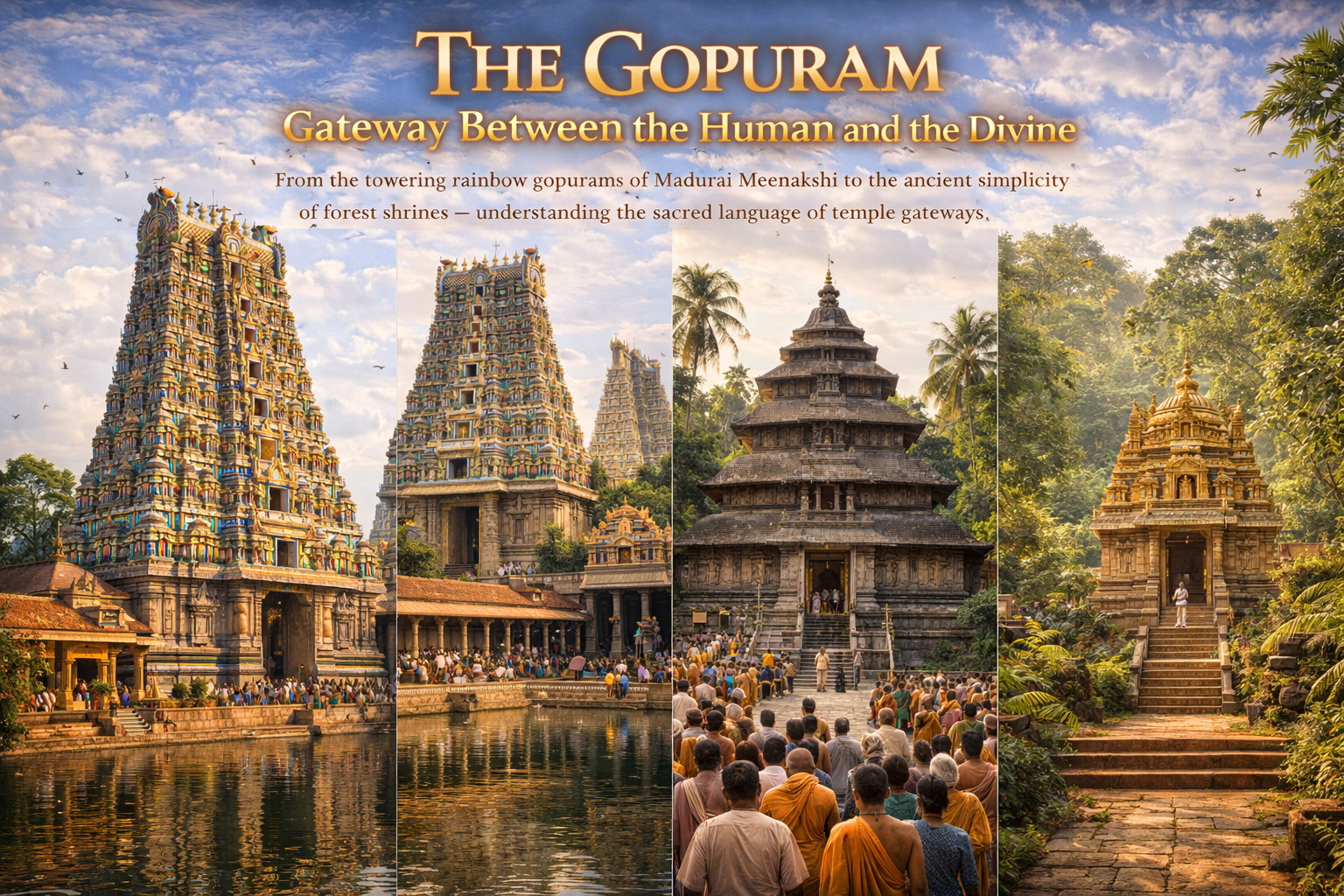
The Gopuram: Gateway Between the Human and the Divine
From the towering rainbow-coloured gopurams of Madurai Meenakshi to the ancient granite simplicity of forest shrines — understanding the sacred language, construction science and living symbolism of South India's most magnificent architectural achievement.
Look up. Rising above the rooftops of any Tamil Nadu town, soaring above the coconut palms and the city's noise, stands a structure unlike anything else on earth — a tower of carved stone and painted stucco that seems to grow upward in tiers, each level more densely populated with deities, guardians, celestial beings and mythological scenes than the last, until the very tip disappears into the sky. This is the gopuram — the gateway tower of the South Indian Hindu temple — and it is among the most extraordinary architectural inventions in human history.
The word comes from Sanskrit: go (cow, or more broadly, the earth) + puram (city, settlement) — the gate of the sacred city. In Tamil it is kōpuram. Whatever the etymology, the gopuram's purpose is unmistakable: it announces the presence of the divine from miles away, drawing the devotee inward, upward, toward the sacred centre that the tower guards and magnifies.
Origins: From Simple Gateway to Celestial Mountain
The earliest South Indian temples — the cave temples of the Pallava dynasty at Mahabalipuram, carved in the 7th century CE — had no gopurams at all. The Pallava-era structural temples, like the Shore Temple at Mahabalipuram (c. 700 CE) and the Kailasanatha Temple at Kanchipuram (c. 725 CE), had modest entrance gates whose towers were smaller than the vimana (the tower above the sanctum). This proportion — inner sanctum tower taller than gateway tower — reflects the original Agamic hierarchy: the divine presence in the innermost shrine is paramount.
What happened over the following millennium is one of architecture's great transformations. As South Indian temples grew into city-sized complexes under the Chola, Vijayanagara and Nayaka dynasties, the relationship between the vimana and the gopuram inverted. By the time of the great Nayaka rulers of the 16th to 18th centuries — who were responsible for the extraordinary gopurams of Madurai, Srirangam, Rameswaram and Chidambaram — the gateway towers had become vastly taller than the inner sanctum towers, sometimes dwarfing them by a factor of five or more.
"The inversion of the gopuram and vimana is not architectural accident. It encodes a deep theological truth: that the approach to the divine — the journey of the soul — is more visible, more celebrated, more intensely experienced than the moment of arrival, which is always simple, dark and still." — Prof. Stella Kramrisch, The Hindu Temple
Anatomy of a Gopuram: The Sacred Language of Each Element
A mature South Indian gopuram is not a random accumulation of sculptures — it is a rigorously ordered cosmological diagram rendered in stone and stucco. Every element has a prescribed name, position and meaning in the Agamic architectural manuals (the Manasara, Mayamata and related texts).
The Dvarapalas: Guardians of the Sacred Threshold
Every gopuram entrance is flanked by a pair of dvarapalas — divine doorkeepers whose towering stone forms greet every devotee entering the temple. They carry clubs or tridents, wear crowns, and their expressions combine ferocity with benediction. Their message to the devotee is clear: leave your ego, your worldly concerns and your impurities outside. What you are entering is not ordinary space.
In the Shaiva tradition, the dvarapalas are identified as Nandi's attendants. In the Vaishnava tradition, they are Jaya and Vijaya — the celestial doorkeepers of Vaikunta, Vishnu's heavenly abode. Their presence at the temple entrance is a reminder that this earthly temple is a replica of the celestial one.
The Stucco Sculptures: A Painted Universe
Above the granite base, most major gopurams are constructed of brick faced with surkhi mortar (a lime-based render mixed with crushed brick) and shaped into thousands of sculptures in stucco plaster. These sculptures are traditionally repainted every 12 years at the time of Kumbhabhishekam, in vivid colours — blue, red, yellow, white, green — that give the gopuram its characteristic rainbow intensity when freshly painted.
The repainting tradition has attracted some criticism from architectural conservationists who prefer the weathered stone aesthetic. But in the Agamic tradition, the bright colours are not decoration — they are prescribed. Each colour carries specific meaning: white for purity, red for power and auspiciousness, yellow for prosperity, blue for transcendence, green for fertility.
The Greatest Gopurams of South India
| Temple | Location | Height | Tiers | Period | Notable Feature |
|---|---|---|---|---|---|
| Ranganathaswamy (Rajagopuram) | Srirangam, Tamil Nadu | 73m | 21 | 20th C (completed 1987) | Tallest functioning gopuram in the world; completed 1987 after 600 years — surpassing Srivilliputhur as tallest in Tamil Nadu |
| Andal Temple Rajagopuram ⭐ | Srivilliputhur, Virudhunagar | 59m (192ft) | 11 | Pandya/Vijayanagara, 15th C | Official symbol of the Tamil Nadu state emblem; tallest gopuram in Tamil Nadu until Srirangam's 20th-century completion; birthplace of Saint Andal |
| Annamalaiyar (East Gopuram) | Thiruvannamalai, Tamil Nadu | 66m | 11 | Vijayanagara, 16th C | Sacred to Shiva as the element of Fire; glows red at sunset |
| Meenakshi Amman (South Gopuram) | Madurai, Tamil Nadu | 52m | 9 | Nayaka, 17th C | 33,000 sculptures; the most photographed temple in India |
| Kapaleeshwarar (Rajagopuram) | Mylapore, Chennai | 37m | 7 | Vijayanagara, 16th C | Rebuilt after Portuguese destruction; finest surviving gopuram in Chennai |
| Nataraja (East Gopuram) | Chidambaram, Tamil Nadu | 49m | 7 | Chola/Nayaka, 12th–17th C | Tiles depict all 108 karanas (dance poses) of Bharatanatyam |
| Rameswaram (Corridor Towers) | Rameswaram, Tamil Nadu | 38m | 9 | Nayaka, 17th C | The world's longest temple corridor (1,220m); 4 gopurams |
The Srirangam Rajagopuram: The Tallest in the World
The Rajagopuram of the Ranganathaswamy Temple at Srirangam, Tamil Nadu, is the tallest gopuram on earth — a staggering 73 metres (239 feet) across 21 tiers. But its story is as remarkable as its dimensions. The gopuram's foundation was laid in the 14th century, but construction was interrupted by the catastrophic Malik Kafur invasion of 1311 CE, which devastated Srirangam and forced the evacuation of the main deity to Karnataka for 48 years.
The tower stood incomplete for over 600 years — a truncated silhouette against the Tamil sky — until 1987, when the current structure was finally completed and consecrated. The Rajagopuram is not merely a religious landmark; it is a statement of cultural resilience — the completion of a promise made to the deity by devotees seven centuries earlier.
Standing at its base and looking straight up, the visual experience is disorienting in the best possible way — tier upon tier of sculpted figures receding into the sky, the scale shifting perception, the ordinary world suddenly small beneath the weight of the divine imagination that conceived this structure.
The Chidambaram Gopurams: Where Dance Becomes Architecture
The four gopurams of the Nataraja Temple at Chidambaram are unique in world architecture for a single, extraordinary feature: their golden tiles depict all 108 karanas — the fundamental movement units of Bharatanatyam, as codified in the Natya Shastra of Bharata Muni. These are not merely decorative panels; they constitute the world's oldest surviving visual record of classical Indian dance, carved in stone between the 12th and 17th centuries.
The Natya Shastra itself declares that Shiva revealed the 108 karanas in his cosmic dance form as Nataraja — so at Chidambaram, where Shiva as Nataraja is the presiding deity, the gopurams literally embody the divine dance. The temple's architecture and the god's nature are inseparable: the building dances.
"At Chidambaram, the 108 dance poses carved on the gopurams are not illustrations of a text. They ARE the text — the Natya Shastra made stone, made permanent, made available to every devotee who looks up." — Dr. Kapila Vatsyayan, National Centre for the Performing Arts
Construction Science: How Gopurams Were Built
The engineering achievement of the gopuram is all the more remarkable given the tools available to its builders. The great Nayaka-period gopurams of the 16th and 17th centuries were constructed without modern surveying instruments, steel scaffolding or hydraulic lifting equipment — yet they have stood for 400 years in a seismically active region, surviving monsoons, earthquakes and the weight of their own ambition.
Materials and Method
- Granite base (adhisthana) — The lower portion, typically to a height of 5–10 metres, is constructed of precisely cut granite blocks laid without mortar, relying on gravity and the sheer precision of the stonecutting for structural integrity. This technique, known as dry masonry, actually performs better in seismic conditions than mortar-bound construction.
- Brick superstructure — Above the granite base, the gopuram is constructed of kiln-fired brick bonded with lime mortar mixed with organic additives (jaggery, egg white, and various plant gums) that create a mortar of extraordinary adhesive strength and flexibility.
- Surkhi stucco facing — The brick surface is faced with a plaster made from slaked lime, crushed brick (surkhi) and organic binders, applied in successive layers and then modelled by hand into thousands of sculptural forms.
- Timber centering — Large timber frameworks were used as formwork for the arched gateways and as scaffolding during construction. The timber was often incorporated permanently into the structure in horizontal layers (called kattai), which also serve to distribute lateral loads and prevent crack propagation.
The Taper: Engineering Stability into Beauty
Every gopuram tapers as it rises — each successive tier is slightly smaller than the one below. This taper is not merely aesthetic; it is structural. The reducing mass at higher levels progressively reduces the overturning moment caused by wind and seismic loads. The curve of the taper — slightly convex in the finest gopurams, following the entasis principle also found in Greek columns — gives the structure a visual elasticity that makes it appear to breathe. The finest gopurams seem to lean slightly backward, as if caught in the act of reaching toward the sky.
The Aandaal Project's Hindu Temple Pillar is building the most complete temple directory in South India and the diaspora. Share your temple's history, deity, upcoming festivals and sacred architecture with devotees worldwide — completely free.
The Gopuram and the City: Sacred Urbanism
In the great temple towns of Tamil Nadu — Madurai, Srirangam, Chidambaram, Kanchipuram, Thiruvannamalai — the gopuram is not just a religious structure. It is the organising principle of the entire urban fabric. Traditional Tamil temple towns were laid out in concentric squares (prakaras) radiating outward from the inner sanctum, with the main streets running between the gopurams of successive enclosure walls. The gopuram was the city's compass point, its clock tower and its community centre simultaneously.
This relationship between the gopuram and the city street is most perfectly preserved at Madurai, where the four great gopurams of the Meenakshi temple define the four cardinal directions of the city's original grid. The main bazaar streets run directly from each gopuram outward, and even today the city's spatial logic traces back to the temple's architecture. Madurai is, in the deepest sense, a city that grew around a gopuram.
Gopurams Under Threat: Conservation and Restoration
The gopuram faces genuine challenges in the 21st century. The traditional knowledge required for gopuram construction and restoration — the mixing of surkhi mortar, the modelling of stucco sculptures, the Agamic iconographic programmes that govern which deity appears in which position — is held by a diminishing number of craftspeople. The sthapatis (master temple architects) and silpis (temple sculptors) who carry this knowledge train for years in gurukul settings, but the pipeline of new entrants is narrowing.
The Tamil Nadu government's HR&CE Department, the Archaeological Survey of India (ASI) and private trusts have all undertaken gopuram restoration projects with varying degrees of success. The most controversial have involved cement-based repairs, which — while structurally effective in the short term — are chemically incompatible with the original lime mortars and can accelerate long-term deterioration. The most successful restorations have used traditional materials and engaged craftspeople from the surviving Vishwakarma silpi communities of Tamil Nadu.
Srirangam Rajagopuram — completed 1987 after 600 years, using both traditional and modern construction techniques. A landmark in temple conservation history.
Kapaleeshwarar Temple, Mylapore — the present gopuram is a 16th-century Vijayanagara reconstruction of the original, destroyed by the Portuguese in the 1560s. It demonstrates that gopuram traditions can survive even deliberate destruction.
Brihadeeswara Temple, Thanjavur — a UNESCO World Heritage Site. The Chola-era vimana (not a gopuram, strictly) stands 66m — the only surviving example where the inner tower is taller than the outer gateway, preserved in its original 1010 CE form.
French Institute of Pondicherry — has produced the most comprehensive documentation of Agamic architectural manuals, providing the iconographic reference material that modern restoration craftspeople rely upon.
Experiencing the Gopuram: A Guide for Visitors
The Best Gopurams to Visit
- Srirangam Rajagopuram — best viewed from the outer street at dawn when the rising sun catches the painted tiers. Go on a weekday morning to avoid crowds.
- Meenakshi Amman, Madurai — the southern gopuram is the tallest and most photographed. The rooftop viewing platform (small fee) gives a rare eye-level view of the upper tiers and their thousands of sculptures.
- Nataraja Temple, Chidambaram — arrive at a puja time to see the gopuram lit with oil lamps at dusk, when the dance sculptures on the tiles cast extraordinary shadows.
- Annamalaiyar, Thiruvannamalai — best viewed during Karthigai Deepam (November/December) when a massive flame is lit on the mountain behind, creating an unforgettable image of fire and architecture.
- Shore Temple, Mahabalipuram — for historical perspective, this Pallava-era structure (c. 700 CE) shows the earliest form of the tower, before the gopuram inversion, when the vimana still dominated the skyline.
How to Look at a Gopuram
- Start at the very base and look upward slowly — let the scale of the structure register before you begin examining individual sculptures
- Find the dvarapalas first — the guardian figures who frame the entrance — and read their expressions and attributes
- Look for the narrative panels: at Chidambaram, find the dance karanas; at Madurai, find the scenes from the Devi Mahatmya
- Visit at different times of day — gopurams look entirely different in the flat light of noon, the golden hour of late afternoon, and the blue hour of twilight
- Step back — far back — and look at the silhouette. The tapering profile against the sky, the rhythmic recession of tiers, the finial piercing the blue — this is the view the builders intended
The Aandaal Project documents and celebrates Tamil temple architecture, sacred art and living heritage for the global community. Your support helps ensure that the knowledge of gopuram construction — its materials, its iconography, its Agamic science — is preserved and transmitted to the craftspeople of the future.