 THE AANDAAL PROJECT
THE AANDAAL PROJECT
THE AANDAAL PROJECT
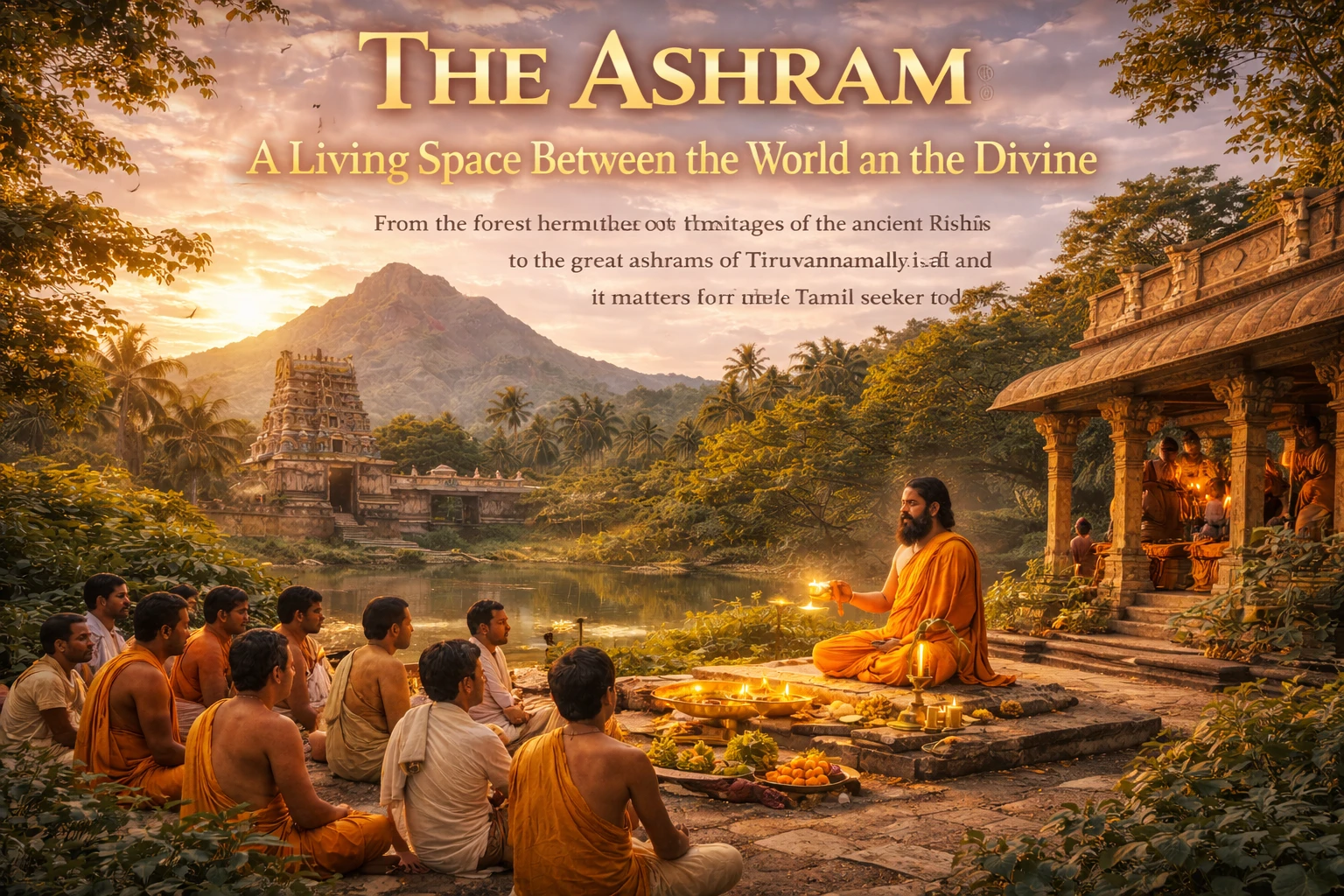
From the forest hermitages of the ancient Tamil Rishis to the great ashrams of Tiruvannamalai and Pondicherry — what an ashram truly is, the 3,000-year tradition that shaped it, its most important living exemplars, and why this extraordinary institution matters more than ever for the seeker today.
Stand at the entrance to Sri Ramanasramam in Tiruvannamalai at four o'clock in the morning. The great hill of Arunachala rises behind you in the darkness. From inside the ashram walls comes the faint sound of chanting beginning. The air is cool and very still. People are already moving through the gate — barefoot, silent, unhurried — from a dozen different countries, carrying a dozen different histories, drawn by a single inexplicable pull.
This is one of the most visited spiritual destinations in India, receiving hundreds of thousands of seekers each year. And yet it operates with a quietness — an absence of spectacle, ceremony and commerce — that is immediately, unmistakably different from the world outside its gates. You have entered something that is neither a temple, nor a monastery, nor a retreat hotel, nor a tourist attraction, though it has elements of all of these. You have entered an ashram.
The ashram is one of India's — and specifically Tamil Nadu's — most distinctive contributions to the spiritual life of humanity. It has existed in some form for at least three thousand years. And yet most people, even those who visit them regularly, have only a partial understanding of what an ashram actually is, where it came from, and what it is truly for.
The Sanskrit word ashrama is built on the root shram — to exert effort, to labour with purpose, to strive towards a defined goal. The prefix a gives the sense of completeness. An ashrama is therefore a place of complete, purposeful effort. Not rest. Not escape. Not comfort. Effort — directed towards the highest goal a human being can pursue.
This etymology immediately corrects the most widespread misunderstanding about ashrams: that they are refuges from difficulty, places of peaceful withdrawal where the pressures of ordinary life can be set aside. The great ashram teachers were unanimous on this point. Ramana Maharshi, Sri Aurobindo, the Kanchi Paramacharya, Sadhguru Jaggi Vasudev — all describe the ashram as a more demanding life, not an easier one. The demand, however, is of a different kind: the demand of sustained inner attention, rigorous self-examination, and the willingness to let the ordinary structures of personality be questioned down to their roots.
In Tamil, the tradition that gave rise to the ashram is described through several related terms. Tapovanam — "forest of austerity" — describes the ancient forest hermitage where sages went to practise tapas, the generating of spiritual heat through sustained discipline. Matham denotes a religious or philosophical institution maintained by a lineage. Peedam refers to the seat of a great spiritual tradition — literally the teacher's seat, from which the entire tradition radiates. Each term points to a different facet of the ashram idea, but all share the understanding that what is at stake is not bodily comfort but the liberation of consciousness.
Long before the ashram became a physical institution, it was the central concept within the most comprehensive model of human life that classical Indian civilisation produced: the Chaturashrama Dharma — the four-stage system that mapped the entire arc of a human existence from birth to liberation.
This system divided life into four sequential stages, each with its own duties, practices and relationship to the sacred:
Tamil Nadu has one of the oldest and most continuous traditions of sacred hermitage in the world. The image of the munivan — the forest sage — is embedded in the earliest stratum of Tamil literary culture. The Sangam corpus (c. 300 BCE to 300 CE), representing the oldest surviving Tamil literature, is suffused with references to the kadu (forest) and its inhabitants: men and women who had withdrawn from society not out of failure or bitterness, but out of the recognition that the world's deepest truths are not available to those who never stop moving.
The Sangam concept of tinai — the five landscape zones of classical Tamil poetry — assigned specific spiritual and emotional qualities to different environments. The mountainous kurinji landscape and the dry forest palai landscape were associated with the interior life: with waiting and longing, with the encounter between the solitary human soul and something vast and silent. The ashram, in its Tamil understanding, is inseparable from this landscape. It is not merely a building but a specific quality of meeting between human consciousness and the natural world at its most unmediated.
"In the forest, one does not escape the world. One encounters it at its roots — before it has been covered over by the noise of human occupation. This is why the ancient sages chose the forest. Not for its beauty, but for its silence. And what speaks in that silence is not nothing."
— Thirumoolar, Thirumandiram, commentary tradition (c. 5th century CE)
Among the oldest identified ashram sites in Tamil culture is the region of Agasthiyarkoodam — the mountain peak in the Agasthyamalai range of the southern Western Ghats, attributed to the sage Agasthiyar (Sanskrit: Agastya), considered the father of the Tamil language, Tamil grammar, Tamil medicine (Siddha Vaidyam) and Tamil yoga. Agasthiyar's hermitage in these mountains is referenced in texts of extraordinary antiquity. The site is today a protected forest reserve, one of the richest biodiversity hotspots in peninsular India — and it remains a living pilgrimage destination, its peak accessible only during a designated annual season.
The continuity at Agasthiyarkoodam is remarkable: the same site that ancient Tamil literature identifies as the founding sage's hermitage is today protected precisely because its spiritual and ecological significance have been understood to be inseparable. The ashram tradition and the conservation tradition, at this site, are one and the same thing.
Tiruvannamalai and its sacred hill Arunachala represent perhaps the densest concentration of uninterrupted ashram culture anywhere in the world. The hill has been associated with tapas and hermitage since at least the first millennium BCE. The Skanda Purana identifies Arunachala as the primordial site of the element of fire in the sacred geography of South India — one of the five Pancha Bhuta Stalas. The Tevaram hymns of the 7th-century Nayanmars describe the hill and its caves as occupied by sages from time immemorial.
When Ramana Maharshi arrived at Tiruvannamalai in September 1896 — aged 16, having undergone a spontaneous experience of death and Self-realisation in Madurai weeks earlier — he was not discovering a new sacred site. He was returning to one of the most ancient. He first lived in the Ayyankuli tank chamber of the great Arunachalesvara temple, then in the Patalalingam vault beneath it, then in Virupaksha Cave on the hill's eastern slope — a cave that local tradition holds had been the residence of sages for at least five hundred years before his arrival. The Ramanasramam that grew organically around his presence from 1922 onwards was not a new institution. It was the formalisation of something that had existed, in the same place, for a very long time.
A common misunderstanding presents the ashram as a withdrawal from life into something other than life. The Tamil ashram tradition corrects this emphatically. The great Tamil sages did not go to the forest because they could not bear the world. They went because they saw through the world's surface — its noise, its urgency, its insistence on its own importance — to the still, aware, luminous ground beneath it. The ashram does not stand apart from ordinary life. It inhabits its deepest layer — the layer that was always there, awaiting attention.
Across their enormous variety — from the one-room hermitage of a single Siddha to the vast institutional complexes of Isha or Sri Aurobindo Ashram receiving thousands of visitors daily — the great ashrams of the Tamil tradition have always performed four distinct and interconnected functions that together define what an ashram is fundamentally for.
The ashram's primary purpose is the transmission of a living tradition from realised teacher to receptive student. This is not information transfer. It is not the same as a school, a library or an online course. The Tamil term for this process is guru-shishya parampara — the unbroken lineage of teacher and student across generations. The Sanskrit root of guru — gu (darkness) + ru (that which removes) — defines the teacher as one who removes spiritual ignorance. What they transmit is not merely knowledge about the divine but direct acquaintance with it: the shift from intellectually understanding that consciousness is inherently free, to actually living from that freedom as a continuous fact of experience.
Sri Ramana Maharshi transmitted almost entirely in silence, sitting in the presence of whoever came, his awareness creating the conditions in which others' awareness could recognise its own nature. Sri Aurobindo transmitted through his voluminous writings and through the total environment of the Pondicherry ashram. Kanchi Paramacharya transmitted through his extraordinary precision in the details of the Vedic and Agamic tradition, his very faithfulness to the form carrying the force of the content. The form of transmission varies entirely; its substance is always the same.
The ashram has historically served as the primary institution for the preservation of classical knowledge — not in the museum sense of dead preservation, but in the living sense of a tradition that is actively practised and therefore continuously renewed. Tamil ashrams have preserved Agamic ritual practice, Sanskrit learning, classical Carnatic music, Siddha medicine, Vedantic philosophy, Sangam literary culture and dozens of other knowledge traditions that would otherwise have been lost to the disruptions of colonial history, demographic change and cultural assimilation.
The Sri Aurobindo Ashram's careful editorial work on Sri Aurobindo's philosophical writings — 35 volumes in the Complete Works — is one of the great achievements of 20th-century Indian publishing. The Kanchi Kamakoti Peetham's maintenance of Vedic chanting schools and Agama patashalas across Tamil Nadu keeps alive textual traditions of extraordinary antiquity. Sri Ramanasramam's preservation of Ramana Maharshi's recorded conversations — the Talks with Sri Ramana Maharshi, the Day by Day with Bhagavan, the Guru Vachaka Kovai — gives seekers worldwide access to one of the most penetrating teachings in the history of contemplative life.
Every major Tamil ashram maintains substantial programmes of service to the surrounding and wider community: feeding programmes (Annadanam), medical facilities, schools, water conservation, and environmental restoration. This is not social work maintained separately from the spiritual mission. It is the natural, inevitable expression of the ashram's central insight: that the divine is encountered most immediately in the face of the suffering human being. Ramalinga Swamigal — Vallalar — who in many ways brought the Tamil Siddha tradition into the 19th century — made this principle explicit in terms that remain radical today: he could not eat when others were hungry. His Sathya Dharma Salai in Vadalur, established in 1867, fed anyone who arrived regardless of caste, religion or social status — one of the first explicitly caste-free public feeding institutions in Indian history.
This is the ashram's ultimate function and its most difficult to describe. At its deepest level, the ashram is an environment engineered for the transformation of consciousness. Every element of its daily structure — the timing of activities, the quality of silence, the balance of solitary practice and community engagement, the sustained proximity of sincere practitioners, the simplicity of physical conditions, and above all the presence or living influence of a realised teacher — is understood as a field of conditions that accelerates inner change. This is why even visitors who spend only a few days at a great ashram often report experiences of unusual clarity, depth or stillness that they cannot easily account for. The ashram is doing something. It is simply doing it very quietly.
The Aandaal Project's Ashram Pillar is building South India's most complete ashram directory — connecting seekers worldwide with ashrams, retreats and spiritual traditions. List your ashram free.
Tamil Nadu is home to some of the world's most significant living ashrams — institutions that have maintained the transmission of a realised tradition for generations and continue to draw seekers from across the world.
The ashram that grew around Ramana Maharshi at the foot of Arunachala. Ramana arrived in 1896 aged 16, having undergone a spontaneous and complete experience of Self-realisation in Madurai. He never formally lectured. He taught primarily through silence — and yet seekers from across the world, including figures as different as Somerset Maugham, Heinrich Zimmer and Arthur Osborne, found their understanding of consciousness permanently transformed by his presence. The practice he pointed to — Self-enquiry, the direct investigation of "Who am I?" — remains one of the most immediate approaches to liberation in any tradition. The ashram today receives visitors from over 80 countries annually.
Founded by Sri Aurobindo Ghose (1872-1950) and Mirra Alfassa — "The Mother" (1878-1973) — the Pondicherry ashram is the institutional home of Integral Yoga: the synthesis of all major yoga paths into a single process aimed not merely at individual liberation but at the transformation of human nature itself, including the physical body, into a medium for the divine. The ashram today maintains a school running from kindergarten through university level, extensive publishing operations (Aurobindo's Complete Works: 35 volumes), medical facilities, and cultural programmes — a total community in which every dimension of life is understood as yoga.
One of the most ancient living spiritual institutions on earth, the Peetham traces its founding to Adi Shankaracharya (c. 788-820 CE), who established four monastic centres to preserve Advaita Vedanta across India. Its greatest modern figure — Chandrasekharendra Saraswathi Swami, "The Kanchi Paramacharya" (1894-1994) — walked barefoot through Tamil Nadu for decades, visiting every village temple he could reach, a man of complete austerity and encyclopaedic learning who lived to 100 in full mental clarity. His collected conversations, published as Deivathin Kural (The Voice of God), run to seven volumes and constitute one of the most comprehensive accounts of Tamil Vedic and Agamic culture ever assembled.
The most recently founded of Tamil Nadu's major ashrams, Isha was established by Sadhguru Jaggi Vasudev at the foot of the sacred Velliangiri mountains, traditionally known as the "Kailash of the South." Its centrepiece is the Dhyanalinga — a unique yogic space described by Sadhguru as an energy form embodying all seven dimensions of the spiritual path, consecrated through a three-year process. Isha has reached an estimated 9 million people through its Inner Engineering programme. Its environmental initiatives — Project GreenHands (90 million trees planted in Tamil Nadu) and Rally for Rivers — make it one of the most socially significant spiritual institutions in contemporary India.
In the Tamil spiritual landscape, the temple and the ashram are both sacred spaces, but they embody fundamentally different principles that help clarify what makes an ashram specifically what it is.
The temple is a public space. It is the organised meeting point between a community and its divine cosmology, maintained by a hereditary priestly lineage, its every ritual prescribed by the Agama Shastras. The divine in the temple is approached through form — through the consecrated murti, through sensory elaboration, through the collective performance of devotion. It is a space of communal religious life, of the renewal of the bond between the human community and its sacred geography.
The ashram is primarily a teaching space. It is organised around a living teacher who has themselves crossed the threshold of ordinary consciousness, and its central relationship is not between devotee and deity but between student and teacher. The divine in the ashram is approached through awareness, through direct investigation of experience, through the questioning of every assumption the mind carries about the nature of reality. The ashram requires no hereditary priesthood and no fixed ritual prescription. It requires a qualified teacher and students burning with real sincerity.
There is, of course, profound overlap. The Arunachalesvara temple in Tiruvannamalai and Ramanasramam coexist in a relationship of deep mutual reference. The Kanchi Peetham is simultaneously an ashram and the institutional guardian of a vast temple network. The distinction is one of emphasis and primary orientation — not an absolute boundary.
"The temple is where you go to meet God in his house. The ashram is where you go to discover you were never separate from him."
— Traditional formulation, Advaita Vedanta commentary
No account of the ashram is complete without examining its most essential and most misunderstood element: the guru-shishya relationship.
In the West, this relationship has been distorted by the genuine abuses of fraudulent teachers and by cultural unfamiliarity with any relationship organised around trust in a higher authority. The Tamil tradition understands the relationship with much greater precision. The guru is not a deity. They are not infallible in worldly matters. They are, specifically, one who has realised the nature of their own consciousness, and who can — through the particular clarity of their awareness and the method they teach — assist others towards the same realisation.
The qualified student is described in the Vedantic texts as a mumukshu — one who is genuinely burning with the desire for liberation, not merely intellectually interested but inwardly compelled. The Vivekachudamani — the primary Advaitic text studied in Tamil ashrams — devotes extensive verses to the qualities of both the qualified teacher and the qualified student, making clear that the guru-shishya relationship is a meeting of two specific kinds of readiness, not an arrangement of service provider and consumer.
This precision matters. The Tamil ashram tradition is not naive about the potential for this relationship to be exploited. It has, for that reason, always maintained rigorous standards for what constitutes a genuine teacher: direct realisation of the Self, confirmed over time in their presence and life; a living connection to an established lineage; and freedom from the need to acquire followers, wealth or social recognition. By these standards, genuine gurus are rare. The great ashrams are organised around honouring and transmitting the rare ones who have been.
In 2026, the case for the ashram's relevance has never been more pressing. The conditions of contemporary life — chronic digital distraction, social fragmentation, the collapse of shared meaning structures, epidemic anxiety and disconnection — are precisely the conditions against which the ashram has always been a response. The ashram says, in effect: the interior life is real. Consciousness is not a by-product of neural activity. The questions "Who am I?", "What is the nature of reality?", "How should I live?" are not philosophical hobbies but the most important questions a human being can ask. And there are methods, tested across three thousand years of serious practice by some of the most penetrating minds in human history, for answering these questions — not merely intellectually, but experientially, in the direct and irreversible transformation of how one lives.
For Tamil communities worldwide — whether in Tamil Nadu itself or in the great diaspora communities of the UK, Canada, Australia, Singapore or the United States — the ashram tradition is a living inheritance of incalculable value. It is not an artefact of history. Sri Ramanasramam is open today. Sri Aurobindo Ashram is open today. Isha Yoga Centre is open today. The Kanchi Peetham is active today. This living tradition is available, in its most essential form, right now.
Every ANDAL Coin booked supports The Aandaal Project's mission to document, preserve and celebrate 4,000 years of Tamil spiritual heritage — including the living ashram tradition. Your support keeps this knowledge visible, findable and alive for future generations.


