 THE AANDAAL PROJECT
THE AANDAAL PROJECT
THE AANDAAL PROJECT
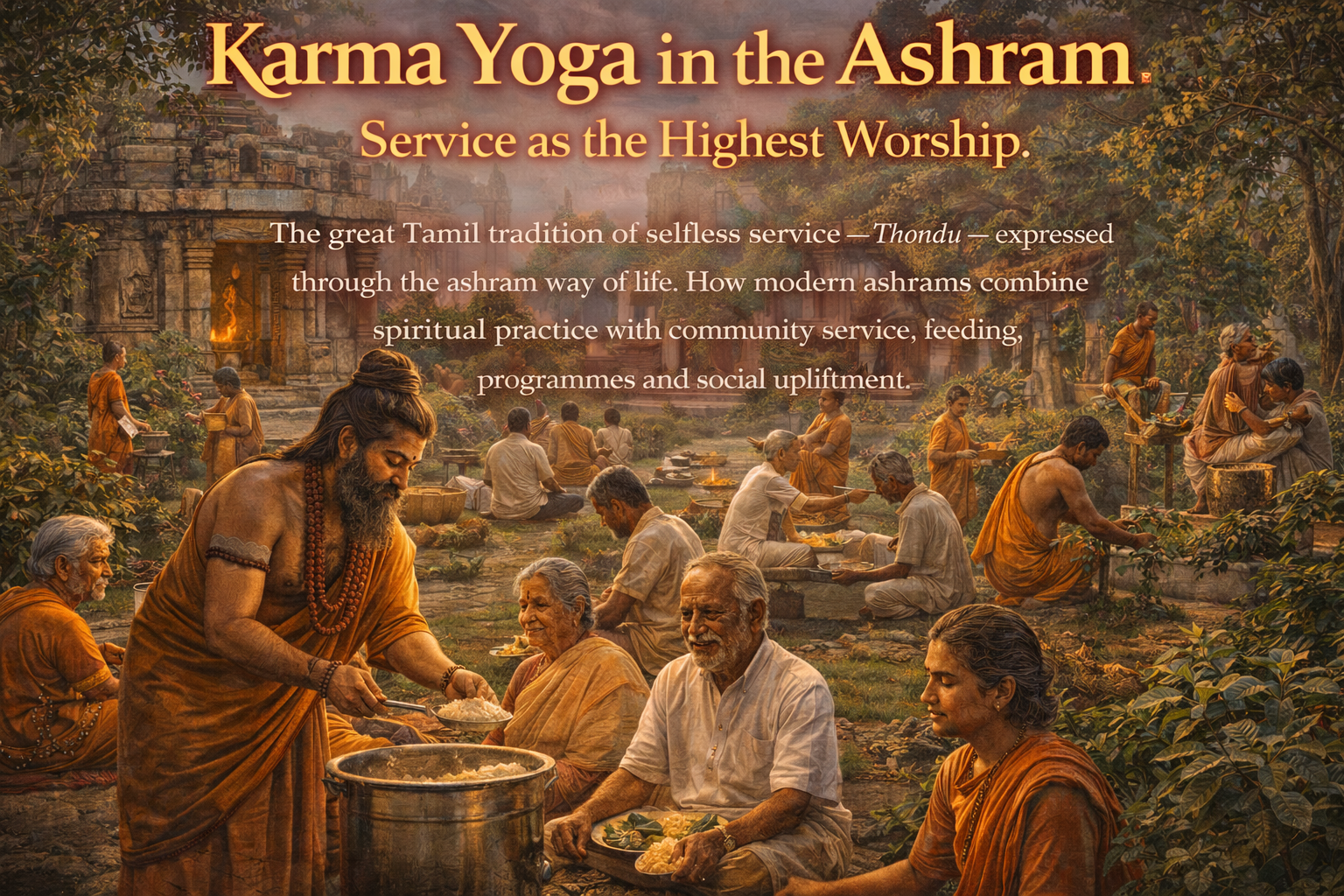
In the Tamil spiritual tradition, the highest form of worship is not elaborate ritual or prolonged meditation. It is the complete, wholehearted offering of oneself in service to others — with no expectation of reward, recognition or result. This is Thondu. This is Karma Yoga. And it has always been at the heart of the Tamil ashram.
Every morning at 4am, in the kitchen of Sri Ramanasramam in Tiruvannamalai, a group of ashram residents begins preparing the day's food. By 6am, the kitchen is in full operation. By the time the first meal is served at noon, hundreds of people — residents, pilgrims, visitors, and simply the hungry — will have been fed. No one is turned away. No one is charged. No one who serves in the kitchen will be named or thanked.
This is Annadanam — the gift of food — one of the most ancient and most revered forms of service in the Tamil tradition. It is not social welfare. It is spiritual practice. The act of feeding another human being, performed without attachment to the outcome, is understood as an act of worship of the divine in human form.
The Bhagavad Gita — composed in Sanskrit but absorbed deeply into Tamil spiritual culture through the Alvar tradition and subsequent commentaries — presents Karma Yoga as one of the three great paths to liberation. The word karma comes from the Sanskrit root kri — "to do, to act." Karma Yoga is, literally, the yoga of action.
But it is a very specific kind of action. The Gita's central teaching on Karma Yoga is summarised in what may be the most quoted verse in all of Indian philosophy: "You have the right to perform your actions, but you are not entitled to the fruits of your actions." What liberates the practitioner of Karma Yoga is not the action itself but the inner quality with which it is performed — the completeness of the giving, the totality of the offering, the absence of any private agenda.
Do not wait to have a large heart before you serve. Serve, and the heart will grow large. This is the secret of Karma Yoga that the ashram tradition has always known.
— Swami Vivekananda, adapted
Tamil culture has its own deep vocabulary for this principle. The word Thondu — service, devoted offering — runs through Tamil spiritual literature from the Nayanmars to the present. The Nayanmars themselves were characterised not merely by their devotion to Shiva but by their service to Shiva's devotees — the principle that serving the devotee is equivalent to serving God.
Ramalinga Swamigal (Vallalar) — perhaps the most radical figure in 19th-century Tamil spirituality — made compassionate service the centrepiece of his entire spiritual vision. For Vallalar, the sight of a suffering being was not merely a call to social action. It was a spiritual crisis. He could not eat when others were hungry. His famous Annadana Suddha Sanmarga Sangam — the Society of Pure Path of Giving Food — was both a feeding programme and a declaration of theological principle: that the divine is encountered most directly in the face of the hungry.
In the context of the modern ashram, Karma Yoga takes many forms. All of them share the same essential quality: action performed without attachment to personal gain.
The ancient practice of feeding the hungry without discrimination. At major Tamil ashrams, this ranges from the daily feeding of hundreds at Ramanasramam, to the massive Annadanam operations at the Isha Yoga Centre that serve thousands daily, to the temple feeding programmes maintained by the Kanchi Kamakoti Peetham in villages across Tamil Nadu.
The practice of serving — cleaning, maintaining, cooking, attending — within the ashram as an act of spiritual practice. In traditional ashrams, there is no distinction between "high" and "low" service. Sweeping the floor of the ashram is as sacred as chanting in the puja hall — if it is done with the same quality of attention and offering.
Several major Tamil ashrams maintain free or subsidised medical facilities serving the surrounding communities. The Isha Foundation operates multiple rural health initiatives across Tamil Nadu. The Kanchi Kamakoti Peetham runs a network of free medical camps. This tradition of ashram medicine — combining Siddha, Ayurvedic and allopathic approaches — continues a service tradition that stretches back to the earliest Siddha hermitages.
Education as service has always been central to the ashram tradition — from the ancient gurukula (residential school) system to the remarkable Sri Aurobindo Ashram school in Pondicherry, which runs from kindergarten to university level, and the Isha Vidhya schools established by the Isha Foundation in rural Tamil Nadu to bring quality education to children who would otherwise have none.
What distinguishes Karma Yoga from ordinary charitable work is its inner dimension. The Karma Yogi is not simply doing good. They are using the act of service as a spiritual practice — as a means of dissolving the boundary between self and other, between giver and recipient, between the one who acts and the action itself.
Every moment of genuine service — every act of giving that is complete and asks nothing in return — loosens slightly the grip of the ego's claim to be a separate self. Over time, this loosening becomes a profound inner freedom. The Karma Yogi discovers, as Sri Ramana Maharshi described from the perspective of Jnana Yoga, that the self that imagined it was serving was never as solid or as separate as it seemed.
Many Tamil ashrams welcome volunteers — both from India and from the diaspora — who wish to experience Karma Yoga in practice. Volunteering typically involves contributing one's skills and time to the ashram's service activities: cooking, maintenance, teaching, healthcare, or other forms of practical work. Most ashrams ask for a minimum commitment of two to four weeks, and provide simple accommodation and meals in return. The experience is consistently described by participants as transformative — not because of anything dramatic that happens, but because of the gradual dissolution of habitual patterns of self-concern that the practice of service, day after day, quietly effects.
The Aandaal Project's own foundational commitment is to Seva in the digital sphere: making Tamil heritage findable, accessible and alive for the 80 million members of the Tamil diaspora and for the billions of people worldwide who might benefit from encountering this extraordinary civilisation's spiritual wisdom.
Our Ashram Pillar is, in its own way, an act of service — connecting seekers to the ashrams that can serve their journey, connecting ashrams to the communities that need them, and helping to ensure that the living tradition of Tamil spiritual practice does not become invisible in the digital age. We offer it freely, in the spirit of Thondu — because the Tamil world gave us something of incalculable value, and this is how we give back.