 THE AANDAAL PROJECT
THE AANDAAL PROJECT
THE AANDAAL PROJECT
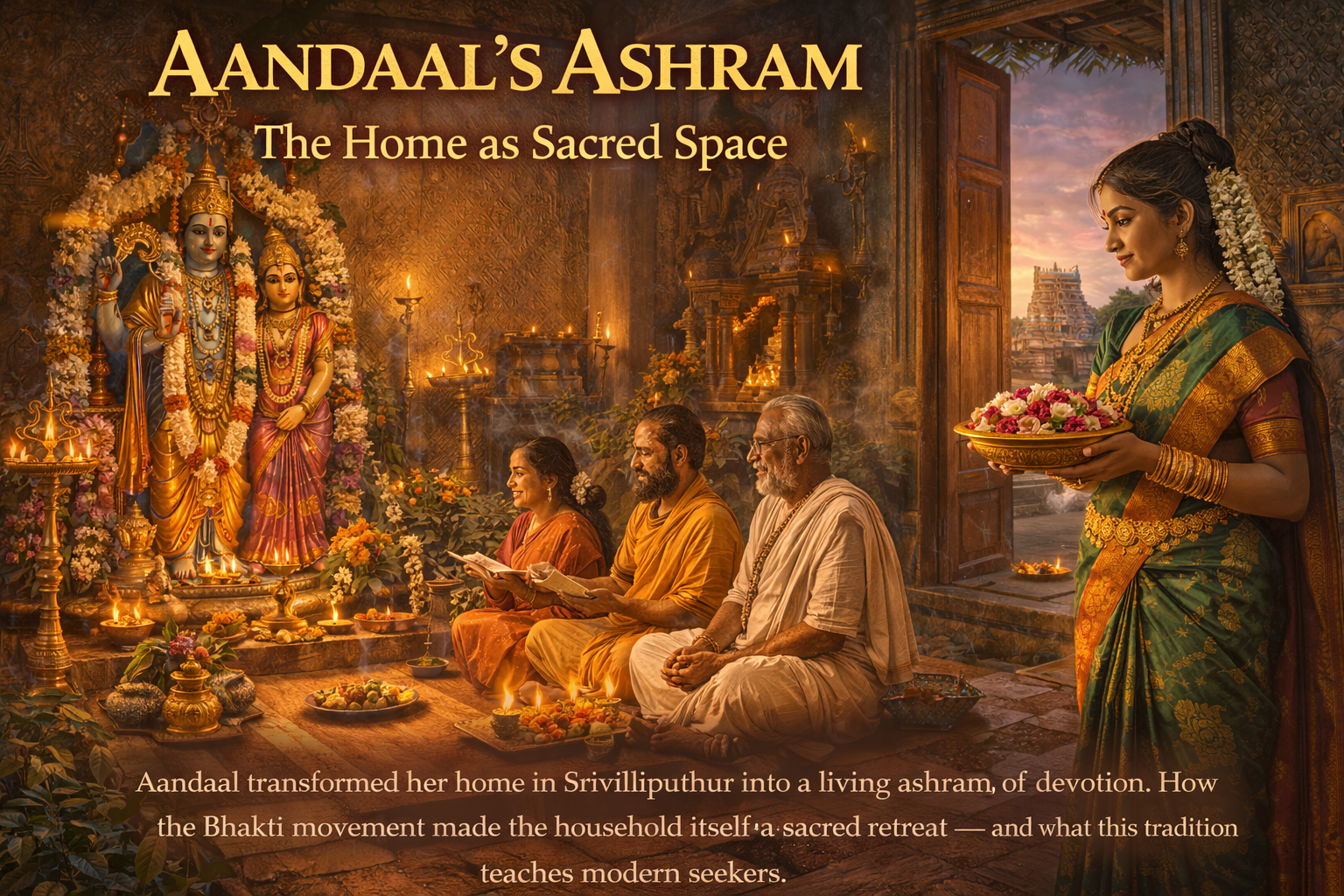
Aandaal did not live in a forest hermitage or a mountain cave. She lived in her father's home in Srivilliputhur — and yet she created the most intense ashram of devotion in the history of Tamil spirituality. Her story transforms our understanding of what a sacred space truly is.
She was born into a garden. Her father, Vishnuchitta — known as Periyalvar — was a devoted gardener who tended the sacred tulsi plants in the Andal temple at Srivilliputhur. According to tradition, he found her as an infant beneath a tulsi plant and raised her as his own daughter. From the earliest age, she was immersed in the stories, songs and presence of Vishnu.
What Aandaal did with this immersion is without parallel in the history of devotional religion. She did not merely love the divine as a devotee loves a distant God. She loved Vishnu as a bride loves her bridegroom — with a totality of longing, a completeness of surrender, a burning intensity that consumed everything else in her being. Her home became, in the most complete sense, an ashram of Bhakti.
Every year during the Tamil month of Margazhi (December-January), millions of Tamil Hindus rise before dawn to recite Aandaal's 30 verses of the Thiruppavai. This practice — unbroken for over 1,200 years — is one of the most extraordinary examples of living spiritual transmission in the world.
The Thiruppavai is a profound document. On the surface, it is a young woman and her companions rising before dawn to bathe in the river, preparing themselves to receive the grace of Lord Vishnu. But at a deeper level, it is a complete map of the spiritual path: the pre-dawn awakening (the soul stirring from its sleep of ignorance), the calling of companions (the building of spiritual community), the bathing (purification), the approach to the divine presence (the stages of meditation), and the final vision (the experience of grace).
Narayana! Ke-sava!
Namam paadi
Neer naadi selvom, kol
"Calling the names of Narayana, of Kesava,
Let us go together to the water."
If the Thiruppavai is the gentle awakening of a devotional community, Aandaal's second great work — the Nachiyar Thirumozhi (The Sacred Words of the Lady) — is something altogether more intense. In 143 verses, Aandaal gives voice to a spiritual longing of such ferocity that even today her words can stop the breath.
Here she dreams of Vishnu, burns with longing in her waking hours, rebukes the moon for its cold indifference to her suffering, rallies her companions for a ceremony that mirrors a village marriage ritual, and finally — in the poem's culmination — describes her union with the divine in images of overwhelming tenderness.
The Nachiyar Thirumozhi is the most searingly personal piece of devotional literature in the Tamil language — perhaps in any language. It reads not like a poem written about God, but like a letter written to God, by a woman who could not survive without him.
— Dr. Vidya Dehejia, Art historian and Tamil Studies scholar
Aandaal's story raises a question of profound importance for contemporary seekers: what actually makes a space sacred? The conventional answer points to temples, forest hermitages, mountain caves — places consecrated by tradition and separated from ordinary life. But Aandaal's home was none of these things. It was a simple dwelling in a small town. What transformed it into one of the most powerful ashrams in Tamil spiritual history?
The answer the Bhakti tradition gives is: consciousness. A space becomes sacred not through architecture or ritual alone, but through the quality of attention brought to it. Aandaal's home was transformed because every inch of it — every flower she tended, every garland she made, every verse she composed — was saturated with the single-pointed awareness of the divine. The distinction between sacred and secular collapsed entirely, because there was nothing in her world that was not sacred.
The Bhakti movement's most radical contribution to Indian spirituality was its democratisation of the sacred. You did not need to be a Brahmin, a man, or a forest renunciate to experience the divine. You needed only sincerity of longing and totality of surrender. Aandaal — a woman, a non-Brahmin by birth in most traditions, living in a domestic setting — became the exemplar of this principle. Her home was the most complete ashram of her age.
Srivilliputhur, the town where Aandaal lived and composed her verses, remains a living pilgrimage destination in southern Tamil Nadu. The Andal temple there — whose gopuram became the official symbol of the Tamil Nadu government — is one of the 108 Divya Desams, the most sacred Vaishnava pilgrimage sites.
The spot where the tulsi garden stood, where Vishnuchitta found the infant Aandaal, is still marked. Pilgrims come throughout the year, but especially during Margazhi when the Thiruppavai is recited — to stand in the space where one of the world's greatest poets of divine love once lived, composed, and ultimately, according to tradition, was taken directly into the presence of Vishnu.
For contemporary Tamil Hindus — whether living in Tamil Nadu or in the diaspora — Aandaal's example offers something of immense practical value. Most of us cannot go to live in an ashram. We have families, careers, responsibilities. We live in cities, not forests. But Aandaal's life says: this is enough. Your kitchen, your garden, your daily work — these can be your ashram, if you bring to them the quality of attention she brought to hers.
The Thiruppavai, recited each morning of Margazhi, is a daily ashram practice that requires no special setting — only an early rising, a recitation, and the willingness to begin each day by calling on something larger than oneself. Over 1,200 years, this practice has proved its power. It is one of the great gifts of Tamil civilisation to the world.