 THE AANDAAL PROJECT
THE AANDAAL PROJECT
THE AANDAAL PROJECT
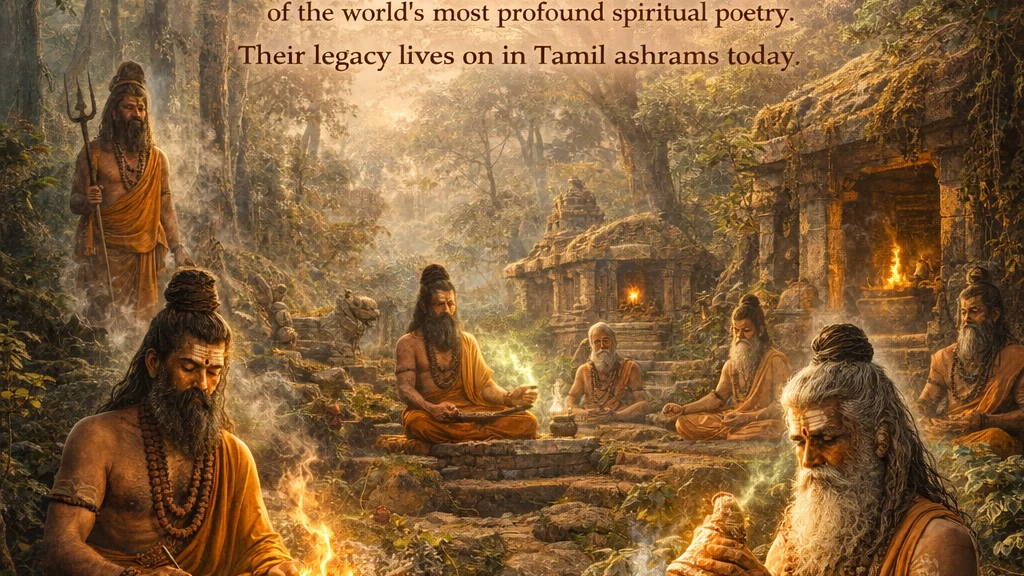
The 18 Tamil Siddhas lived in the forest hermitages of Tamil Nadu and composed some of the world's most radical, beautiful and enduring spiritual literature. They challenged caste, defied convention, and mapped the interior landscape of human consciousness with extraordinary precision.
Somewhere in the mountains above Palani, legend has it, the Siddha Boganathar sat in meditation for centuries. Somewhere in the forests of the Nilgiris, Thirumoolar composed 3,000 verses of the Thirumandiram — one verse per year, over three thousand years. At the cave of Skandashram on the hill of Arunachala, Ramana Maharshi — widely understood as the last of the great Siddha-type masters — maintained a silence so profound that it transformed everyone who came near it.
These are the Tamil Siddhas: masters of an inner science so advanced that even today, scholars struggle to fully decode their writings. They are not figures of mythology. They are the originators of a living tradition that continues in ashrams, in yoga centres, in the practices of millions of Tamils worldwide.
The Tamil word Siddha (from Sanskrit siddha — "one who has achieved") denotes a human being who has attained siddhi — mastery, perfection, or extraordinary power — through spiritual practice. But this definition barely scratches the surface of what the Tamil Siddhas represent.
Unlike the Nayanmars (Shiva saints) and the Alvars (Vishnu saints) who worked primarily within orthodox temple religion, the Siddhas were deliberate outsiders. They wrote in the vernacular Tamil of the marketplace rather than Sanskrit. They challenged the authority of priests. They attacked caste distinctions with extraordinary ferocity. They were, in many respects, the spiritual radicals of their age — and yet they are now recognised as among the most profound spiritual masters the Tamil world has produced.
"Do not seek God in temples and sacred hills. He lives in the breath — in each inhalation, each exhalation. Know this and you have found everything."
— Thirumoolar, Thirumandiram, verse 724
Tamil tradition identifies 18 principal Siddhas — the Pathinetthu Siddhar — though the lists vary somewhat between different lineages. Here are the most widely recognised:
The sage to whom the Tamil language itself is attributed. Agasthiyar is considered the father of Tamil grammar, Tamil medicine (Siddha Vaidyam), and Tamil yoga. His hermitage at Agasthiyarkoodam in the southern Ghats remains a pilgrimage site to this day. He is credited with over 200 texts spanning medicine, yoga, astrology and philosophy.
Author of the Thirumandiram — 3,000 verses composed at Chidambaram that constitute the most comprehensive exposition of Shaiva Siddhanta philosophy ever written in Tamil. Thirumoolar's revolutionary assertion that "God is love" — "Anbe Sivam" — centuries before the Christian era, places him among humanity's greatest spiritual voices.
One of the most mysterious of the Siddhas, Boganathar is said to have travelled extensively — to China, to South America, to the Himalayas — transmitting knowledge across civilisations. He is the creator of the Palani Murugan idol, cast from nava pashanam (nine poisonous substances transformed through alchemical process). His texts on alchemy and medicine — the Bogar 7000 — remain extraordinary documents.
The most recent of the Siddhas, Ramalinga Swamigal of Vadalur represents the culmination of the Siddha tradition in modern times. His Thiruvarutpa (Sacred Songs of Grace) are among the most exquisite devotional poems in any language. His insistence on compassion as the highest spiritual practice — his feeding programme, his opposition to animal sacrifice — makes him one of the most socially progressive figures in Tamil history. His final disappearance in 1874, leaving only his clothes, is one of Tamil spirituality's great mysteries.
The poet-rebel of the Siddha tradition, Sivavakkiyar composed verses of ferocious social criticism alongside deep spiritual insight. His attacks on religious hypocrisy, caste discrimination and empty ritual remain as sharp today as when they were first composed. His verses are marked by a distinctive caustic wit that makes them among the most memorable in Tamil literature.
The Siddhas were not merely spiritual poets. They were practitioners of an integrated science that encompassed what we would today call multiple disciplines:
Siddha medicine is one of the world's oldest surviving medical systems and is officially recognised by the Indian government. Tamil Nadu has a dedicated Department of Indian Medicine and Homeopathy that oversees Siddha medical education and practice. Major Siddha hospitals operate in Chennai, Madurai, Palayamkottai and other cities. Several of the plant-based formulations developed by the Siddhas have been validated by modern pharmacological research for their efficacy against a range of conditions.
The Siddhas lived in the wild margins of the world — in forest caves, on mountain peaks, in the burning grounds. Their ashrams were not institutions but intense fields of spiritual energy created by the sustained practice of a realised master. Seekers came, were tested, and either received transmission or were sent away.
Many of these ancient hermitage sites retain their spiritual potency today. Thiruvannamalai — the site of Ramanasramam — has been associated with hermitage life since long before Ramana Maharshi's time. The cave of Virupaksha on the hill, where Ramana first lived, had been the residence of Siddhas for centuries. Palani, the site of Boganathar's alchemical work, remains one of Tamil Nadu's most powerful pilgrimage destinations. Agasthiyarkoodam in the Agasthyamalai hills is still regarded as a living sacred site.
Every serious Tamil ashram today stands, consciously or not, in the tradition of the Siddhas. When an ashram teaches yoga, it is drawing on the yogic science systematised by Thirumoolar and his contemporaries. When it offers Siddha medicine, it is using formulations developed by Agasthiyar and Boganathar. When it insists on the equality of all seekers regardless of caste or gender, it is continuing the radical social vision of Sivavakkiyar and Ramalinga Swamigal.
The Siddhas remind us that the ashram is not a comfortable refuge from the world but a place of rigorous transformation — where the human being is understood as raw material to be refined, and where the goal is nothing less than the complete realisation of the divine potential latent in every soul.