 THE AANDAAL PROJECT
THE AANDAAL PROJECT
THE AANDAAL PROJECT
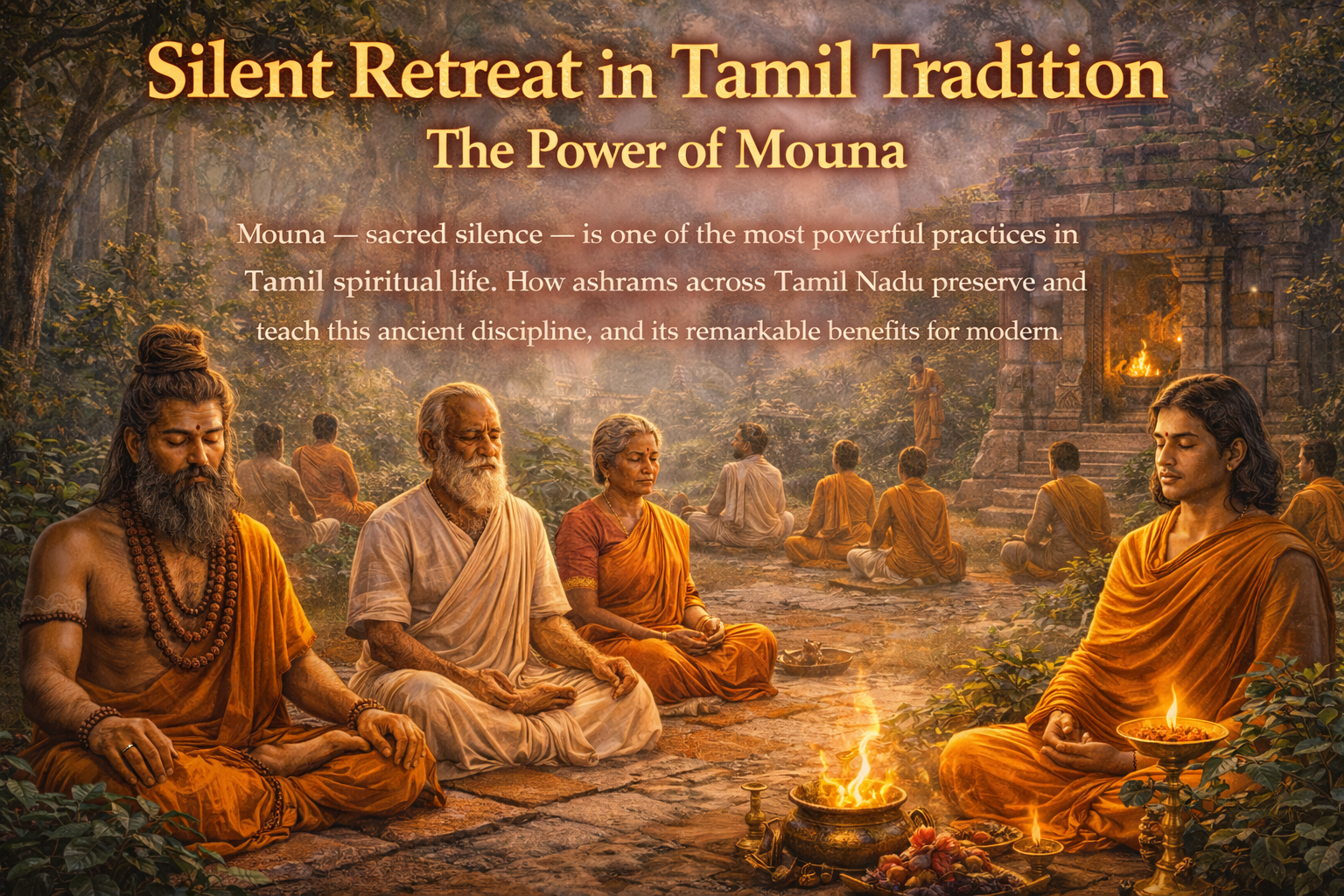
In a world of relentless noise, the Tamil spiritual tradition has always known something that neuroscience is only now beginning to confirm: silence is not the absence of something. It is the presence of everything. Mouna — sacred silence — is among the most potent and most misunderstood practices in the ashram tradition.
"Silence is the language in which God speaks.
Everything else is a poor translation."
When Sri Ramana Maharshi arrived at Arunachala in 1896 at the age of 16, he did not begin his spiritual life by seeking a teacher, studying texts, or performing elaborate rituals. He sat down. He went quiet. He maintained a silence so complete — for years — that even those who came to question him often found their questions dissolving before they could be asked. And he described the silence not as an absence of communication but as the highest form of it.
This was not eccentric behaviour in the Tamil spiritual context. It was the continuation of a practice — Mouna — that runs through Tamil spiritual culture from the earliest Sangam literature to the present day. The forest sage seated in silence beneath a tree is one of the oldest images in Tamil poetry. The silent master whose presence transforms without a word being spoken is one of the most celebrated figures in Tamil hagiography.
The Sanskrit word mouna (Tamil: mounam) is typically translated as "silence." But in the Tamil spiritual tradition, this translation is dangerously incomplete. Mouna is not merely the absence of speech. It is a graduated practice that moves through at least three distinct levels:
The most accessible level: the deliberate cessation of verbal communication. Even at this level, the effects are profound. Without the constant externalization of inner experience through speech, attention naturally turns inward. Many practitioners report that even a single day of Vak Mouna produces a noticeable deepening of inner awareness.
The subtler practice: the quieting not merely of external speech but of the internal monologue — the constant commentary, planning, remembering, imagining that constitutes ordinary mental life. This is the realm of formal meditation practice, where the practitioner works to reduce the volume and frequency of thought until what remains is a quiet, spacious awareness.
The ultimate level, described by Ramana Maharshi and other masters as the natural state of liberated consciousness: a silence that is not the suppression of noise but the recognition that awareness itself is inherently silent, still and complete. This is not an achievement or an attainment — it is the discovery of what has always already been the case.
Every serious Tamil ashram maintains some form of Mouna practice. The forms vary enormously — from designated silence hours in a yoga ashram, to the total silence maintained for months or years by advanced practitioners in the Ramana tradition, to the specific Mouna Dinam (silence day) practices at the Kanchi Kamakoti Peetham.
What is common across all these contexts is the understanding that silence is not a deprivation but an enhancement — that when the constant noise of ordinary communication is suspended, something else becomes available. Practitioners consistently report:
After three days of silence, I stopped trying to manage my experience. Things arose and passed away, and there was something watching that was not troubled by any of it. I understood for the first time what the word 'peace' actually means.
— A seeker at Sri Ramanasramam, Tiruvannamalai (2024)
Modern neuroscience has begun to catch up with what Tamil rishis knew millennia ago. Research into the effects of silence on the brain has produced findings that would not surprise any serious practitioner of Mouna:
A landmark 2013 study published in the journal Brain Structure and Function found that two hours of silence per day prompted cell development in the hippocampus — the brain region associated with memory formation, learning and emotional regulation. Separate research has shown that the brain's Default Mode Network (associated with self-referential thought, creativity and integration of experience) becomes more coherently organised during periods of sustained silence.
Most remarkably, studies of long-term meditators — many of them from Vedantic and Tamil yoga traditions — show measurable differences in brain structure and function compared to non-meditators: thicker cortex in regions associated with attention, greater connectivity between brain regions, and significantly reduced activity in the amygdala (the brain's threat-detection centre) even in non-meditative states.
You do not need to enter a formal silent retreat to begin exploring Mouna. Many Tamil practitioners maintain a daily Mouna Velai (silent time) of one to two hours — typically in the early morning hours of Brahma Muhurta (approximately 4-6am), traditionally considered the most auspicious time for inner practice. During this time, no speech, no screens, no reading. Simply sit, breathe, and notice what arises in the absence of distraction.
Several of Tamil Nadu's major ashrams offer formal silent retreat programmes accessible to contemporary seekers. Sri Ramanasramam in Tiruvannamalai welcomes visitors who wish to spend time in the environment of silence that Ramana Maharshi established, though no formal programme is required. The Isha Yoga Centre offers structured programmes incorporating silence alongside yoga and meditation. Several smaller ashrams in the Tiruvannamalai area — the region most associated with Mouna practice in Tamil Nadu — offer accommodation specifically designed for those undertaking independent silent practice.
For diaspora Tamils, the challenge of maintaining any silent practice in the context of demanding modern lives is real — but the Tamil tradition is emphatic that even short periods of genuine silence, practised consistently, are transformative. The Mouna Vrat (silent vow) taken for a single day per week, or even for a few morning hours daily, has been a standard feature of Tamil spiritual practice for centuries.
In the end, the practice of Mouna comes down to a single question: are you willing to stop talking — to yourself, as much as to others — long enough to hear something else? The Tamil masters are unanimous: what you hear, in that silence, will change everything.