 THE AANDAAL PROJECT
THE AANDAAL PROJECT
THE AANDAAL PROJECT
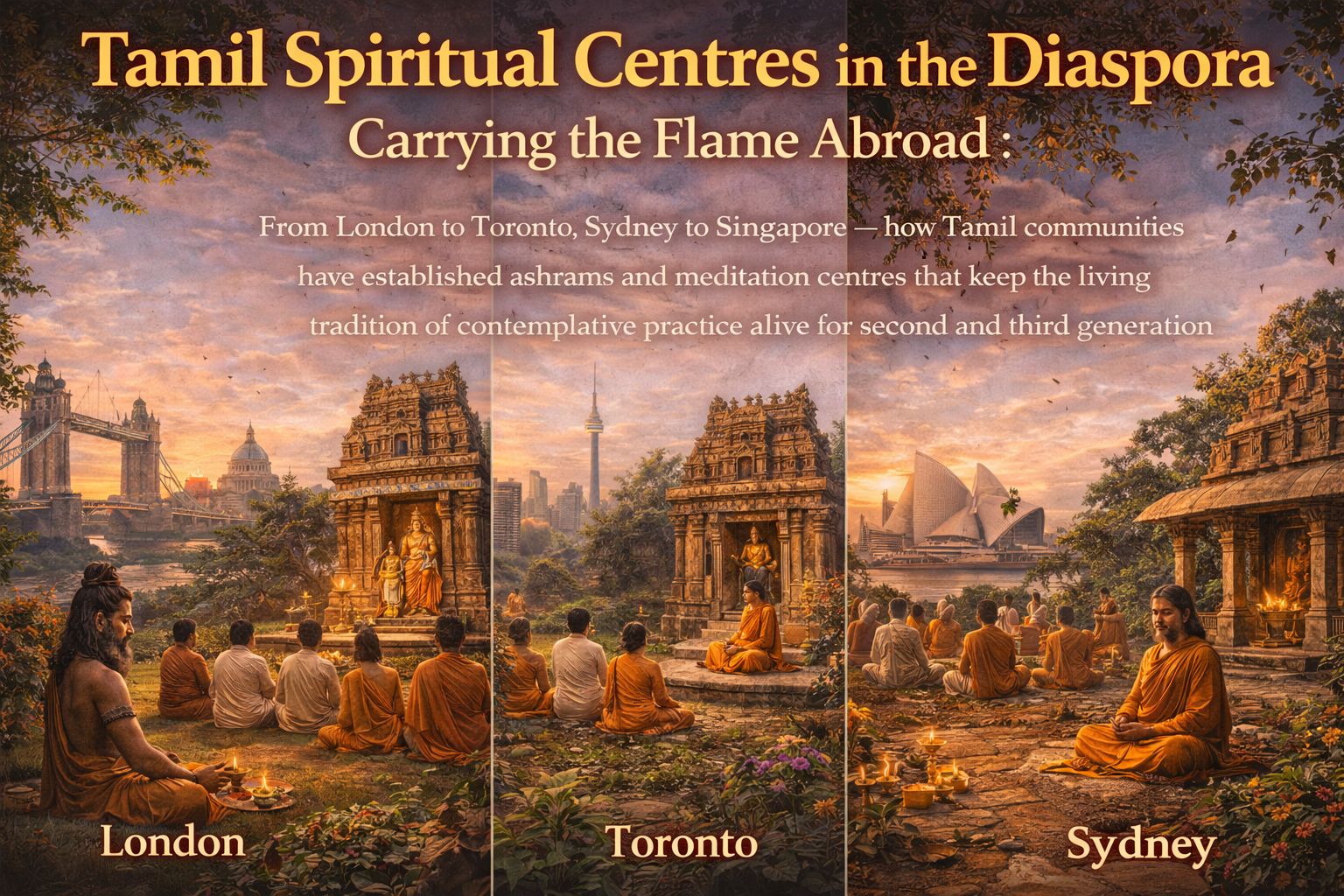
The Tamil diaspora is one of the world's great migrations — 80 million people spread across every continent, carrying with them a spiritual inheritance of extraordinary depth. Across the world, Tamil communities have established ashrams, yoga centres and meditation spaces that keep the living tradition of contemplative practice alive far from its origins.
In a converted community hall in Wembley, north London, a group of Tamil families gathers every Sunday morning. They are not there for a temple service, though the altar in the corner carries the usual images. They are there for something they call simply "practice" — a combination of Thiruppavai recitation, silent meditation, pranayama, and collective reading from the Thirumandiram. The group has been meeting, in various forms and locations, for 22 years.
This is the diaspora ashram: not necessarily a building, not necessarily a formal institution, but a community of practice organised around the transmission of a living spiritual tradition. It exists in hundreds of forms, in dozens of countries — wherever Tamil people have settled in sufficient numbers and sufficient longing to recreate, in new soil, the conditions that support inner life.
Maintaining a living spiritual tradition in diaspora is not straightforward. The physical landscape — the sacred hills, the ancient temples, the forest caves — that form the backdrop of Tamil spiritual practice in India are absent. The social fabric that in Tamil Nadu naturally reinforces spiritual practice — festival calendars, temple rituals, the presence of teachers, the ambient culture of devotion — must be deliberately reconstructed rather than simply inhabited.
And the second generation faces pressures that their parents did not. Raised between cultures, often in environments where Tamil identity itself is contested or marginalised, many diaspora Tamil young people struggle to find a meaningful connection to a spiritual tradition that can feel distant, formal, or irrelevant to their actual lives.
The most successful diaspora spiritual centres are those that have found ways to honour both the depth of the tradition and the realities of the contemporary context — presenting the yoga, the meditation, the Bhakti, the philosophy not as cultural artefacts to be preserved in aspic, but as living technologies that address real human needs right now.
The UK Tamil community — concentrated in London (particularly Wembley, Harrow, East Ham and Tooting), but significant also in Leicester, Birmingham and Manchester — has established one of the most sophisticated diaspora Hindu communities outside South Asia. Multiple Shaiva temples following full Agamic ritual, several Vaishnava centres offering regular Divya Prabandham recitation, and a growing number of yoga and meditation centres offer a range of entry points to the tradition. Several ashram-style residential communities exist in rural areas, offering structured retreats.
Canada has the largest Tamil diaspora population outside Asia, concentrated in the Greater Toronto Area — which has been called "Little Jaffna" by some commentators. The Canadian Tamil spiritual landscape is particularly rich in Shaiva Siddhanta institutions, reflecting the Sri Lankan Tamil background of much of the community. Several major temples in Mississauga and Scarborough maintain full Agamic worship, and associated cultural-spiritual organisations offer classes in yoga, Carnatic music, Tamil language and Bhakti practice.
The Tamil communities of Singapore and Malaysia represent the oldest continuous Tamil diaspora, with some families tracing their presence to the 18th and 19th century plantation era. The result is a spiritual tradition that has had time to put down deep local roots — adapted to the regional context while maintaining remarkable fidelity to Tamil spiritual forms. The Sri Mariamman Temple in Singapore, one of the oldest Hindu temples outside India, is a functioning Agamic institution. Several yoga centres in Singapore draw explicitly on the Tamil Siddha tradition.
Australia's Tamil community — concentrated in Sydney and Melbourne — is younger than those in the UK or Canada, but growing rapidly and with considerable spiritual energy. Several temples in the western suburbs of both cities have established themselves as full Agamic institutions. A notable feature of the Australian Tamil community is the relative youth of its spiritual leaders and the energy directed towards making the tradition accessible to second-generation Tamils through English-language programming.
Across all these contexts, the diaspora spiritual centres that thrive share certain characteristics. They take the tradition seriously — they do not offer a diluted or purely cultural version of Tamil spirituality, but engage genuinely with its depth. They are accessible — they explain, translate, contextualise, and welcome genuine inquiry. And they serve not merely the first generation but actively invest in the transmission of the tradition to younger people.
Our parents brought the tradition here in their hearts and their memories. Our job is to give it a form that our children's children can still find meaningful. That is the ashram's work in diaspora.
— Founding member, Tamil Meditation Centre, Toronto (2025)
The Aandaal Project's Ashram Pillar is building the world's first comprehensive directory of Tamil spiritual centres worldwide — including diaspora ashrams, meditation groups and yoga centres. If you run or know of a Tamil spiritual community anywhere in the world, register it free so that seekers can find you.
The COVID-19 pandemic accelerated something that was already underway: the migration of aspects of spiritual community life online. For the Tamil diaspora, this has been particularly significant. Teachers in Tamil Nadu can now reach students in Toronto and London in real time. Thiruppavai recitation circles that might draw 15 people in person can draw 150 online. Young people who feel culturally isolated can find a global community of Tamil spiritual practitioners with a few clicks.
The Aandaal Project's ANDAL Chat is part of this larger movement — creating digital spaces in which the conversation around Tamil spiritual heritage can happen across geographic boundaries, connecting seekers to communities and communities to the ashrams and teachers that can serve their journey.