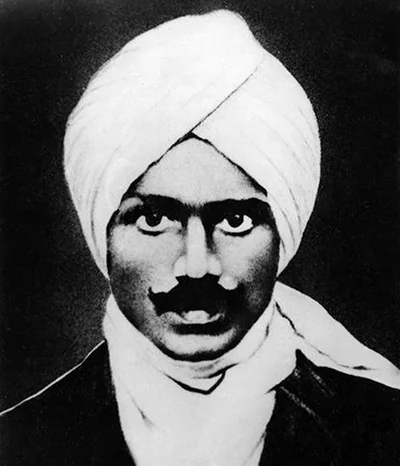
Subramania Bharati — Bharathiyar, National Poet
He was given the title Bharati — meaning one blessed by the goddess Saraswati — by the scholars of the Ettayapuram court when he was eleven years old, and he astonished them with his Tamil verse. He would die thirty-nine years later in Chennai, largely impoverished, after a temple elephant he had been feeding knocked him down. In the interval, he had transformed the Tamil language, lit the fire of the independence movement in South India, and written verses that would be memorised by every Tamil child for the next hundred years.
Chinnaswami Subramania Bharati, known to Tamil Nadu simply as Bharathiyar, was the first great modern Tamil poet. He broke the shackles of classical Tamil verse — its elaborate metres, its feudal conventions, its restriction to themes approved by tradition — and used the language to speak directly to ordinary people about freedom, women's rights, national pride, and the divine. He wrote with urgency because he felt urgency: India was under colonial rule, Tamil women were denied education, and the old certainties of caste and tradition were being used to keep people down.
I. The Child Prodigy of Ettayapuram
Bharati was born on 11 December 1882 in Ettayapuram, a small principality in what is now the Thoothukudi district of Tamil Nadu. His father Chinnaswami was a clerk at the local court. His mother Lakshmi Ammal died when he was five. He grew up in the court environment, absorbing both the classical Tamil tradition and the political winds of the late 19th century — the rise of Indian nationalism, the reformist movements, the encounter with Western ideas of liberty and equality.
The title Bharati was conferred at eleven. By his early twenties he was writing for nationalist newspapers, working as a journalist and editor, and making contact with the leaders of the Indian independence movement — including Bal Gangadhar Tilak, Lala Lajpat Rai and, crucially, Sister Nivedita, the Irish disciple of Swami Vivekananda whose influence on his thinking about women and spirituality would be profound.
II. The Pondicherry Years — Exile and Creation
In 1908, with the British government issuing warrants for nationalist writers, Bharati fled across the border to Pondicherry — then French territory, beyond the reach of British law. He would spend the next decade there, living in poverty but writing with extraordinary intensity. The major works of his literary life were produced in this period of exile: Panchali Sabatham, the epic poem retelling the Mahabharata through the eyes of Draupadi; Kuyil Pattu, the lyrical poem of the cuckoo; and the patriotic songs that would become the anthems of the South Indian independence movement.
Aadi Paraasakthi! We shall not fear. We shall not be enslaved. We shall live as free human beings on this earth.
— Subramania Bharati
He lived in Pondicherry alongside Aurobindo Ghosh, the revolutionary-turned-mystic, whose ashram would later become one of the great spiritual centres of South Asia. The encounter with Aurobindo deepened Bharati's synthesis of nationalism, Vedantic philosophy, and social reform.
III. The Revolutionary — Women, Caste and Freedom
What makes Bharati exceptional in the context of his time is not just his literary genius but his political radicalism. In an era when women's education was contested and caste hierarchy was treated as natural law, Bharati wrote and campaigned for a vision of Tamil society that was radical even by 21st century standards.
Bharati on Women's Freedom
Bharati's poems on women are unlike anything produced by his contemporaries. He wrote of women as intellectual equals, as embodiments of Shakti, as freedom fighters. His vision of the liberated Tamil woman — educated, unconstrained by convention, spiritually sovereign — was so far ahead of his time that it would take Indian society most of a century to begin catching up.
His poem Pudhumai Penn (The New Woman) remains one of the most powerful feminist texts in any Indian language — not as a political document but as a poetic celebration of what a woman could become when freed from imposed limitation.
On caste, Bharati was equally uncompromising. He wrote against untouchability, dined with Dalits in public acts of deliberate social transgression, and argued that caste distinctions were incompatible with the Tamil spiritual tradition he revered. He was not without contradiction — no human being of his time was — but the direction of his moral compass was unmistakable.
IV. The Poems — A Language Reborn
Bharati's most enduring achievement is what he did to the Tamil language itself. Tamil had a literary tradition extending back over two thousand years — the Sangam poetry, the Thirukkural, the devotional hymns of the Nayanmars and Alvars, the epics of Kambar and Ilango. It was a tradition of immense richness, but also one constrained by convention and accessible primarily to the educated.
Bharati broke it open. He wrote in a direct, spoken Tamil that could be sung, memorised, and understood by anyone. He introduced free verse into Tamil poetry. He used modern imagery — trains, factories, newspapers — alongside the classical imagery of flowers, rivers and gods. He made the language feel urgent, contemporary, and alive in a way it had not felt for centuries.
V. Death and Immortality
Bharati returned to British India in 1918 and was briefly imprisoned by the colonial authorities. He was released but remained under surveillance. He spent his final years in Chennai in deteriorating health and financial difficulty. On 11 September 1921, he died aged 39 after injuries sustained from an elephant he had been feeding at the Parthasarathy Temple in Triplicane.
The Tamil Nadu government did not recognise his work during his lifetime. After his death, his manuscripts were purchased by his widow for a nominal sum. The recognition came slowly and then completely — his image on postage stamps, his birthday a state celebration, his poems in every school curriculum. Today Subramania Bharati is not merely a poet but a symbol of what the Tamil language and Tamil civilisation can aspire to be.
Explore Tamil Heritage
Discover more profiles in our living archive of Tamil civilisation. Browse Heritage Blogs →