I. The Book Without a Name
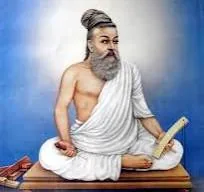
Thiruvalluvar — Author of the Thirukkural
In 1848, Monsieur Ariel — a French Orientalist and translator working on the Tamil classics — published a famous observation about the text he had spent years translating. The Thirukkural, he wrote, was "the book without a name by an author without a name." The original Tamil text does not name itself. The author's name does not appear anywhere within it. The title we use — Thirukkural — was applied by later commentators. The author we call Thiruvalluvar is identified only in a later collection of verses, the Tiruvalluva Maalai.
This anonymity is not accidental. It is, in retrospect, exactly right. The Thirukkural makes no claims that depend on the authority of its author. It makes no appeal to revelation, to divine inspiration, to the prestige of a lineage or a school. Every one of its 1330 couplets stands or falls on the quality of its reasoning and the truth of its observation. The author erased himself — and in doing so, made the text permanently accessible to every human being who has ever faced the questions it addresses.
The questions it addresses are: How should a person live? How should a community be governed? What is the nature of love between human beings? These are not Tamil questions or Indian questions. They are the questions that every human civilisation has had to answer — and the answers the Thirukkural offers are, at their best, not merely among the oldest but among the wisest available in any language on earth.
II. The Dating Question — What We Know and Don't Know
The scholarly debate over when Thiruvalluvar lived is one of the most extensively discussed problems in Tamil literary history — and it remains genuinely unresolved. The range of proposed dates spans nearly a thousand years: from the 4th century BCE at the earliest to the 6th century CE at the latest.
The Tamil Nadu government officially declared 31 BCE as the year of Valluvar's birth, following the assessment of the scholar Maraimalai Adigal — a date accepted in Tamil public life and celebrated as Thiruvalluvar Day on January 15 (or 16 in leap years) as part of the Pongal celebrations.
The most careful scholarly assessment, by the Czech Tamil scholar Kamil Zvelebil — probably the most authoritative 20th-century voice on Sangam literature — places the composition of the Thirukkural between 500 and 600 CE. This is later than popular tradition holds, but Zvelebil's methodology is rigorous: linguistic analysis of the Tamil used, comparison with other dated texts, examination of the cultural and philosophical content.
There is, however, a remarkable piece of evidence pointing to a much earlier date. The Dutch scholar François Valentijn, writing in 1726 in his Description of Ceylon, cites a reference to the Thirukkural in the works of the Roman Stoic philosopher Seneca the Younger (c. 4 BCE — 65 CE). The passage reads: "Tiriwalluwir: One of their best prayer books, composed in clear and concise verses by Thiruwalluwer. Those who can read and understand him, can also understand the most difficult poets. This writer, according to the writings of Seneca, lived over 1500 years ago at Mailapore." If this attribution to Seneca is accurate — and scholars debate it — Thiruvalluvar lived before 65 CE and the Kural was known in the Roman world.
What can be said with certainty is that the Thirukkural belongs to the Late Sangam period of Tamil literary production, and that by the medieval period it was already being treated as one of the foundational texts of Tamil civilisation. The commentarial tradition — with the great medieval scholar Parimelazhagar's commentary (13th century CE) being the most influential — treats the text with the reverence accorded to a work of established antiquity.
Monsieur Ariel's Observation — What It Really Means
The anonymity of the Thirukkural is not merely a historical accident — it is the text's most radical intellectual feature. By removing himself from the text entirely, Thiruvalluvar made an implicit claim: these observations are not true because I said them. They are true because they are true. Verify them yourself. Apply them to your own experience. The authority is in the content, not the author.
This is an extraordinarily modern epistemological position. Most ancient ethical and philosophical texts — including the Vedas, the Bible, the Quran, the Confucian classics — derive their authority from the prestige of their source: divine revelation, prophetic transmission, the authority of a sage. The Thirukkural makes no such appeal. It is, as one of its nine names declares, Poyyamoli — the falseless word. Not "the divinely inspired word" or "the word of the sage." Simply: the word that is not false.
III. The Structure — Three Books, One Vision
The Thirukkural is organised with a precision that itself constitutes a philosophical statement. Its 1330 couplets are divided into 133 chapters of exactly 10 couplets each — a mathematical regularity that facilitates memorisation and suggests a mind that conceived the work as a unified whole rather than an anthology.
The three books correspond to three of the four classical Indian life-goals (purusharthas): Aram (virtue/dharma), Porul (wealth and governance/artha), and Kaamam (love/kama). The conspicuous absence of the fourth — Moksha (liberation) — is one of the most discussed features of the text.
By omitting Moksha, Thiruvalluvar made a radical choice: his text would address the conduct of life in this world, not the path to liberation from it. This is not because he was ignorant of the moksha tradition — the Kural shows deep familiarity with the philosophical and spiritual currents of his time. It is because he chose to address a different question: not how to escape the world, but how to live in it well. His is, in this sense, the most worldly and the most practically useful of all the major ethical texts of the ancient Tamil and Indian tradition.
Book One — Aram (38 chapters, 380 couplets): Virtue in personal life. Covers the conduct of the householder, the practice of renunciation, the virtues of compassion, truth, patience, non-killing, non-covetousness, hospitality, kind speech. The first chapter — on the praise of God — is the only theistic section; everything else is addressed to human conduct regardless of religious affiliation.
Book Two — Porul (70 chapters, 700 couplets): The largest book, covering the governance of states, the conduct of kings, ministers, ambassadors, armies, cities, and subjects. Also covers the ethics of public life: friendship, enmity, the dangers of flattery, the importance of good counsel, the necessity of learning. The longest and most practically specific section of the text — and the one that makes it genuinely useful as a treatise on governance.
Book Three — Kaamam (25 chapters, 250 couplets): Love between a man and woman — specifically the love of the akam (interior) tradition of Sangam poetry: the secret meeting, the separation, the longing. These couplets are among the most celebrated in Tamil literature for their poetic quality — the scholar Zvelebil noted that it is here that the text most fully achieves what he called "true and great poetry."
IV. The Kural Form — Economy as Philosophy
Each of the 1330 couplets is composed in the kural venba metre — a strict prosodic form of two lines, the first of four feet and the second of three, with a total of seven units. This economy is not merely formal: it requires the poet to say in seven units what other texts say in twenty. The compression enforces precision. Every word must earn its place. Every image must do double duty.
The result is a text of extraordinary density. Individual couplets require extended commentary to unpack — the great 13th-century commentator Parimelazhagar's commentary runs to many times the length of the original text. Yet the couplets themselves are memorisable — Thiruvalluvar's form was designed for a culture that transmitted its most important knowledge through oral memorisation, and the kural metre is perfectly suited to that purpose.
Here are some of the most celebrated couplets, with commentary:
பகவன் முதற்றே உலகு
இவ்வுலகம் இல்லாகியவாறு
மெய்ப்பொருள் காண்பதறிவு
தீயினும் அஞ்சப்படும்
ஆமோ தடைப்படுவது
V. The Nine Names — What the Tamil Tradition Called It
The Sacred Couplets — the most widely used name, applied by later tradition
The Ultimate Veda — placed alongside the Sanskrit Vedas as a scripture of equal authority
The Falseless Word — the word that does not lie. A claim about content, not source.
The Divine Book — acknowledging the quality of the work as divinely inspired
The Common Veda — the Veda accessible to all, regardless of caste or religion
The Three-fold Path — referring to the three books of virtue, wealth and love
The Tamil Veda — explicitly positioning Tamil literary knowledge as equivalent to Vedic knowledge
Truthful Praise — recognition of the text's fidelity to truth
The text named after its author — an unusual case where the work and the person become synonymous
These nine names are not merely honorifics. Each represents a claim about what the text is and what it does. The diversity of the claims — it is a Veda, it is a common book, it is divine, it is true, it is the Tamil alternative to Sanskrit authority — reflects the extraordinary range of communities and traditions that have found the Thirukkural to be the expression of something essential to their own understanding.
VI. The Translation History — A Text That Crossed Every Boundary
The first translation of the Thirukkural into a European language was a Latin version produced in Tamil Nadu in 1710 — less than a century after the East India Company's arrival. The text was recognised immediately as something requiring transmission.
The first major English translation was by George Uglow Pope — a missionary, Tamil scholar and translator of extraordinary range who also produced the first comprehensive English translation of the Tiruvachakam of Manikkavasagar. Pope called Thiruvalluvar "the greatest poet of South India" and "the Bard of Universal Man." His translation, published in 1886, gave the Kural its first wide readership in the English-speaking world. The British colonial context of Pope's work was complex — Christian missionaries sometimes claimed that Thiruvalluvar had been influenced by Christian scriptures, a claim that Tamil scholars of the nationalist period vigorously rejected — but the quality of his scholarship was genuine and his translations remain influential.
The printed text itself was first published from manuscripts in 1812 by Francis Whyte Ellis, working as Collector in the Madras Presidency. The manuscripts had been preserved for centuries in Tamil academic houses and Shaiva Aadheenams near Kumbakonam — copied from palm leaf to palm leaf every fifty years as the older leaves deteriorated. Ellis's 1812 edition made the text permanently accessible in print.
Today, the Thirukkural has been translated into more than 80 languages. It is, by most assessments, the most widely translated Indian text after the Bible and the Quran. There are translations in every major European language, in Arabic, Japanese, Chinese, Swahili and dozens of others. The United Nations maintains a reference copy. UNESCO has recognised it as part of the world's intangible cultural heritage.
VII. Claimed by Everyone, Owned by None
One of the most remarkable features of the Thirukkural's reception history is the number of religious traditions that have claimed Thiruvalluvar as their own. Jains claim him because the Kural's emphasis on ahimsa (non-violence), truth and non-possessiveness closely parallels Jain ethics. Hindus claim him as a devotee of Shiva — some accounts make him one of the 64 Nayanmars. Buddhists claim him because of the Kural's emphasis on compassion and the absence of caste distinctions. Tamil Christians of the 19th century claimed him as proto-Christian, pointing to Kural 987 and its echo of the Sermon on the Mount. Dravidian political movements claimed him as a proto-rationalist who rejected Brahminical authority.
None of these claims are entirely wrong — and none are entirely right. The Thirukkural is genuinely secular in the deep sense: it addresses the conditions of a good human life in terms that apply regardless of religious commitment. Valluvar uses the word Kadavul (God) in the opening chapter — but he does not specify which god, which tradition, which form of worship. He uses the vocabulary that his Tamil-speaking audience would recognise while leaving the referent deliberately open.
This universality is not vagueness — it is precision of a higher order. Valluvar identified the ethical claims that are true regardless of which religion you belong to, which caste you were born into, which century you live in. That is why every tradition can find itself in the Kural. And that is why Monsieur Ariel was right: the absence of the author's name is the text's most carefully crafted feature.
VIII. The Memorials — Stone and Statues
The 133-foot statue at Kanyakumari — designed by sculptor V. Ganapati Sthapati — stands on a small island at the southernmost tip of the Indian subcontinent, where the Arabian Sea, the Bay of Bengal and the Indian Ocean meet. It was inaugurated in 2000. The height is deliberate: one foot for each chapter of the Thirukkural. The statue faces the sea — looking outward, toward the world to which the text has been addressed.
The Valluvar Kottam in Chennai, built in 1976, is a temple-like memorial complex in the heart of the city — including a massive chariot carved from three blocks of granite and a large auditorium. It is one of the principal cultural landmarks of Chennai and a site of regular literary and cultural events.
Outside India: there is a statue of Thiruvalluvar outside the School of Oriental and African Studies in Russell Square, London. In 2009, a statue was unveiled in Ulsoor, Bengaluru — the first statue of a Tamil poet in a neighbouring state. In 2025, the Sri Lankan Tamil community erected a statue in Dortmund, Germany. In Haridwar, Uttarakhand — deep in the Hindi-speaking heartland of North India — a 12-foot statue stands.
These statues mark something that goes beyond cultural pride: they mark the presence of Tamil-speaking communities who carry the Thirukkural as an active part of their intellectual and emotional life, not merely as heritage. The Kural travels with the Tamil diaspora wherever it goes — to Malaysia, Singapore, South Africa, the UK, the US, Germany — because it addresses questions that remain relevant in every context.
IX. The Tamil Veda — What It Means for Tamil Civilisation
The name Tamilmarai — the Tamil Veda — is the most philosophically significant of the nine names of the Kural. It is a claim that Tamil civilisation possesses its own scriptural authority, equivalent in depth and scope to the Sanskrit Vedic tradition. The Kural does not need the Vedas to validate it. It validates itself — through the quality of its reasoning, the truth of its observations, the breadth of its applicability.
This has been a live political and cultural claim in Tamil Nadu since at least the Dravidian movement of the 20th century — and it has a genuine intellectual basis that goes beyond politics. The Thirukkural addresses the same fundamental questions as the Upanishads and the Bhagavad Gita: how should a person live? what is the nature of virtue? what is the relationship between the individual and the social order? It arrives at different answers in some respects — and in the quality of its ethical precision, it arguably surpasses them.
The Aandaal Project honours Thiruvalluvar as the foundational voice of Tamil civilisation's ethical tradition — the poet who distilled the wisdom of a culture at its most mature into a form that could be carried across centuries and continents, quoted in every context, applied to every human situation. The book without a name by the author without a name — and yet the most enduring book Tamil civilisation has produced.
It is compassion, the most gracious of virtues, which moves the world.
— Thiruvalluvar, Kural (translation: Goodreads)
Tamil Brahmi — The Script Behind the Kural
The ancient Tamil script that preserved the Sangam literary tradition — of which the Thirukkural is a late flowering. Read the Tamil Brahmi article →
Keeladi — Archaeological Evidence of the Civilisation That Produced the Kural
The excavations at Keeladi have produced material evidence of the urban Tamil civilisation of the Sangam period. Read the Keeladi article →
Further Reading
Kamil Zvelebil: The Smile of Murugan — On Tamil Literature of South India (1973). The most scholarly overview of Sangam literature and the dating of the Thirukkural.
George Uglow Pope: The Sacred Kural of Thiruvalluvar Nayanar (1886). The first major English translation — available online in its entirety.
Parimelazhagar commentary: The definitive medieval commentary on the Thirukkural — the standard reference for understanding individual couplets.
C. Rajagopalachari: Kural — The Great Book of Tiru-Valluvar. A translation by one of independent India's most distinguished statesmen and Tamil scholars.