I. A Casual Suggestion That Changed Tamil History
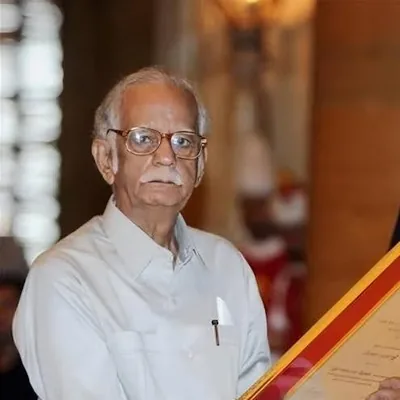
Iravatham Mahadevan — Decipherer of Tamil Brahmi
In 1961, Iravatham Mahadevan was posted to Madras as Deputy Secretary in the Tamil Nadu government's Industries Department — a competent, mid-career IAS officer navigating the administrative world of post-independence India. At a meeting, the historian K.A. Nilakanta Sastri — one of the foremost scholars of South Indian history of the 20th century and author of the magisterial A History of South India — made a casual remark to him about some cave inscriptions in Tamil Nadu that remained puzzling.
The inscriptions were found in natural caverns in the small hillocks of Tamil Nadu — Brahmi-like letters carved into rock faces, different enough from the standard Asokan Brahmi to resist easy reading, yet clearly part of the same script family. Earlier scholars had attempted to read them; the results were inconsistent. Nilakanta Sastri said, in effect: this is an unsolved problem — can you give it a shot?
Mahadevan had studied chemistry and law. He was not a trained epigraphist or linguist. He was an IAS officer with a passion for history and a methodical mind. He took up the challenge — not as a career move but as an intellectual puzzle. What followed over the next five decades was one of the most consequential contributions to Tamil historical scholarship of the 20th century.
Iravatham Mahadevan was born on 2 October 1930 in Manachanallur, near Tiruchirappalli, Tamil Nadu. He completed his schooling in Tiruchirappalli and earned degrees in chemistry and law in Chennai. At 24, in 1954, he joined the Indian Administrative Service — the elite civil service that formed the administrative backbone of post-independence India. He served for 27 years in various roles across Tamil Nadu before voluntarily retiring in 1981 to dedicate himself fully to scholarship.
II. The Cave Inscriptions — What He Found
The Tamil Nadu cave inscriptions are a remarkable body of material. They are found in natural rock shelters — small hillocks with overhanging rock faces, scattered across Tamil Nadu — where Buddhist and Jain monks and traders of the early historic period sheltered and carved their names and dedications. The inscriptions are brief: typically a name, a title, an act of donation. But they are written in a script that is clearly related to Brahmi yet has modifications that suggest it was adapted specifically for Tamil phonology.
The problem that had defeated earlier scholars was precisely this adaptation. Asokan Brahmi — the standardised script of the Mauryan emperor Ashoka's edicts — had been designed for a Prakrit (Indo-Aryan) sound system. Tamil has sounds — retroflex consonants, the Tamil letters ழ (zh), ற (rra), ண (nna) — that do not exist in Prakrit. The cave inscriptions used modified Brahmi forms to represent these sounds. When earlier scholars tried to read the inscriptions as standard Asokan Brahmi, the results were garbled.
Mahadevan's key insight — building on earlier work by K.V. Subrahmanya Aiyar — was to treat the inscriptions as a systematically modified form of Brahmi specifically adapted for Tamil. The modifications were not errors or corruptions; they were a coherent script engineering project, an early example of Tamil culture taking an external script technology and adapting it to its own linguistic needs. He named this adapted script Tamil Brahmi — a name that has since become standard in the scholarly literature.
I was encouraged in my studies because it is part of the Indian tradition that civil servants have passionate hobbies. Many of the greatest scholars of the 19th century had been civil servants. After I reached the age of 50 I felt that I had enough of administrative work. I felt that the remaining years of my life I must devote to the Indus script and the Brahmi script, especially the Tamil Brahmi script.
— Iravatham Mahadevan, in interview with Harappa.com
III. The Names of Kings — What the Stones Said
Once Mahadevan had established the reading principles for Tamil Brahmi, the inscriptions began to yield their contents. And what they contained was extraordinary: the actual names and titles of Tamil kings from the early historic period — the Pandiya and Chera dynasties — preserved in stone, corroborated by the early Tamil literary tradition of the Sangam texts.
This was a pivotal moment in Tamil historical scholarship. The Sangam literature — the body of ancient Tamil poetry collected in anthologies like the Purananuru, Akananuru, and the Ten Idylls — mentions kings, poets, battles and places by name. For most of the 20th century, the relationship between the literary record and the archaeological record was unclear. Were the kings named in the Sangam poems historical figures? Were the places real? Did the events described actually occur?
The Tamil Brahmi inscriptions provided, for the first time, a material bridge between the literary and the archaeological. Mahadevan read the names and titles of several generations of Pandiya and Chera kings — and these names matched those found in the Sangam literary corpus. The kings mentioned in poems composed over two thousand years ago were not mythological or legendary figures. They were historical kings who left their names in stone. The oldest surviving Tamil words were the names of real people who lived in a real civilisation.
What Tamil Brahmi Proved About Tamil Civilisation
The significance of Mahadevan's Tamil Brahmi work goes beyond the inscriptions themselves. It established several fundamental facts about Tamil civilisation's timeline:
Literacy in Tamil was ancient. The Tamil Brahmi inscriptions date to as early as the 3rd century BCE — placing literate Tamil culture in a time contemporary with the Mauryan empire of Ashoka. Tamil was not a "late" literary tradition that developed under Sanskrit influence; it had its own written culture from the beginning of the literate period in South Asia.
Tamil adapted script independently. The systematic modification of Brahmi for Tamil phonology demonstrates a sophisticated metalinguistic awareness — Tamil speakers understood the sound system of their language well enough to engineer a script for it. This is not the work of borrowers but of innovators.
Continuity with the literary tradition. The names of kings in stone matched the names in the poems. Literature and history were not separate — they described the same world. Tamil civilisation was exactly as old, and as historically grounded, as its literary tradition claimed.
IV. The Indus Script — Fifty Years on the Hardest Problem
Alongside his Tamil Brahmi work, Mahadevan devoted the second major chapter of his scholarly life to the Indus Valley Civilisation script — the writing system of the great Bronze Age civilisation that flourished in the Indus valley and surrounding regions from roughly 3300 to 1300 BCE. The Indus script has approximately 400 distinct signs and appears on thousands of seals, pottery sherds, and small objects found across a vast geographic area. It has never been deciphered.
In 1977, Mahadevan published The Indus Script: Texts, Concordance and Tables — the only openly available comprehensive corpus of the Indus Script. Before this publication, scholars who wanted to work on the Indus Script had to piece together the available material from scattered sources. Mahadevan's corpus — which collected, organised and indexed 3,700 inscribed objects, recording 417 distinct signs — gave the entire scholarly community a shared working dataset. It remains the standard reference for the field nearly fifty years after its publication.
His argument was that the Indus Script was written in a Dravidian language — specifically an early form of the Dravidian language family that includes Tamil. He built this case through historical linguistics: examining the Dravidian substratum in Vedic Sanskrit, identifying loanwords that suggested contact between Dravidian speakers and the Indo-Aryan tradition, and developing statistical analyses of sign frequency and distribution that he argued were consistent with a Dravidian agglutinative language structure.
The Dravidian hypothesis for the Indus Script remains debated — and Mahadevan himself was admirably honest about the limits of his own achievement. In a remarkable late-career interview with Harappa.com, he stated directly: "I realize that I have not deciphered the Indus script and if I may say so, it is extremely unlikely that I may do so in the remaining years of my life." This intellectual honesty — the willingness to clearly distinguish between what is known and what is hypothesised — was characteristic of his entire scholarly career and is part of what earned him the respect of the international academic community.
Gregory Possehl, one of the world's foremost authorities on the Indus Valley Civilisation, described Mahadevan as "a careful, methodical worker, taking care to spell out his assumptions and methods" — the highest compliment one archaeologist can pay another.
V. The IAS Tradition — Civil Servants as Scholars
Mahadevan was explicit in his own self-understanding about the tradition he belonged to. When asked about his choice to pursue serious scholarship as a civil servant, he invoked what he called "the Indian tradition that civil servants have passionate hobbies" — and pointed to the 19th-century officers of the British colonial administration who had produced some of the most important early scholarship on Indian archaeology, epigraphy, natural history and linguistics.
This tradition is a real and significant one. The first printed edition of the Thirukkural was produced in 1812 by Francis Whyte Ellis — a Collector in the Madras Presidency. The Sangam literary corpus was largely recovered in the 19th century by U.V. Swaminatha Iyer — a Tamil pandit working with palm-leaf manuscripts that had survived in traditional scholarly households. The Archaeological Survey of India, founded in 1861 by Alexander Cunningham, was a government institution that produced the foundational documentation of Indian archaeological sites.
Mahadevan stands in this tradition but also transforms it: he is the Indian civil servant as scholar — not the colonial administrator documenting a subject culture, but a Tamil speaker reading the oldest surviving words of his own language in the stones of his own landscape. The personal stake was different, and it gave the work a different quality of urgency.
He served as Director of Handlooms and Textiles from 1962 to 1966, continuing his epigraphic research alongside his administrative duties. He published his first monograph on Tamil Brahmi inscriptions while still in service. After retiring voluntarily in 1981, he briefly served as editor of the Tamil daily Dinamani from 1987 to 1988 — an episode that reflects his breadth of engagement with Tamil public culture — before focusing entirely on his scholarly work.
VI. The Major Works — An Enduring Scholarly Legacy
The first systematic corpus of Tamil Brahmi cave inscriptions. Presented at the first International Tamil Conference, Kuala Lumpur. Established the field.
The only openly available comprehensive corpus of the Indus Script. 3,700 inscribed objects, 417 distinct signs. The standard reference for the field worldwide.
The definitive academic treatment of Tamil Brahmi. Published by Harvard Oriental Series and the Cre-A Foundation, Chennai. Over 800 pages with illustrations, letter charts and glossaries.
Over forty scholarly papers arguing for the Dravidian hypothesis of the Indus Script, examining the connections between the Indus civilisation, Vedic culture and the Tamil linguistic tradition.
VII. The Keeladi Connection — His Intellectual Legacy in Stone
Mahadevan died on 26 November 2018 — just as the Keeladi excavations in Sivaganga district, Tamil Nadu were beginning to generate their most exciting results. The potsherds from Keeladi bearing Tamil Brahmi inscriptions — one of the most electrifying finds of the excavation — were read using precisely the framework that Mahadevan had spent decades building. The Tamil Brahmi script that he had named, systematised and documented was the key that unlocked the Keeladi writings.
Keeladi confirmed several things that Mahadevan had argued from epigraphic evidence alone: that Tamil urban civilisation was ancient, that literacy in Tamil was present by at least the 6th century BCE (possibly earlier), and that the material culture of early Tamil Nadu was sophisticated and connected to wider networks of trade and culture. He did not live to see the full implications of the Keeladi findings — but the Keeladi findings could not be read without his work.
The Bridge Between Keeladi and the Sangam Poems
Mahadevan's greatest achievement was to build the scholarly bridge between three bodies of evidence that had previously been treated as separate: the Sangam literary tradition (Tamil poetry dating to at least the early centuries BCE), the Tamil Brahmi cave inscriptions (physical records in stone from the same period), and the Keeladi material culture (urban life, craft production, literacy evidenced in potsherds).
By reading king's names in the cave inscriptions that matched names in the Sangam poems, he demonstrated that the literary and the epigraphic records described the same world. By establishing the reading framework for Tamil Brahmi, he made it possible to read the Keeladi potsherds. The three bodies of evidence together — literary, epigraphic, archaeological — constitute proof of an urban, literate Tamil civilisation existing at least 2,500 years ago. None of this would have been possible without Mahadevan's fifty years of patient, methodical work.
VIII. The Honours — Recognition at the End of a Long Road
For much of his career, Mahadevan worked in relative obscurity by the standards of popular recognition — his work was known and respected in the international scholarly community but had not penetrated public consciousness in the way that more dramatic archaeological discoveries sometimes do.
Late in his life, the recognition came. He received the Padma Shri in 2009 — India's fourth-highest civilian honour — for his contributions to Tamil art and literature through epigraphic research. He was awarded the Jawaharlal Nehru Fellowship in 1970 for his Indus Script research — an early recognition of the significance of the 1977 corpus work. The National Fellowship of the Indian Council of Historical Research followed in 1992 for his Tamil Brahmi work. Honorary doctorates came from Tamil University, Thanjavur (2009) and Dravidian University (2015). He received the Tolkappiyar Award for lifetime achievement in Tamil scholarship.
These recognitions came late but they came fully deserved. He had spent nearly six decades reading stones that had been silent for two thousand years and making them speak again.
IX. The Intellectual Honesty — His Greatest Quality
The quality that distinguishes Mahadevan from many scholars of ancient scripts is intellectual honesty of a high order. The Indus Script is the most contested and hypothesised undeciphered script in the world — every few years, a new "decipherment" is announced, typically by someone with an ideological agenda (to prove it was Sanskrit, to prove it was Tamil, to prove it was something else). These decipherments invariably unravel under scrutiny.
Mahadevan had his own hypothesis — the Dravidian hypothesis, which he developed over decades with careful methodology. But he was always clear about what it was: a hypothesis, supported by evidence but not yet proven, subject to revision as new evidence emerged. In a field where overconfidence is the norm, his calibrated uncertainty was itself a contribution to scholarship.
His frank statement in his late-career interview — that he had not deciphered the Indus Script and probably would not — stands as a model of scholarly integrity. It did not diminish the significance of his contribution. The only openly available corpus of the Indus Script, a systematic framework for reading Tamil Brahmi, and the demonstration that early Tamil kings are named in stone — these are permanent contributions to human knowledge, regardless of whether the Indus Script is ever fully deciphered.
Keeladi — The Excavation His Work Made Readable
The Tamil Brahmi potsherds from Keeladi were read using Mahadevan's framework. Read the Keeladi article →
Tamil Brahmi — The Script He Named and Systematised
The full story of Tamil Brahmi — from its discovery to its significance for Tamil civilisation's antiquity. Read the Tamil Brahmi article →
Thiruvalluvar — The Voice He Helped Restore to Its Historical Context
Mahadevan's work on Tamil Brahmi established that Tamil literacy predates Thiruvalluvar by centuries — giving the Thirukkural a deeper historical root. Read the Thiruvalluvar article →
Further Reading
The Indus Script: Texts, Concordance and Tables (1977) — Mahadevan's magnum opus. Still the standard corpus for Indus Script study worldwide.
Early Tamil Epigraphy: From the Earliest Times to the Sixth Century AD (2003) — Published by Harvard Oriental Series. The definitive academic treatment of Tamil Brahmi.
The Complete Interview — Harappa.com: The most extensive published interview with Mahadevan, covering both his Tamil Brahmi and Indus Script work. Available at harappa.com
The Harappa.com Expert Profile: harappa.com/experts/iravatham-mahadevan