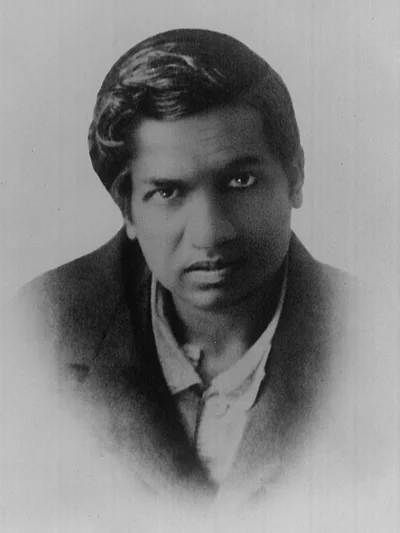
Srinivasa Ramanujan — Mathematical Genius of Kumbakonam
On 16 January 1913, a letter arrived on the desk of G.H. Hardy, the most eminent pure mathematician in England, from an unknown clerk in the Accounts Department of the Madras Port Trust. The letter contained nine pages of mathematical theorems. Hardy and his colleague J.E. Littlewood spent several hours studying them. Their conclusion: the writer was either a fraud of extraordinary ingenuity, or a mathematical genius of the first rank. He was not a fraud.
Srinivasa Ramanujan Iyengar was born on 22 December 1887 in Erode, Tamil Nadu, to a Brahmin family of modest means. He grew up in Kumbakonam, where his father was a clerk in a cloth merchant's shop. By the age of twelve he had mastered all the mathematics available in his local library. By the time he wrote to Hardy, he had been producing original mathematical results for over a decade — without any formal training, without any academic position, largely without any audience who could evaluate what he was doing.
I. The Notebooks — Mathematics Without a Teacher
Ramanujan's mathematical education effectively ended when he failed his college examinations — not in mathematics, where he was extraordinary, but in English and other subjects that his examination-focused school required. He lost his scholarship and was unable to complete his degree. He spent years in poverty, doing mathematical work in spare notebooks, supporting himself with occasional tutoring and, eventually, the Port Trust clerkship.
The notebooks he kept during this period contain thousands of results — formulas for infinite series, identities for elliptic integrals, properties of prime numbers, approximations for pi, and much more — most without proof, written in a compressed notation that reflected a mind working faster than it could document. When Hardy eventually examined the notebooks, he estimated that a significant proportion of the results were not merely correct but new to Western mathematics.
I had never seen anything in the least like them before. A single look at them is enough to show that they could only be written down by a mathematician of the highest class.
— G.H. Hardy, on first reading Ramanujan's letter
II. Cambridge — Five Years That Changed Mathematics
Hardy arranged for Ramanujan to come to Cambridge in 1914. The five years he spent there, despite serious illness and the cultural dislocation of an orthodox Tamil Brahmin Vaishnavite living through English winters during World War One, produced an outpouring of collaborative work between Ramanujan and Hardy that remains one of the great partnerships in the history of science.
In 1918, he was elected a Fellow of the Royal Society — among the youngest ever, and the second Indian to receive that honour. He was also elected a Fellow of Trinity College Cambridge. These honours were unprecedented for an Indian without a formal degree.
The Goddess and the Mathematics
Ramanujan attributed his mathematical insights to the goddess Namagiri of Namakkal — a form of Lakshmi, his family deity. He described receiving formulas in dreams, where the goddess would write equations on his tongue. Hardy, a committed atheist, found this charming and irrelevant. Mathematicians have found it instructive: Ramanujan's methods often bypassed the intermediate steps of proof entirely, arriving at results by intuition that later required decades of work to verify rigorously. Whether or not this was divine, it was certainly extraordinary.
III. The Illness and Return
Ramanujan contracted tuberculosis in England — possibly aggravated by the difficulty of maintaining his strict vegetarian diet during wartime rationing, and by the relentless cold of Cambridge. He returned to India in 1919 in deteriorating health. He died on 26 April 1920 in Kumbakonam, aged 32.
The results he left behind in his notebooks continue to be worked on by mathematicians. In 1976, a further notebook — known as the "Lost Notebook" — was discovered in the Trinity College library. It contained over 600 additional formulas. Mathematicians are still publishing papers verifying and extending Ramanujan's results more than a century after his death.
IV. The Tamil Heritage
Ramanujan's story is inseparable from Tamil Nadu. Kumbakonam — the town where he grew up, where the family deity Namagiri resides in Namakkal, where he returned to die — is one of the most important temple towns of the Tamil cultural heartland. His mathematical genius emerged from within the Tamil Brahmin tradition: its rigorous intellectual culture, its Vedic emphasis on number and pattern, its comfort with abstraction.
Today Ramanujan is celebrated with a national holiday in India on his birthday — 22 December is National Mathematics Day. His home in Kumbakonam is preserved as a museum. The Ramanujan Institute for Advanced Study in Mathematics is located at the University of Madras. And in Cambridge, the Hardy-Ramanujan collaboration remains a model of what happens when extraordinary talent, wherever it originates, finds the conditions it needs to flourish.
Explore Tamil Heritage
Discover more profiles in our living archive of Tamil civilisation. Browse Heritage Blogs →