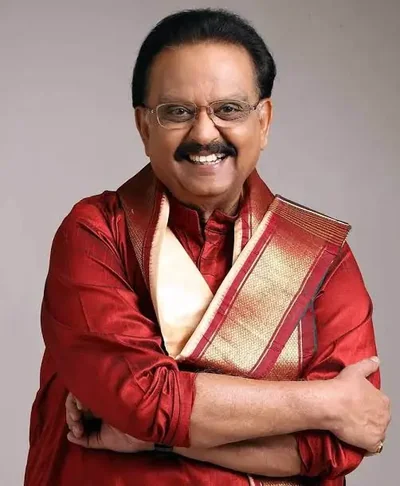
S.P. Balasubrahmanyam — Voice of Tamil Cinema
He was supposed to become an engineer. His father S.P. Sambamurthy — a respected Harikatha exponent in Nellore — wanted a secure future for his son. The boy enrolled in engineering. Then typhus intervened, he left college, and a singing competition in Madras in 1964 changed everything. Sripathi Panditaradhyula Balasubrahmanyam, known universally as SPB or Balu, would go on to record more songs than any human being in documented history.
The Guinness World Record. Six National Film Awards. The Padma Vibhushan. The voice of Rajinikanth in Tamil. The voice of Salman Khan in Hindi. The singing partner of Ilaiyaraaja for two decades and A.R. Rahman for another. In a career spanning 54 years, SPB did not merely participate in South Indian film music — he was its defining sound.
I. The Beginning — One Competition, One Mentor
Born on 4 June 1946 in Konetampeta near Nellore in a musically devout Telugu Brahmin family, Balasubrahmanyam grew up in an environment saturated with Carnatic music and Harikatha. His father performed regularly; his sister S.P. Sailaja would also become a singer. Music was not a hobby in this household — it was the family's relationship with the divine.
Despite having no formal training, the young Balu taught himself harmonium and flute by listening. He participated in competitions throughout his college years. At the 1964 Madras competition organised by a Telugu cultural organisation, he won first place. The music director S.P. Kodandapani, who was in the audience, effectively adopted him as a protégé on the spot.
His first song was recorded on 15 December 1966 for the Telugu film Sri Sri Sri Maryada Ramanna, composed by Kodandapani. His first Tamil hit — Ayiram Nilave Vaa from Adimai Penn — came shortly after, sung for the legendary M.G. Ramachandran. There would be no looking back.
II. The Ilaiyaraaja Partnership — A Musical Revolution
Before either of them was famous, S.P. Balasubrahmanyam and Ilaiyaraaja performed together in a light music troupe that travelled South India. Ilaiyaraaja played guitar, then harmonium. Gangai Amaran played guitar. Anirudha played harmonium. They were young men earning a living through music, with no indication that they were about to change Tamil cinema forever.
When Ilaiyaraaja's career as a film composer took off in the late 1970s, SPB became his primary voice. The partnership produced some of the most celebrated Tamil film music ever recorded — Sundari Kannal Oru Seidhi, Maankuyile Poonkuyile, Ilaya Nila, and hundreds more. Their collaboration on Telugu films including Saagara Sangamam (1983) and Rudraveena (1988) won both men National Awards.
SPB's voice is one of the main reasons for my success.
— Chiranjeevi, South Indian actor
III. The Record — 28 Songs in One Day
On 8 February 1981, S.P. Balasubrahmanyam set a recording that stands to this day. In a single day in Bangalore, he recorded 28 songs in Kannada. In that same period, he had also recorded 19 songs in Tamil in one day, and 16 in Hindi in one day — records that demonstrate not just his voice but his extraordinary ability to absorb, prepare and deliver.
He reportedly needed only twenty minutes on average to learn a new tune. He refused to record songs line-by-line — the modern studio practice of assembling a vocal performance in fragments. SPB insisted on recording songs in one complete take, as a musician would, maintaining the continuity of breath and feeling across the full composition.
The Voice Across Languages
SPB sang in Telugu, Tamil, Kannada, Malayalam, Hindi, and eleven other languages. He dubbed for Kamal Haasan in Tamil — so convincingly that audiences sometimes could not distinguish actor from singer. He dubbed for Rajinikanth. He became Salman Khan's voice in Hindi for a decade, from Maine Pyar Kiya through Hum Aapke Hain Kaun and beyond. No other South Indian singer has penetrated Bollywood so completely.
IV. The Rahman Chapter — Tamil Music Enters a New Era
When A.R. Rahman emerged as a composer in the early 1990s, he brought an entirely new sonic landscape to Tamil film music — synthesisers, world music textures, studio production of a kind Tamil cinema had never heard. SPB navigated this transition with characteristic ease. Kadhal Rojave from Roja (1992), Thanga Thamarai Magale — these songs demonstrated that the voice which had defined Ilaiyaraaja's era could equally define Rahman's.
V. Honours and the Final Year
The Government of India awarded him the Padma Shri in 2001 and the Padma Bhushan in 2011. He was honoured as Indian Film Personality of the Year at the 47th International Film Festival of India in 2016. After his death from COVID-19 complications on 25 September 2020, the Padma Vibhushan — India's second highest civilian honour — was conferred posthumously in 2021.
His final public recording, made in May 2020 as COVID-19 swept the world, was a song titled Bharath Bhoomi — a tribute to doctors, nurses, police and essential workers, composed by Ilaiyaraaja. The two old collaborators, one in his seventies and one in his late sixties, closing a circle that had opened in a light music troupe fifty years earlier.
He died on 25 September 2020 at MGM Healthcare, Chennai, where he had been admitted for COVID-19 complications in August. He was 74. The Tamil film industry held virtual prayer services. Candlelight vigils were held outside the hospital. When the news came, it felt to much of Tamil Nadu like the loss of a family member — because his voice had been present in the home for fifty years.
Explore Tamil Heritage
Discover more profiles in our living archive of Tamil civilisation. Browse Heritage Blogs →