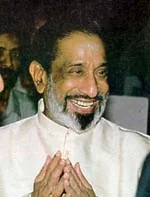
Sivaji Ganesan — Nadigar Thilakam
His birth name was Villupuram Chinnaiahpillai Gnanadesikan. He was born in 1928 in Villupuram to a family that had no connection to cinema or theatre. By the time he died in 2001, he had made over 300 films, been honoured at the Cannes Film Festival as the first Indian actor recognised on that stage, received the Padma Vibhushan from the Government of India, and been given a title — Nadigar Thilakam, Jewel Among Actors — that the Tamil public conferred on him spontaneously and that no one has claimed since.
I. The Stage Before the Screen
Sivaji Ganesan's entry into public life came not through cinema but through theatre. He joined a drama company as a teenager and performed in plays celebrating the Maratha king Shivaji — from whom he took his stage name. His theatrical training gave him the foundation for what would become his most distinctive quality as a film actor: an absolute command of emotional range and physical expression, disciplined by stage technique.
His film debut came in 1952 with Parasakthi, directed by Krishnan-Panju and written by M. Karunanidhi. The film was a landmark in Tamil cinema — socially and politically charged, with a screenplay that attacked caste discrimination and religious hypocrisy. Sivaji's performance announced the arrival of a new kind of Tamil actor.
II. The Cannes Recognition
In 1960, Sivaji Ganesan attended the Cannes Film Festival where he was honoured for his performance in Veerapandiya Kattabomman (1959) — a historical film about the Polygar chieftain who resisted British colonial authority. He became the first Indian actor to be recognised at Cannes. The honour was noted in India but perhaps not celebrated with the significance it deserved — in part because Tamil cinema, despite its enormous domestic audience, was not yet visible to the national cultural establishment in the way it should have been.
I have seen many actors in my career, but none with the emotional depth and range of Sivaji Ganesan.
— Widely attributed to Akira Kurosawa on his India visit
III. The Range — Comedy, Tragedy, Devotion, History
What distinguished Sivaji Ganesan from every other Tamil actor of his era was his refusal to specialise. He played tragic heroes, comic characters, historical figures, mythological roles, social reformers, villains and saints with equal conviction. His performances in devotional films like Thiruvarutchelvar, historical epics like Karna, social dramas like Parasakthi, and comedies demonstrated a range that remains unmatched in Tamil cinema.
The Sivaji-MGR Rivalry
Tamil cinema in the 1950s and 60s was defined by the creative tension between two giants: Sivaji Ganesan and M.G. Ramachandran (MGR). MGR represented the heroic ideal — the action hero, the man of the people, physically commanding and ideologically simple. Sivaji represented the actor's ideal — psychological complexity, emotional nuance, technical mastery. Both were necessary. Tamil cinema was large enough for both. The rivalry between their fan bases generated an energy that drove the entire industry.
IV. The Legacy
Sivaji Ganesan received the Padma Vibhushan — India's second highest civilian honour — in recognition of his lifetime contribution to Indian cinema. He died on 21 July 2001 in Chennai. His son Prabhu and grandson Vikram have continued in Tamil cinema, but the title Nadigar Thilakam has not passed to any subsequent actor. It remains his alone — an acknowledgement that what he brought to Tamil cinema was not merely talent or charisma but a standard of craft that continues to define what the best Tamil acting can aspire to.
Explore Tamil Heritage
Discover more profiles in our living archive of Tamil civilisation. Browse Heritage Blogs →