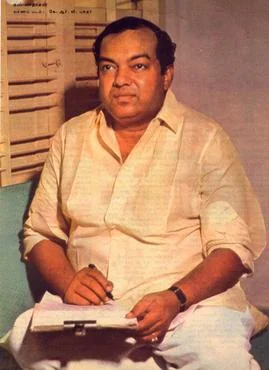
Kannadasan — Kaviarasu, King of Tamil Poets
His birth name was Muthiah. He was the eighth child in a Chettinad family, given away in adoption as was customary, raised by foster parents in Sirukoodalpatti. He dropped out of school at the eighth grade. He had no formal literary training. By the time he died in 1981 in Chicago — at a Tamil conference, where else — he had written more Tamil poetry than any modern figure since the medieval era.
Kannadasan — the name he chose for himself, meaning servant of Lord Krishna — was at various points in his life an atheist, a Dravidian activist, a DMK founder-member, a jail inmate, a novelist, a film producer, a politician, a journalist, and the Poet Laureate of Tamil Nadu. What held all these incarnations together was an extraordinary command of the Tamil language and a philosophical depth that his film songs carried to millions who would never read a literary journal.
I. The Eighth Child
Muthiah was born on 24 June 1927 in Sirukoodalpatti, a small village near Karaikudi in the Sivaganga district of Tamil Nadu. He was the eighth of ten children born to Sathappan Chettiar and Visalakshi Aachi. Following the established Chettinad practice, he was given at an early age to a childless couple — Palaniappa Chettiar and Chigappi Aachi — who renamed him Narayanan.
He completed his primary education at Sirukoodalpatti and studied up to the eighth grade at Amaravathiputhur High School before circumstances ended his formal education. But Narayanan read voraciously — Tamil classics, political pamphlets, film magazines, anything he could find. The Tamil language was his inheritance and his education simultaneously.
It was while travelling in search of work that he renamed himself. He knew the story of Lord Krishna, eighth child of Vasudeva and Devaki, born to transform the world. He was also the eighth child. He became Kannadasan — the servant of Kannan.
II. The Dravidian Years — Politics Before Poetry
In 1949, the young Kannadasan joined the Dravida Munnetra Kazhagam under the influence of C.N. Annadurai. He became a committed atheist, a passionate advocate of the Dravidian movement's anti-Brahmin, anti-Hindi politics, and an active participant in the agitations of the 1950s. He was jailed during the Kallakkudi protests.
It was in prison that he completed his first major literary work — the short epic Maankani. Prison, as for many Tamil writers, was not an obstacle to creativity but a concentrated literary environment. He interacted with ordinary criminals, listened to their stories, absorbed their Tamil. His later writing would carry the texture of those encounters.
When suffering people come together, they become friends. When greedy people come together, they become enemies. Goalless and unplanned life will not take us anywhere.
— Kannadasan, Vanavasam (autobiography)
He contested the 1957 Thirukoshtiyur assembly election and lost. On 9 April 1961, after more than a decade of political involvement, he resigned from the DMK. The political life had run its course. The poetic life was about to deepen beyond all recognition.
III. The Transformation — Andal and the Return to God
The turning point in Kannadasan's life came when he read the Thiruppavai of Andal — the 12th-century Vaishnava poetess from Srivilliputtur whose thirty verses to Lord Vishnu are among the most sublime compositions in the Tamil language. He was, by his own account, struck by the mystical power of her poetry in a way that no political tract or rationalist argument could match.
Andal's Influence on Kannadasan
The connection between Kannadasan and Andal is one of the quietly important stories in modern Tamil literary history. Andal's Thiruppavai — composed in Srivilliputtur, now central to the mission of the Aandaal Project — moved Kannadasan from atheism back to devotion not through argument but through pure poetic beauty. It is the power of language itself that converted him.
He went on to write Arthamulla Indhu Matham (Meaningful Hindu Religion) in ten volumes — perhaps the most widely-read modern Tamil exposition of Hinduism, composed with the same clarity and poetic compression that defined his film lyrics.
He also wrote Yesu Kaviyam — a long poem on the life of Jesus Christ — and engaged deeply with the Quran, concluding that all religious paths converged on the same divine source. This was not syncretism as a political position but as a poet's intuition: that the transcendent speaks in every language and every tradition.
IV. The Lyricist — 5,000 Songs and the Philosophy in Every Verse
Kannadasan's entry into Tamil film lyrics came in 1949 with the film Kanniyin Kaadhali. He had already begun writing poems, but the film industry provided him with both an income and an audience of millions. He quickly became the dominant figure in Tamil cinema lyrics — a position he held without serious challenge until his death thirty-two years later.
What distinguished Kannadasan's film songs from those of his contemporaries was philosophical density compressed into singable Tamil. He did not write about love and separation as surface events — he wrote about them as expressions of larger metaphysical truths. A song about a river was also a song about time. A song about a mother was also a song about devotion. His listeners absorbed Vedantic ideas, Saiva philosophy, and classical Tamil aesthetics through the medium of cinema.
Notable Works
Among his most celebrated lyrics: Paasam (devotion), Paasavalai (the net of attachment), songs from Pasamalar, Moondram Pirai, Thiruvilaiyaadal and hundreds of others. His collaboration with composers including G. Ramanathan, Viswanathan-Ramamoorthy, M.S. Viswanathan, and later Ilaiyaraaja produced some of the most enduring works of Tamil musical culture.
V. The Writer — 232 Books
Beyond film lyrics, Kannadasan was a prolific author. His four-part autobiography — Vanavasam, Manavasam, Enathu Vasantha Kaalangal, and Enathu Suyasaritham — constitute one of the most candid self-portraits in Tamil literary history. His novel Cheraman Kathali won the Sahitya Akademi Award in 1980, the year before his death.
The ten-volume Arthamulla Indhu Matham remains a landmark in popular Tamil religious writing — accessible, philosophically serious, and written in the same compressed prose style that made his film lyrics memorable. The Jagadguru Shankaracharya of Kanchi contributed an introduction to the work.
VI. Death in Chicago
Kannadasan died on 17 October 1981 in Chicago, where he had travelled to attend a Tamil conference organised by the Tamil Association of Chicago. He was 54. The cause of death was not disclosed at the family's request. He was at the height of his reputation — Poet Laureate of Tamil Nadu, Sahitya Akademi laureate, and still actively writing — when he died.
The Tamil Nadu government built a memorial and library in his hometown of Karaikudi. His recordings of Arthamulla Indhu Matham in his own voice remain in circulation. His film songs are still heard daily across Tamil Nadu and the Tamil diaspora, sixty years after they were first recorded.
Honour Tamil Heritage on the Guru Support Network
The Aandaal Project preserves and celebrates Tamil literary and cultural heritage. Visit the Guru Support Network →
Explore Tamil Heritage
Discover more profiles in our living archive of Tamil civilisation. Browse Heritage Blogs →