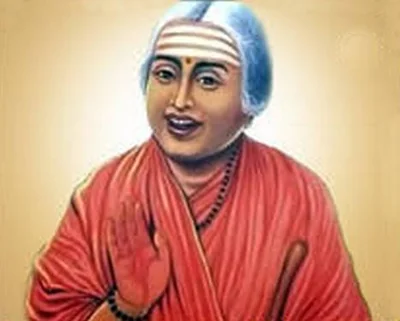
Avvaiyar — Ancient Tamil Poetess of Wisdom
She is, in a sense, the first teacher of every Tamil child. Before a Tamil-speaking child learns to read literature, before they encounter the Thirukkural or the Ramayana or the Purananuru, they learn the Aathichudi: 108 one-line maxims arranged in alphabetical order, one for each letter of the Tamil alphabet, beginning with Aram seya virum bu — "Desire to do good." Simple enough for a four-year-old to memorise. Profound enough to spend a lifetime understanding.
Avvaiyar — the name means "respected elderly woman" in Tamil, and was given to several different poets across different centuries of Tamil history. The Avvaiyar of the Sangam age (roughly 1st–3rd century CE) was a court poet who moved between the kingdoms of the Chera, Chola and Pandya kings, known for her sharp wit, her ability to speak truth to power, and her deep devotion to Murugan, the Tamil god of war and wisdom. The Avvaiyar of the medieval period (roughly 9th–12th century) is the author of the wisdom literature that Tamil schoolchildren still learn — the Aathichudi, Konraivendan, Moodhurai and Nalvazhi.
I. The Sangam Poetess — Truth-Teller to Kings
The earliest Avvaiyar appears in the Sangam literature — the body of classical Tamil poetry dating from the early centuries of the Common Era, produced at the courts of the three great Tamil kingdoms. She was not a court poet in the conventional sense — not a flatterer, not a panegyrist. She was a poet who told kings what they needed to hear, even when it was uncomfortable.
The stories that surround her — most of them legendary, some of them possibly rooted in historical incident — portray a woman of formidable intelligence, spiritual authority, and complete freedom from social convention. She was old, or chose to appear old, to exempt herself from the social expectations placed on women. She travelled freely. She dined with saints and debated with kings. She was the only person in the Tamil tradition whose authority was recognised across all social boundaries.
What has been learned is a handful of earth. What remains to be learned is the size of the world.
— Avvaiyar, Purananuru
II. The Legend of Murugan and the Naaval Fruit
Among the most beloved stories associated with Avvaiyar is her encounter with Murugan, the Tamil god of war and wisdom who is also the patron deity of the Tamil language itself. In the story, the young god appears to her in human form, sitting in a naaval (jamun) tree. He asks her if she wants a hot fruit or a cold fruit. She asks for a cold one. He tosses her a warm fruit. As she blows on it to cool it, Murugan laughs and says she is learning — clearing the dust of ignorance before consuming knowledge.
The story is compressed and precise in the way of the best Tamil wisdom literature: knowledge must be prepared before it can be absorbed; wisdom that comes too easily, without effort or humility, is not truly digested. Avvaiyar, in this encounter, is not merely learning a lesson — she is recognising her teacher.
The Aathichudi — Compressed Wisdom
The 108 maxims of the Aathichudi cover the full range of human life: ethics, social conduct, the treatment of guests, the management of anger, the value of learning, the importance of gratitude, the dangers of pride. They are written in the simplest possible Tamil — one or two words per line, packed into units that a child can remember and an adult can spend years unpacking.
Beginning with Aram seya virum bu (Desire to do good) and ending with Aakaaththu amara neer vanthu theerkum (Sky-falling rain fills the earth), the Aathichudi is both a primer in the Tamil alphabet and an introduction to the Tamil ethical universe. No other text in the Tamil tradition has been more continuously taught.
III. The Wisdom Texts — Moodhurai and Nalvazhi
The medieval Avvaiyar's other major works include Konraivendan, addressed to the god Murugan at Tiruvannamalai; Moodhurai — "old sayings" — a collection of proverbial wisdom in verse; and Nalvazhi — the good path — ethical instructions in quatrain form. Together these texts constitute a curriculum of practical wisdom that the Tamil tradition has valued as highly as any philosophical treatise.
IV. Why Avvaiyar Matters Today
In an age of information overload, Avvaiyar's method remains radical: compression, not expansion. She did not write long treatises. She wrote two-line couplets that could be carried in memory and deployed in life. The Aathichudi asks a child not merely to read wisdom but to internalise it — to let Aram seya virum bu become not a sentence but a habit of mind.
She is also Tamil Nadu's most important female voice from the classical tradition — a counterweight to the assumption that the Tamil literary heritage belongs primarily to men. In her stories, she argues with gods, corrects kings, and moves through the world on her own terms. For Tamil girls learning the Aathichudi in school today, there is an inheritance there that goes beyond the text itself.
Explore Tamil Heritage
Discover more profiles in our living archive of Tamil civilisation. Browse Heritage Blogs →