I. The Unlikely Starting Point
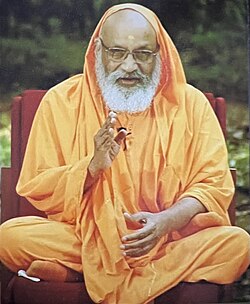
Pujya Swami Dayananda Saraswati
1930 — 2015
Founder, Arsha Vidya Gurukulam
Manjakkudi is a small village on the Kaveri delta in Thiruvarur district, Tamil Nadu — a quiet place of agricultural land, temple tradition, and the deep Vedic culture that has sustained this part of India for millennia. It was here, on August 15, 1930 — the same day India would later celebrate its independence — that Natarajan was born to Gopala Iyer and Valambal, the eldest of four brothers.
His father died when Natarajan was eight. The responsibility of a family at eight years old has a way of either crushing a person or sharpening something essential in them. In Natarajan's case it sharpened a quality that would define everything that followed: the refusal to allow any external circumstance to determine his inner life. He completed his education, came to Chennai, worked as a journalist for the magazine Dharmika Hindu, briefly considered a career in the Indian Air Force (he was underweight and didn't qualify, but was allowed to remain — he later said he realised quickly that the military was not for him: "There was no freedom, I felt they were trying to control my mind. I have never allowed anybody to ever control me at any time, no one. That is why I think I am a Swami.").
In 1953, a meeting with Swami Chinmayananda changed everything. What passed between them in that encounter was, by Natarajan's own account, the recognition that the question he had been circling all his life — the question of the nature of the self, of knowledge, of what is ultimately real — had a tradition behind it that was both ancient and precise. He entered that tradition and never left.
II. The Critical Shift — Vedanta as Pramana
For several years Natarajan worked within the Chinmaya Mission, teaching, studying, and editing the Mission's magazine Tapovan Prasad. In 1961 Swami Chinmayananda gave him permission to go study with Swami Pranavananda at Gudivada. It was here that a decisive shift occurred — one that would distinguish Swami Dayananda's approach to Vedanta from every other teacher of his generation.
Swami Pranavananda helped him understand that the Upanishads were not merely devotional texts or philosophical poetry but a pramana — a means of knowledge. This distinction is everything. Most approaches to Vedanta treat the Upanishadic statements as pointers toward an experience to be attained through practice, grace, or mystical development. Swami Pranavananda showed that they were statements to be understood — that the Upanishads, when properly taught by a qualified teacher using the right methodology, directly produce the knowledge they are pointing to. The teaching itself is the means. There is no further experience required beyond the understanding that the teaching produces.
This impelled Natarajan to study the Shastras with Shankaracharya's commentaries. In 1962, Swami Chinmayananda gave him Sanyasa and the name Swami Dayananda Saraswati — on Maha Shivaratri. He then spent three years at Kailash Ashram in Rishikesh studying the Brahma Sutras under Swami Tarananda Giri — one of the most demanding texts in the Vedantic canon — going deep into Brahma Sutra and the Sanskrit grammar of Panini. The combination would become the signature of his teaching method: philosophical rigour grounded in Sanskrit precision.
III. Piercy, California — The Most Unlikely Gurukulam on Earth
By the late 1970s, Swami Dayananda had already established himself as the most rigorous systematic Vedanta teacher in India. He had developed and taught two three-year residential courses in Mumbai. And then came an unexpected request: American students who had encountered his teaching wanted a residential program in the United States.
In 1979, at the request of students in the US, Swami Dayananda established a three-year study program at Sandeepany West in Piercy, California. Piercy is a tiny unincorporated community in Mendocino County, Northern California — deep in redwood country, near the Eel River, far from any major city. It was, as you rightly described it, an unlikely location for one of the most demanding traditional Vedanta courses ever taught.
The students were Westerners — many of them with no prior background in Sanskrit, in the Vedic tradition, or in formal philosophical study. Some had been drawn to India in the spiritual ferment of the 1970s. Others were professionals — academics, engineers, psychologists — who had found that the intellectual frameworks of the West left some fundamental question unanswered. They came to Piercy and received exactly what the ancient Vedic students had received in the forest hermitages of India three thousand years before: a traditional, systematic, rigorous three-year curriculum in Vedanta, Sanskrit, and the texts of the tradition.
Among the students who completed this program at Piercy from 1979 to 1982 were several who would go on to carry the tradition to new places. Swami Jnanananda Saraswati (formerly a clinical psychologist), Swamini Agamananda Saraswati (formerly Martha Doherty, who would later complete a Ph.D. in Sanskrit and Indian Studies at Harvard) — Western men and women who emerged from that forest ashram as qualified teachers of Advaita Vedanta. The American Vedanta tradition as it exists today — with dozens of teaching centres across North America — traces its roots to those years in Piercy.
IV. The Advaita Makaranda Discovery — A Seminal Moment
It was in this same setting — an early California retreat in San Luis Obispo — the coastal town on the central California coast — teaching a small group of Western students who had no prior exposure to the Vedantic canon — that Swami Dayananda made one of the most significant contributions to Vedantic scholarship of the 20th century: the effective rediscovery and introduction of Advaita Makaranda to the wider world.
Advaita Makaranda — "The Nectar of Non-duality" — is a Sanskrit text of 20 verses composed by Lakshmidhara Kavi, presenting the vision of Advaita Vedanta with extraordinary economy and precision. The text had existed in the traditional canon but had fallen into relative obscurity. Swami Dayananda recognised its unique qualities — its directness, its philosophical completeness within so few verses, its capacity to present the entire Advaita vision in a form accessible to serious students — and introduced it as a teaching text in the Piercy program.
The YouTube recording linked below captures something of the flavour of this: Swami Dayananda's presentation of Advaita Makaranda to Western students, in which — with the same ease he brought to everything — he moves between Sanskrit precision and English clarity, between the ancient text and the contemporary mind of his audience.
Swami Dayananda — Advaita Makaranda (Piercy, California)
Swami Dayananda's introduction and teaching of Advaita Makaranda — beginning with a preamble on Atma-Anatma Viveka, where Swami defines Anatma as anything that requires a means of knowledge to be known. A rare early California teaching in action, with Western students.
▶ Watch on YouTube ▶ Trimmed Clip — Atma-Anatma Viveka PreambleV. Atma-Anatma Viveka — What Swami Dayananda Proved
Before teaching Advaita Makaranda at Piercy, Swami Dayananda offered what has become perhaps the most intellectually compelling preamble in modern Vedantic teaching: his exposition of Atma-Anatma Viveka — the discrimination between the seer and the seen.
Most presentations of this text focus on the practice of discrimination — learning to distinguish between the observer and what is observed, between consciousness and its contents. Swami Dayananda went further. He took the same analysis and turned it into a complete epistemological proof — one that has a unique quality that distinguishes it from anything else in the literature:
Atma-Anatma Viveka: The Universe Lives Inside the Knower
Swami Dayananda divided all of reality into two categories: what is Anatma (non-Self) (the seen, the known, the object) — and what is Atma (Self) (the seer, the knower, the subject).
The drishya category is vast. It includes everything that can be perceived, thought, felt, inferred, or known through any means of knowledge — the entire universe of objects, from a grain of sand to a galaxy, from a sensation to a philosophical concept. If it requires a means of knowledge — a pramana — to be known, it is Anatma.
The drik — the seer — is what remains when everything that can be objectified has been set aside. It is the knower that can never itself become known as an object, because any act of knowing it immediately turns it into something known, which means the original knower must be further back still. The Atma is the pure subject — irreducible, self-luminous, never objectifiable.
The proof moves like this: the attempt to separate drik from drishya — to locate where the seer ends and the seen begins — turns out to be impossible. Every attempt to draw that line reveals that the drishya (everything you can know) exists within the drik (the knowing consciousness). The universe of objects is not independent of consciousness — it appears in consciousness, is known through consciousness, and has no existence independently of consciousness. The container is not the universe. The universe is in the container. And that container — the pure seer, the drik — is what you are.
This is the Advaita vision. But what makes Swami Dayananda's presentation unique is the direction of the proof: instead of asserting "consciousness is everything" and asking you to accept it, he begins with "here is everything you can know" and then demonstrates that this entire universe of knowable things exists inside what you already are. The move is epistemological rather than metaphysical — and it is, as far as is known, Swami Dayananda's own discovery of how to present this ancient insight in a form that the modern analytical mind can verify for itself.
Whether this precise epistemological formulation appears anywhere in the Upanishads as a structured argument is itself an interesting question — one worth putting to serious Sanskrit scholars. What is certain is that no other modern Vedanta teacher has presented it in precisely this way, with this logical structure and this direction of proof. It is the kind of insight that, once encountered, reorganises everything else you have thought about the subject.
VI. The Methodology That Changed Everything
Swami Dayananda's contribution to Vedanta is not merely philosophical. It is pedagogical — a revolution in how Vedanta is taught. He identified what he called seven sentences that a teacher must be able to handle with precision in order to unfold the Vedantic knowledge: statements about the individual, the world, Ishvara, and their relationships. He developed a teaching methodology — grounded in Panini's Sanskrit grammar and Shankaracharya's commentary tradition — that allowed even students with no prior Sanskrit background to engage directly with the primary texts rather than depending on simplified summaries.
The result was that the ten three-year residential programs he taught — five in India and two in the United States — produced graduates who were not merely knowledgeable about Vedanta but qualified to teach it in the traditional way. Over 250 of his students have been initiated as sannyasis and are now teaching across the world. The phrase used most often about him — "teacher of teachers" — is accurate in the most literal sense: the current generation of Advaita Vedanta teachers alive and working across India, North America, Europe, Australia, and Southeast Asia are, to a very great extent, his students or students of his students.
Swami Paramarthananda
Perhaps the most prolific Vedanta teacher alive today. His recorded classes number in the thousands and have produced a generation of teachers — including Swami Guruparananda and Swami Omkarananda Mahaswamigal.
Swami Tadatmananda
Former computer engineer from Milwaukee. Initiated in 1993 on the banks of the Ganga. Founded Arsha Bodha Center. Described his guru as "one who removes the darkness of ignorance, enabling you to discover the divinity within yourself."
Swami Sadatmananda
Head acharya of the Coimbatore Gurukulam, carrying forward the three-year residential tradition in the Tamil Nadu institution established by Swami Dayananda himself.
Swami Sakshatkrtananda
Current head of the Rishikesh ashram — the place where Swami Dayananda spent some of his most formative years and where he attained Maha Samadhi on the banks of the Ganga in 2015.
Swami Viditatmananda
Head of the Pennsylvania Gurukulam — established 1986, carrying forward the American Vedanta tradition that began in Piercy, California.
Swami Omkarananda Mahaswamigal
Student of Swami Paramarthananda. The scholar who brought both Sanskrit and Tamil Vedic traditions together — whose Maha Samadhi in 2021 at 65 was mourned across Tamil Nadu. Read his tribute →
VII. Voices of His Students
When we speak of Pujya Swamiji's legacy the most obvious thing that comes to mind are his disciples who are teaching in India, in this country and around the world. These are disciples who have been rigorously trained by attending one or more long-term courses Swamiji conducted. Hundreds of students attended these courses and today approximately 250 of them have been initiated as sannyāsīs and sannyāsins. The teachers Swamiji trained will be carrying on this lineage and in particular Pujya Swamiji's approach and style of teaching which is deeply rooted in the scholarship of Shankaracarya.
The role of guru — one who removes the darkness of ignorance, enabling you to discover the divinity within yourself — is explained here through my personal experiences of Swami Dayananda. It is possible to show unconditional love and compassion towards all. It is possible to accommodate everyone irrespective of who the other person is. It is possible to help everyone, known or unknown, unconditionally. It is possible to pay attention to every single person even when one is surrounded by a huge crowd. It is possible to listen to everyone intently even when there are endless people. It is possible to remain relaxed in spite of hectic activity.
Swami Dayananda Saraswati was one of the foremost traditional teachers of Advaita Vedanta in the 20th century. His systematic methodology produced a generation of teachers. He founded Arsha Vidya Gurukulam in Anaikatti and the All India Movement for Seva, impacting millions through his lifelong dedication to Vedanta. The loss of Pujya Swamiji is a loss that cannot be measured in the usual terms — it must be measured in the quality of what he gave, which continues to live wherever his students teach.
I had seen Swami Omkarananda first when he was a resident student with Swami Paramarthanandaji, learning the Vedanta Shastra from a very learned and capable traditional Guru — a Guru in the direct lineage of Pujya Swami Dayananda. It was like the river meeting the ocean. A Great Atman, a Mahatma who tirelessly worked day and night to uplift our Society. Swami Dayananda perpetuated the Guru Parampara as upheld by Acharya Shankara to keep the unique yet universal way of transmitting the Wisdom.
VIII. The Beyond-Teaching Work — AIM for Seva and the Acharya Sabha
Swami Dayananda was not merely a teacher in a classroom. He was one of the most consequential public figures in the Hindu world of the late 20th and early 21st centuries.
In November 2000, he founded the All India Movement (AIM) for Seva — an organisation dedicated to bringing medical, educational, nutritional, and infrastructure assistance to villagers in the remote areas of India. The focus was on value-based education and reaching the children of rural India through a network of Chatralayams (free student hostels) and schools. AIM for Seva now operates hundreds of hostels across the country, providing residential education to children from tribal and rural communities who would otherwise have no access to schooling.
In the same year he convened the Hindu Dharma Acharya Sabha — an apex body of 125 Hindu religious heads representing all twelve major Hindu traditions. For the first time in modern history, the spiritual leaders of traditions that had historically remained separate came together under a single coordinating body. Swami Dayananda represented Hinduism alone among 18 world religious leaders invited by the Dutch Government to sign the Faith in Human Rights Statement. He signed the Hindu-Jewish Accord in 2008, putting to rest centuries of misunderstanding between the two traditions.
He was also, perhaps unexpectedly, a composer. Between 1975 and 1990, during his teaching years at Mumbai, Piercy, and Saylorsburg, he composed the majority of his songs — their notation set by Sangeetha Kalanidhi Maharajpuram Santhanam. Among them is Bho Shambho, composed in the 1980s in raga Revati, which has been adopted as a signature tune by spiritual organisations across the world. Wherever Sanskrit devotional music is performed today, this composition appears. It is, in the truest sense, his Thiruppavai — the gift of a teacher's inner life to the world in musical form.
IX. The Maha Samadhi — September 23, 2015
Swami Dayananda had been in declining health for some weeks in the autumn of 2015. On September 23, he attained Maha Samadhi on the banks of the Ganga at Rishikesh — the same river he had lived beside as a young sannyasi in a grass hut in Purani Jhadi, studying the Brahma Sutras. He was 85 years old.
His last rites were performed in the traditional manner of a renunciate — buried in bhu samadhi to the loud chanting of Vedic hymns. Many dignitaries, Hindu leaders, and his students were present. Prime Minister Narendra Modi — himself one of his students — expressed his condolences. The Padma Bhushan, India's third-highest civilian honour, was awarded to him posthumously in 2016.
At his Rishikesh ashram, his Adhisthanam remains a place of teaching and pilgrimage. The Gurukulams in Saylorsburg, Anaikatti, and Nagpur continue their three-year courses. The sixty-plus centres across the world continue their weekly classes. The 250 sannyasi disciples continue to teach. The Advaita Makaranda classes at vedantahub.org include 33 recordings of Swami Dayananda's own teaching of the text. The Atma-Anatma Viveka talks are there too — for anyone who wishes to encounter the epistemological proof that the universe lives inside the knower.
X. The Tamil Roots — What Tamil Civilisation Gave the World
It is worth pausing to note what Swami Dayananda represents for Tamil civilisation specifically. Born in Manjakkudi on the Kaveri delta — in the same Tamil Nadu that gave the world the Thirukkural, the Thiruppavai, the Bhagavad Gita commentary tradition through Ramanuja and Madhva, and the great temple architecture of the Chola and Pallava periods — he became the teacher who carried the most ancient philosophical tradition of India to every continent.
His students in California were taught by a man whose formation was rooted in the Tamil Brahmin tradition of the Kaveri delta, who had studied in Rishikesh but whose deepest intellectual formation was in the Vedic environment of Tamil Nadu. The West's understanding of Advaita Vedanta — as it exists today in hundreds of teaching centres from New Jersey to London to Melbourne — flows from that Tamil source.
The Aandaal Project honours Swami Dayananda Saraswati both as a world teacher and as a son of Tamil civilisation — one of the most consequential figures the Tamil world has produced in the modern era.
From a Student at a Distance
I have never met Swami Dayananda in person. Like millions of others, I have come to him entirely through recordings — and in particular through his Atma-Anatma Viveka preamble to the Advaita Makaranda teaching at Piercy, which I encountered years ago and which reorganised something in the way I understood the tradition.
What struck me was the direction of the proof. Most Vedanta teaching arrives at the Advaita conclusion by starting from the assertion and building toward it. Swami Dayananda's approach was different: he started from where the student actually stands — in the universe of objects, of knowledge, of things that can be known — and then showed that this entire universe is contained within what the student already is. The seer cannot be separated from the seen because the seen exists in the seer. The move is complete, it is verifiable by the student's own reasoning, and it leaves no gap for doubt to enter.
I do not know whether this precise formulation appears explicitly in a text that the world has not yet adequately studied. I suspect Swami Dayananda himself might have said — with characteristic humour — that it is all there in the Upanishads; he was merely reading it carefully. But the gift of reading it carefully, and presenting it in a form that a Western engineer or a Tamil student or a Rishikesh monk could each receive and verify for themselves — that gift was entirely his.
— Sreedhar Pillai, Founder, The Aandaal Project · andal.io
Swami Dayananda on the Guru Support Network
Honour Swami Dayananda Saraswati in the Aandaal Project's Parampara — the unbroken lineage of those who have passed. Visit the GSN →
His Students — Tribute Pages on andal.io
Swami Guruparananda — Poornalayam, Vedanthangal · Swami Omkarananda Mahaswamigal — Vedapuri, Theni
XI. The 1984 West Coast Retreat — Complete Video Archive
In 1984, Swami Dayananda conducted a Spiritual Camp on the West Coast of California — the same setting in which the Advaita Makaranda teaching described in this article took place. A student who attended, Jorge-Luis Jauregui — a Mexican Vedanta teacher, disciple of both Swami Dayananda and Swami Chinmayananda, who has been teaching Vedanta in the San Francisco Bay Area since 1976 — recorded these sessions and uploaded them to YouTube in 2014 as a personal seva, to make the teachings available to all.
These recordings are among the rarest surviving documents of Swami Dayananda teaching in an informal, intimate Western setting — where his characteristic humour, the directness of his interaction with students, and the full unfolding of the Advaita Makaranda vision can be heard in their original context. Some classes from the sequence are missing; Jorge has noted this with regret. If you have recordings of the missing classes, please contact The Aandaal Project or Jorge-Luis directly through his YouTube channel.
🎥 1984 West Coast Spiritual Camp — Advaita Makaranda
Recorded and shared by Jorge-Luis Jauregui · Uploaded to YouTube 2014 · Free to watch
Some classes from the original sequence are missing. If you have recordings of classes 2–6 or 12, 16–20 from this retreat, please contact The Aandaal Project at andal.io or Jorge-Luis Jauregui at youtube.com/user/JorgeLuisJaureguiM
Accessible Resources
Swami Dayananda's teachings: The Arsha Vidya Research and Publication Trust at avrpt.com is the single-source centre for his teachings in print, audio, video, and mobile app. The AVG Courses site at courses.avgbooks.org includes 33 classes on Advaita Makaranda alone.
Advaita Makaranda recording: youtube.com/watch?v=aVvj8qBVs34
Atma-Anatma Viveka — the preamble (San Luis Obispo): Trimmed clip — Atma-Anatma Viveka proof
Swami Tadatmananda's tribute: arshavidya.org/tribute-by-sri-swami-tadatmananda/
Bho Shambho and other compositions: avrpt.com/compositions-of-swami-dayananda.htm