I. A Kerala Brahmin in Chennai
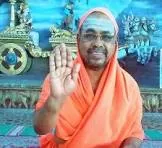
Swami Paramarthananda
Born 18 May 1953, Palakkad
Palakkad — the gap in the Western Ghats that connects Kerala to Tamil Nadu — is perhaps the most liminal place in South India. It has always been a place of passage: armies, traders, pilgrims, ideas. It is fitting that one of the most important bridges between the Vedantic tradition and the modern world was born there.
Swami Paramarthananda was born on 18 May 1953 to Subramania Iyer and Parvathy in Palakkad. He grew up with three older siblings in a family rooted in the Brahminical tradition of the region — a tradition that understood Sanskrit, respected the Vedic texts, and took the question of dharma seriously as a way of life rather than merely a cultural inheritance.
His early schooling and college education were completed in Palakkad. The details of his early intellectual formation are not extensively documented — as is characteristic of teachers in the Vedanta tradition, who tend to deflect biographical attention toward the teaching itself. What is documented is that at some point in his early adult life, the question that the Vedantic tradition considers the only question worth asking in full seriousness — the question of the nature of the Self — became live for him in a way that made ordinary professional life insufficient.
In 1976, he made the decision that would determine everything that followed: he enrolled in the three-year residential Vedanta course being conducted by Swami Dayananda Saraswati at Sandeepany Sadhanalaya in Mumbai.
II. Three Years in Mumbai — The Formation
Sandeepany Sadhanalaya was the Chinmaya Mission's training institution in Mumbai — a serious, residential, traditional programme in Vedanta and Sanskrit. Swami Dayananda had taught several courses there before establishing his own Arsha Vidya institutions, and the curriculum he offered was rigorous: the Bhagavad Gita with Shankaracharya's commentary, the principal Upanishads, the Brahma Sutras, and the Prakarana Granthas (introductory Vedantic texts like Tattvabodha, Vivekachudamani, Panchadashi and others).
For three years, from 1976 to 1979, the young man from Palakkad immersed himself in this curriculum under Swami Dayananda's guidance. Those who completed Swami Dayananda's three-year courses uniformly describe them as transformative in a way that goes beyond the acquisition of knowledge — the systematic, relentless clarity of Swami Dayananda's methodology, the daily discipline of Sanskrit study, the direct exposure to the primary texts in their original language — all of this produced something different from a student who has attended lectures or read books. It produced someone equipped to teach.
After completing the course, on the directive of his guru, the young brahmachari moved to Chennai and began teaching Vedanta. This detail — that he went to Chennai specifically because Swami Dayananda sent him there — is worth pausing on. It reflects the traditional Vedantic understanding of the guru-shishya relationship: the teacher does not merely transmit knowledge but shapes the student's life direction. Swami Dayananda's act of sending his newly graduated student to Chennai was itself a form of teaching — a demonstration of trust and a commission.
III. Chennai — Five Decades of Daily Teaching
Swami Paramarthananda has been teaching Vedanta in Chennai continuously for over four decades. His base is 80, St. Mary's Road, Subramaniam Street, Abhiramapuram, Chennai 600018 — a neighbourhood in Mylapore that has been associated with Tamil Brahmin cultural life for generations. From this modest address, he has conducted classes every day — not occasionally, not in intensive weekend retreats, but daily, systematically, year after year.
The scope of what he has taught is extraordinary. Over four decades he has given complete systematic courses in English on: the Bhagavad Gita, all principal Upanishads (Brihadaranyaka, Chandogya, Taittiriya, Mandukya with Karika, Kena, Katha, Mundaka, Prashna, Isa, Aitareya, Kaushitaki), the Brahma Sutras, and a comprehensive range of Prakarana Granthas including Panchadashi, Naishkarmyasiddhi, Upadesa Sahasri, Vivekachudamani, Drig Drishya Viveka, Vedantasara, Aparokshanubhuti and many others. Each of these courses runs to hundreds of classes — the Brihadaranyaka Upanishad alone runs to several hundred hours. The complete corpus of his recorded teachings numbers over 6,000 hours, available through the Sastraprakasika app (iOS and Android).
He received Sanyasa from Swami Dayananda in 1984 and has continued to live in Chennai and teach ever since.
IV. The Methodology — Clarity as Spiritual Practice
What distinguishes Swami Paramarthananda's teaching — and what has made it accessible to the enormous audience that follows his classes — is a quality that is both intellectually precise and personally warm: an absolute commitment to clarity.
He inherited from Swami Dayananda the core methodological insight that Vedanta is a pramana — a means of knowledge — not a set of practices leading to an experience. The Upanishadic statements, when properly taught by a qualified teacher using the right methodology, directly produce the understanding they are pointing to. This means that the teacher's primary responsibility is to be clear — not impressive, not mystical, not dramatic, but precise and consistent in the deployment of the teaching method.
The Three-Stage Framework: Shravana, Manana, Nididhyasana
Swami Paramarthananda is particularly associated with his clear exposition of the traditional three-stage Vedantic methodology. Shravana — systematic listening to the teaching from a qualified teacher. Manana — reflection on what has been heard, resolving doubts through reasoning. Nididhyasana — dwelling on the understanding, allowing it to transform habitual patterns of self-conception.
What makes his exposition distinctive is his insistence that nididhyasana is not meditation in the commonly understood sense — it is not an attempt to produce a special state of mind. It is the process of allowing the knowledge already gained through shravana and manana to permeate the unconscious patterns of thinking that continue to generate the sense of inadequacy and incompleteness despite intellectual understanding. "Fake it and make it," his own guru Swami Dayananda said — meaning that consciously acting from the Vedantic understanding, even before it feels spontaneous, is itself the practice.
His teaching on this point is precise: nididhyasana is not for gaining new knowledge — knowledge has already been gained through shravana and manana. It is for removing the viparita bhavana — the habitual contrary thinking about oneself — that persists even after intellectual understanding. The goal is not a new experience but the naturalisation of an understanding already attained.
In practical terms, what this means for his classes is that they are highly systematic. He does not jump between topics or offer inspirational aphorisms. He works through texts methodically, explaining each Sanskrit term, unpacking the logic of each argument, demonstrating how each statement connects to the central Vedantic vision. Students who have attended his classes consistently report that the clarity he achieves — making genuinely difficult philosophical content accessible without diluting it — is his most exceptional quality.
One of his often-cited observations crystallises this approach: "Transcending the intellect — in the name of spiritual pursuit — will not lead us anywhere. Any knowledge — material or spiritual — has to take place in the intellect only. Self-realisation is not a mystic experience. Self-realisation is nothing but Self-knowledge."
V. The Student-Teacher Relationship — No Rules, Only Teaching
Those who have studied under Swami Paramarthananda, or who have read accounts from his own teacher Swami Dayananda's residential courses that he attended, speak of a quality in the Arsha Vidya teaching environment that distinguishes it from many other institutional spiritual contexts: the deliberate absence of authoritarian discipline.
Swami Dayananda had strong views on this, and Swami Paramarthananda has clearly absorbed and carried them forward. From the Arsha Vidya tribute literature: "He never believed in rules and regulations or asked the students to obey implicitly. He thought commandments, rules and regulations were a form of control. Controlling another mind in the form of discipline is not good because the mind controlled by force will never be relaxed. It will be stressed and tense and in that atmosphere spiritual learning and growth will not take place."
The alternative to external discipline is understanding — the student comes to value right conduct not because it is demanded but because the teaching itself reveals why it matters. This is not a soft or undisciplined environment; the curriculum is demanding and the expectations of serious study are high. But the motivation comes from within, not from fear of institutional consequences. For a tradition whose central teaching is that moksha — freedom — is the nature of the Self, it would be self-contradicting to teach that freedom through coercion.
Swami Paramarthananda extends this in his own way. His classes are characterised by warmth, by accessibility, by a consistent readiness to revisit the same fundamental points from different angles for as long as a student needs. He does not project the mystique of an unapproachable sage. He is a teacher — present, engaged, consistent, and apparently inexhaustible in his patience.
VI. The Lineage — His Students Teaching Across the World
Perhaps the most significant measure of Swami Paramarthananda's contribution is not the 6,000 hours of recordings, or the decades of daily classes, or the systematic coverage of the entire Vedantic canon — it is the teachers he has produced.
The tradition he received from Swami Dayananda is one that takes the production of qualified teachers as its primary institutional goal. A teacher of Vedanta is not someone who has read the texts — it is someone who has studied them systematically under a qualified teacher, learned to handle the Sanskrit correctly, and can unfold the teaching in a way that produces understanding in a prepared student. The chain of transmission matters: each link must be genuine.
Swami Guruparananda
Direct disciple. Teaching at Poornalayam ashram near Vedanthangal. Known for depth of scholarship and accessibility of his classes. Nominated on the Aandaal Project GSN. Read tribute →
Swami Omkarananda Mahaswamigal
Student who united Sanskrit and Tamil Vedic traditions. His Maha Samadhi in 2021 at 65 was mourned across Tamil Nadu. Read tribute →
Swami Avinashilingam
Presents summaries of Swami Paramarthananda's classes and has helped make the teachings digitally accessible to a new generation of students.
Vasanthi
Began study with Swami Paramarthananda in Chennai in 1988. Later studied Sanskrit with Swami Tadatmananda. Now Programme Director at Arsha Bodha Center — a teacher in her own right carrying the lineage to the US.
These are only the most visible examples. The full number of students who have studied under Swami Paramarthananda over four decades in Chennai — who have then gone on to teach, to spread the tradition, to establish their own classes and study groups across India, the UK, the US, Australia, Southeast Asia — is impossible to count. What is certain is that the current generation of Advaita Vedanta students in Tamil Nadu, and Tamil diaspora communities across the world, has been shaped to a very significant degree by his teaching.
VII. The 6,000 Hours — A Digital Heritage Archive
One of the most striking facts about Swami Paramarthananda's legacy is the sheer volume of recorded material available. The Sastraprakasika app (iOS and Android), maintained by the Yogamalika organisation, contains over 6,000 hours of his classes — organised by text, searchable, accessible to anyone with a smartphone anywhere in the world. Individual CDs of approximately 10 classes each are available at modest cost.
This is a remarkable democratisation of a tradition that was, for most of its history, accessible only to those who could be physically present in a teacher's classroom. The technical accessibility of his recordings does not mean they are casual listening — the content is demanding, systematic and requires sustained attention. But the barrier of physical proximity — historically the greatest limitation on who could access traditional Vedanta teaching — has been entirely removed.
The implication is significant. A student in London, Lagos, or Melbourne who has never visited Chennai can now receive a complete, systematic education in Advaita Vedanta from one of the most qualified teachers alive — working through the same texts, with the same methodology, that students in Abhiramapuram attend in person. The content is identical. Only the medium differs.
Hope the Brahman will endow me with adequate power and energy to fully indulge in Brahmanishta. I never understood Vedantic knowledge ever before like now. Thanks, keep it up.
— A student, writing about Swami Paramarthananda's online recordings
VIII. Twenty-Five Aphorisms
Swami Paramarthananda's clarity of thought is perhaps best captured in the aphorisms collected from his classes — observations that crystallise years of systematic teaching into a single sentence. These are drawn from the published record of his teachings:
Selected Teachings — Swami Paramarthananda
1. Moksha is not something attained through a single path or multiple paths. For moksha is not a destination. It is our very nature which has been disowned due to ignorance.
2. Whatever is disowned due to ignorance has to be claimed through knowledge.
3. Self-knowledge is not a mystic experience. It is the clear understanding of the fact that the ever-experienced Self — the "ever-evident I" — is the non-dual Brahman.
4. To grasp the message of Vedanta, we do not require any new experience. Whatever experiences a normal human being undergoes are more than enough.
5. It is the blind demonisation of all desires as a whole that is the root cause of all evils. The faculty of desire is a unique privilege enjoyed by a human being. Without desire, one cannot even pursue Self-knowledge.
6. Samadhi, as a state of stillness or concentration, cannot lead us to any new knowledge, material or spiritual. Knowledge has to arise by the employment of a relevant means of knowledge.
7. Dakshinamurthi's silence cannot be taken literally as a non-verbal communication — because silence is not a means of knowledge.
8. Any system of teaching which reveals the fact that "I am the whole" is Vedanta — irrespective of the language in which it conveys this fact.
IX. The Tamil Connection — A Kerala Teacher and the Tamil Tradition
Swami Paramarthananda is, like Swami Dayananda himself, a product of the Kerala-Tamil Brahmin world — the cultural zone that straddles the Western Ghats and has produced an extraordinary concentration of Vedantic teachers across the centuries. His family background is in the Palakkad Iyer tradition: Tamil Brahmins who settled in Kerala centuries ago and whose culture is an intricate weave of Tamil and Kerala elements.
His presence in Chennai for over four decades has made him genuinely a part of the Tamil Vedantic world. His students include figures from across the Tamil tradition — Swami Guruparananda from Kanchipuram district, Swami Omkarananda from the Tamil Nadu lineage, and countless householder students from the Tamil middle-class communities of Mylapore, Abhiramapuram and T. Nagar who have attended his classes for decades.
The Aandaal Project honours Swami Paramarthananda as a central figure in living Tamil spiritual culture — not only as an intellectual heir of Swami Dayananda but as the teacher through whom the Advaita Vedanta tradition has most consistently reached Tamil-speaking communities in the 21st century.
X. Tribute — The Gift of Consistency
There is a quality in Swami Paramarthananda's contribution that does not make for dramatic biographical narrative but is, perhaps, the most extraordinary thing about him: consistency.
For over four decades, through heat and monsoon, through the changes of a city and a country in rapid transformation, through the deaths of his own teacher and of some of his most beloved students, through the transition from cassette tapes to CDs to apps — he has taught. Every day. The same tradition. The same methodology. The same unhurried clarity. The same texts.
This kind of consistency is not glamorous. It does not produce the kind of biographical incident that makes compelling journalism. What it produces is something more durable: a living tradition, carried in the understanding of hundreds of teachers who themselves now teach daily in their own locations — a chain of transmission that extends from the Upanishadic forest hermitages of three thousand years ago, through Shankaracharya, through the Advaita teachers of the medieval period, through Swami Dayananda Saraswati, through Swami Paramarthananda, and into classrooms in Chennai, London, New Jersey, Singapore and Sydney today.
The tradition is unbroken. The teaching is unchanged. The clarity — that the Self you are seeking is the Self you already are, that the liberation you are pursuing is the nature you have never lost — has been preserved and transmitted with fidelity. That is the gift of Swami Paramarthananda to the world, and to Tamil civilisation specifically.
Swami Paramarthananda is one of the senior-most disciples of Pujya Swami Dayananda Saraswati, a traditional teacher of Advaita Vedanta in Chennai. He has been teaching Vedanta in the Arsha tradition for decades, and his recordings represent one of the most comprehensive archives of traditional Vedanta teaching available in the English language today.
The Complete Parampara — Vedanta in Tamil Nadu
Swami Dayananda Saraswati — the guru · Swami Guruparananda — his student · Swami Omkarananda — his student
Honour Swami Paramarthananda on the Guru Support Network
The living Vedanta parampara — recorded, honoured and kept alive on the Aandaal Project. Visit the GSN →
Accessible Resources
Sastraprakasika App: The primary archive of Swami Paramarthananda's teachings — 6,000+ hours of recorded classes on all major Vedanta texts. Available on iOS and Android. Individual course packs available at modest cost.
Swami Paramarthananda's address: 80, St. Mary's Road, Subramaniam Street, Abhiramapuram, Chennai 600018. Tel: 044-24997459
Online class notes and transcripts: Several independent student websites maintain class notes, summaries and transcripts. The YesVedanta site at yesvedanta.com and SatVichara at satvichara.info are among the most comprehensive.
Arsha Vidya Center resources: arshavidyacenter.org maintains a collection of his talks and written teachings.