I. A Teacher in the Ancient Tradition
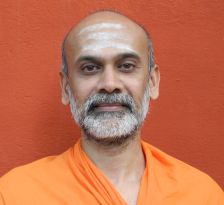
Swami Guruparananda — Poornalayam, Vedanthangal, Tamil Nadu.
Image: poornalayam.org
In the ancient tradition of Vedanta, the teacher — the acharya — occupies a position unlike any other. Unlike the scholar who studies texts from a distance, or the priest who performs rituals on behalf of others, the acharya is a living transmission: someone who has received knowledge from a qualified teacher, assimilated it fully into their own understanding, and then devotes their life to passing it on to those who seek it. The quality that defines this transmission is not scholarship alone — though scholarship is required — but anubhava: the direct experiential understanding of what the texts are pointing to.
Swami Guruparananda was exactly this kind of teacher. For 27 years, from 1992 to July 2019, he taught the Bhagavad Gita, the principal Upanishads, the Brahma Sutra, and a wide range of other Vedantic texts — in Tamil, in a lineage that stretches in unbroken succession from Adi Shankaracharya through the centuries to the present day. He asked nothing of his students except their attention. His classes were offered free of charge, recorded without cost, and distributed without restriction. The 1,600-plus classes that now reside at Poornalayam.org — freely available to anyone anywhere in the world with an internet connection — are his enduring gift to Tamil-speaking seekers of every generation.
His pre-monastic name was Chandru C S. He was born in Tamil Nadu, grew up in the cultural and spiritual environment of the Tamil Brahmin community, and at some point in his formative years encountered the teaching tradition of Swami Paramarthananda — one of the most important living Vedanta teachers of the 20th and early 21st centuries. Through Paramarthananda he received systematic, exhaustive training in the entire Vedantic curriculum. He was then initiated into the Sanyasa order — the order of renunciation — by Pujya Swami Dayananda Saraswati, the foundational figure of the Arsha Vidya tradition, who is widely regarded as among the most important Vedanta teachers of the modern era. At initiation he received the monastic name Guruparananda — "one whose bliss is in the Supreme Teacher."
II. The Lineage — An Unbroken Chain
To understand Swami Guruparananda's significance, it is necessary to understand the tradition he represents. Vedanta — the philosophical system grounded in the Upanishads, the Bhagavad Gita, and the Brahma Sutra — is not merely a set of doctrines to be memorised and recited. It is a pramana: a means of knowledge that, when properly applied under the guidance of a qualified teacher, resolves the fundamental confusion about the nature of the self and reality. This is why the teacher-student relationship is so central to the tradition: the texts alone, without a living guide who has walked the path, cannot perform their function.
The Arsha Vidya Lineage
Pujya Swami Dayananda Saraswati (1930–2015) is described by his students as the "teacher of teachers" — not as flattery but as an accurate description of his role. He founded the Arsha Vidya Gurukulam residential ashrams in Rishikesh and Pennsylvania, and trained a generation of teachers who have carried the Vedantic teaching tradition to every continent. His approach, developed over decades of teaching, was to present Vedanta with methodological rigour — as a system of knowledge with its own epistemology, not as mystical experience or devotional practice alone, but as a form of understanding that could be communicated, clarified, and verified through disciplined inquiry into the texts.
It was this rigorous, systematic approach that Swami Paramarthananda brought to Chennai, and that Swami Guruparananda then carried forward specifically in Tamil — ensuring that the most demanding Vedantic curriculum was accessible not only to English-educated urban elites but to the broader Tamil-speaking world.
III. Teaching in Tamil — The Significance of Language
The decision to teach Vedanta exclusively in Tamil was not merely a practical accommodation to audience preference. It was a statement about the nature of knowledge and its transmission.
Vedanta in India has historically been transmitted primarily in Sanskrit — and in the modern period, increasingly in English, a language that reaches educated urban audiences across India and the diaspora. Tamil-medium Vedanta teaching of the quality Swami Guruparananda offered was genuinely rare. Most Tamil-speaking seekers who wished to study the Upanishads systematically were required either to learn Sanskrit or English, or to accept simplified popular summaries that inevitably lost the precision of the original analysis.
Swami Guruparananda's Tamil classes offered something different: full, exhaustive, technically rigorous exposition of the primary texts — the Mandukya Upanishad, the Chandogya Upanishad, the Kena, the Katha, the Aitareya, the Taittiriya, the entire Bhagavad Gita — in the language that his students lived and thought in. Tamil is itself one of the world's great philosophical languages, with a vocabulary of extraordinary precision for describing states of mind, degrees of knowledge, and the subtle gradations of spiritual understanding. To teach Vedanta in Tamil was to honour this capacity.
He chose to speak in Tamil, thereby ensuring that this divine knowledge reaches the maximum number of people — unlike many who mostly speak only in English and perhaps take pride in never giving discourses in Tamil, although it may be their mother tongue. On that score, Swamiji has shown immense kindness to the common people.
— A student, writing on the Poornalayam community forum
The comment captures something important: the choice to teach in Tamil was an act of cultural democratisation. Knowledge that had, in practice, been accessible mainly to those with English or Sanskrit education was made available — freely, systematically, and in full depth — to anyone who spoke Tamil.
IV. Poornalayam and Vedanthangal
The name Poornalayam — the home or abode of completeness — was chosen for the institution and website that houses Swami Guruparananda's recorded teaching legacy. It reflects the Vedantic understanding of purna: the Sanskrit term for completeness or fullness, which in Advaita Vedanta refers to the ultimate nature of Brahman — the absolute reality — as inherently, unconditionally complete. The opening invocation of the Isha Upanishad begins with the word: purnamadah purnamidam — "That is complete; this is complete." The name is therefore not merely descriptive but philosophical.
Swami Guruparananda's ashram is located at Vedanthangal — a village in the Kanchipuram district of Tamil Nadu that carries its own extraordinary heritage. Vedanthangal is home to the Vedanthangal Bird Sanctuary — one of the oldest protected bird sanctuaries in the world, where migratory birds from as far as Siberia, Australia, and Central Asia congregate each year in their tens of thousands to nest and breed. The village sits in a landscape where ancient Tamil agricultural traditions — the eri tank irrigation system that maintained the waterbird habitat for centuries — are directly responsible for one of the world's most important wetland ecosystems.
There is something fitting in this geography: a teacher of Advaita Vedanta — which teaches the non-difference between the individual self and the universal — making his home in a place where the boundaries between the local and the global dissolve each winter in the arrival of birds from every corner of the earth.
V. What Swami Guruparananda Taught
The curriculum Swami Guruparananda taught over 27 years was not a series of inspirational talks or devotional lectures. It was the complete, systematic Vedantic education — the same curriculum that the ancient Vedic universities offered, transmitted now through recorded audio to anyone with a smartphone.
Bhagavad Gita
The complete 18-chapter text, verse by verse, with full philosophical commentary and grammatical analysis.
The Upanishads
Mandukya, Chandogya, Taittiriya, Kena, Katha, Aitareya, Mundaka — the principal texts of Vedanta.
Brahma Sutra
Badarayana's systematic sutra text reconciling the apparent contradictions of the Upanishads — the most advanced Vedantic study.
Vedantic Texts
Panchadasi, Vivekachudamani, Ananda Lahari, Thayumanavar's Ananda Kalipu, and other key works of the tradition.
Meditation
The Vedantic understanding of meditation as a tool for mental preparation, not as an end in itself.
General Talks
Accessible introductory talks — including the celebrated Illaram series on purposeful family life.
The breadth of this curriculum is worth pausing on. The Brahma Sutra alone — the systematic philosophical text that Shankaracharya considered the pinnacle of Vedantic study — demands years of preparation and is rarely taught in full even in traditional settings. That Swami Guruparananda taught it in Tamil, in full, with the same rigour that Sanskrit scholars bring to it in traditional residential programmes, represents a remarkable intellectual and spiritual commitment.
VI. The 27-Year Mission and Its Completion
Swami Guruparananda began his Chennai teaching in 1992. He taught regularly — not occasionally, not for brief residential programmes, but week in week out — for twenty-seven years. In July 2019 he concluded his teaching, completing a curriculum that had been systematically planned and executed across nearly three decades.
The completion was not the end of his legacy but the beginning of a different kind of reach. From 1995 onwards, his classes had been meticulously recorded by devoted students. By 2019, this archive — over 1,600 classes covering the complete Vedantic curriculum — had been digitised, organised, and made available free of charge on the Poornalayam website, on YouTube, and on the Internet Archive. Swamiji himself, described as "the guiding force behind the creation of this website," ensured that all content would remain advertisement-free — a deliberate choice that preserves the purity and accessibility of the teaching.
Access Swami Guruparananda's Teachings
All 1,600+ classes — Bhagavad Gita, Upanishads, Brahma Sutra, and general talks — are available free of charge at poornalayam.org, on YouTube (youtube.com/user/swamiguruparananda), and on the Internet Archive. No registration required. All classes are advertisement-free.
VII. The Advaita Teaching — What It Is and Why It Matters
The philosophical tradition Swami Guruparananda taught is Advaita Vedanta — the non-dual school of Indian philosophy associated with Adi Shankaracharya (8th century CE). Its central teaching — expressed most directly in the mahavakyas (great statements) of the Upanishads — is that the individual self (jiva) and the universal reality (Brahman) are not ultimately different. Aham Brahmasmi: I am Brahman. Tat tvam asi: Thou art That. Prajnanam Brahma: Consciousness is Brahman.
These statements are not articles of faith to be believed. They are propositions to be understood — and it is precisely this demand for understanding, rather than mere belief or devotional acceptance, that makes Vedanta teaching so technically demanding and so dependent on a qualified teacher. The texts of the Upanishads are not straightforward philosophical treatises. They speak through paradox, through negation, through the pointing-beyond-language that characterises all genuine mystical literature. Without a teacher who has understood them and can unfold their logic step by step, a student faces either incomprehension or misunderstanding.
This is what makes the availability of Swami Guruparananda's recordings so significant. For the Tamil-speaking world — stretching from Tamil Nadu to Sri Lanka to Malaysia, Singapore, the United Kingdom, Canada, and the Tamil diaspora worldwide — these classes represent access to a quality of Vedantic teaching that would otherwise require residence at a traditional ashram.
VIII. Swami Guruparananda and the Tamil Spiritual Tradition
Swami Guruparananda's teaching sits within a Tamil spiritual tradition that is itself among the oldest and most sophisticated in the world. The Shaivite saint-poets of the first millennium CE — Thirugnana Sambandar, Sundarar, Appar, Manikkavacakar — gave Tamil devotional literature a depth and emotional directness that has never been surpassed. The Thiruvasagam of Manikkavacakar, composed in the 9th century CE, is to Tamil spiritual literature what the Psalms are to the Hebrew tradition: a sustained cry of the soul toward the divine, of extraordinary lyrical and philosophical power.
The connection between this devotional tradition and the Advaita Vedanta that Swami Guruparananda taught is not incidental. Shankaracharya himself composed devotional hymns — the Vivekachudamani, the Soundaryalahari — that show how bhakti (devotion) and jnana (knowledge) are not opposed but complementary in the Advaita framework. Swami Guruparananda's inclusion in his curriculum of Thayumanavar's Ananda Kalipu — the ecstatic devotional poetry of the 18th-century Tamil saint — is a signature of this integration: the teaching that knowledge and love are not different paths but different facets of the same movement toward liberation.
Vedanthangal — Place of Birds and Teachers
Swami Guruparananda's ashram is near Vedanthangal in Kanchipuram district — a day trip from Chennai. Our Chennai Heritage Travel Guide includes Kanchipuram as a key day trip destination.
IX. A Personal Note from The Aandaal Project
From the Founder
Swami Guruparananda is my Guru. Whatever I have understood about the deeper purpose of culture, heritage, and service — the conviction that Tamil civilisation carries something the world needs — has been shaped, more than anything else, by the years I spent listening to his teachings.
He taught that knowledge is complete — purna — and that the purpose of all genuine education, whether of arts, history, or philosophy, is to help the student recognise this completeness in themselves. The Aandaal Project was born from exactly this conviction: that Tamil heritage is not a museum piece or a commercial asset, but a living transmission of something complete and whole that belongs to everyone.
We created a profile of Swamiji on our Artist Heritage platform not because he is famous in the conventional sense, but because his life's work represents exactly the kind of cultural transmission that The Aandaal Project exists to honour. He asked for nothing. He gave everything. His 1,600 classes are free, advertisement-free, available to anyone, and will remain so. In a world of cultural commodification, this is extraordinary.
To anyone who reads this — whether you have a connection to Vedanta or not — I encourage you to listen to one of his introductory talks at poornalayam.org. Even if the philosophy is unfamiliar, the quality of the mind and the warmth of the communication are immediately apparent. Some teachings transcend their immediate content.
— Sreedhar Pillai, Founder, The Aandaal Project · andal.io
X. Legacy — What Swami Guruparananda Leaves Behind
The legacy of a Vedanta teacher is, by the tradition's own understanding, the understanding they have produced in their students — not fame, not institutional scale, not cultural visibility. By this measure, Swami Guruparananda's legacy is immeasurable in the most literal sense: it lives in the understanding of every student who listened deeply enough to let the teaching do its work.
But the digital archive at Poornalayam represents something more unusual: a legacy that continues to grow after the teaching has concluded. Every day, somewhere in the Tamil-speaking world — in Chennai, in Colombo, in Kuala Lumpur, in London, in Toronto — someone discovers these recordings and begins to listen. For them, the teaching is not historical. It is present. The 27-year mission continues, as all genuine teaching must, in the minds of those who receive it.
At The Aandaal Project, we honour Swami Guruparananda as part of the same living tradition that produced the Sangam poets, the temple architects, the classical musicians, and the dancers whose heritage we celebrate. Tamil civilisation, at its deepest, has always understood that the purpose of culture is not decoration but liberation — not entertainment but understanding. Swami Guruparananda embodied this understanding in a form that will outlast all of us.
ஓம் தத் சத்
Explore Tamil Heritage — Free
The Aandaal Project celebrates Tamil civilisation through games, heritage articles, and the Artist Pillar — a free platform for artists of India. Join at andal.io/app