I. The Rarity He Represented
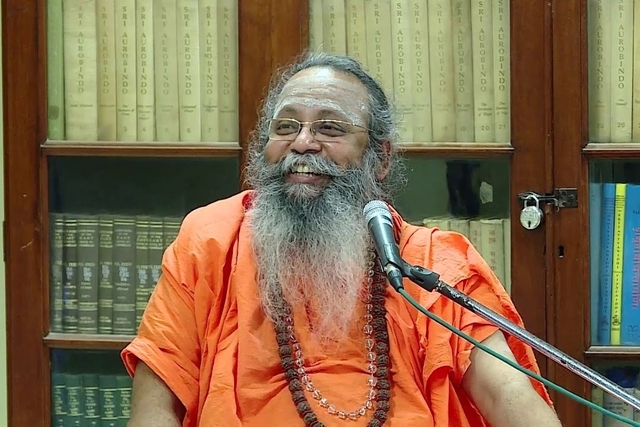
Pujyasri Omkarananda Mahaswamigal
Vedapuri, Theni, Tamil Nadu
Image: vedaneri.org
In the long history of Indian spiritual tradition, the teacher who is equally at home in Sanskrit and Tamil — who can quote with equal authority from the Upanishads and the Thirukkural, from the Bhagavad Gita and the Thiruvachagam, from Brahma Sutra Bhashya and Kaivalya Navaneetham — is extraordinarily rare. Most scholars of the Sanskrit tradition have at best a respectful familiarity with Tamil devotional literature. Most Tamil scholars approach Sanskrit as an admired but external tradition. To hold both living and breathing inside oneself, to move between them in a single discourse without the slightest seam, is a gift that perhaps only one teacher in a generation possesses.
Pujyasri Omkarananda Mahaswamigal possessed it. Those who attended his discourses — whether in Chennai, Madurai, Coimbatore, or in international camps across the globe — consistently described the same experience: a voice that could cite Shankaracharya's commentary on the Mandukya Upanishad and then, in the next breath, illuminate it with a verse from Thayumanavar's hymns or a couplet from Thiruvalluvar, showing that the Dravidian and the Sanskritic traditions were never two rivers but one. This capacity was not an affectation. It was the natural expression of a man who had been born into the Vedic tradition at its deepest level and had then spent decades immersed in the Tamil spiritual texts with equal rigour.
His death on 10 May 2021, at the age of 65, from COVID-19 complications in Madurai, was mourned across Tamil Nadu and beyond. The Shankaracharyas of both Kanchi and Sringeri had expressed their admiration for him. The Sringeri Acharya had conferred on him the first-ever Shankaracharya Sammana. Political leaders of multiple parties paused to pay tribute. But the truest measure of the loss was simpler: the 20,000 students who received his daily Whatsapp messages on the Bhagavad Gita and Thirukkural suddenly found those messages had stopped.
II. Origins — Born Into the Vedic Tradition
He was born on January 17, 1956 — the Tamil month of Thai, under the Pooram nakshatra — in Perur, near Coimbatore, Tamil Nadu. His birth name was Goshteswara Sharma, also known as Manoharan. His father, Vaidyanatha Ghanapaadigal, was himself a Ghanapathi — a Vedic scholar who had mastered the recitation of the Vedas at the highest traditional level, the Ghana Patha, which requires memorising not just the texts forwards but in multiple complex recitation patterns. His mother was Smt. Alamelu Ammal.
To be born the son of a Ghanapathi is to grow up immersed in a sonic environment of the Vedas from infancy — not as a background or a ceremony but as the texture of daily life, as natural as language itself. Young Goshteswara absorbed this environment with the intensity of someone for whom it was evidently his true element. His early schooling was at Saraswathi School in Perur, followed by Ponnu Iyengar School and Sethupathi High School in Madurai, and Santhalinga Adigalar School in Perur. Even in his school years, he was winning prizes in oratorical and music competitions — the two great Tamil traditions of verbal eloquence and devotional music already alive in him.
He received his Upanayana samskara — the sacred thread ceremony that marks the beginning of formal Vedic study — in his eleventh year, in the presence of His Holiness Sri Jayendra Swamigal of Kanchi. From that moment, the pull toward sanyasa — toward the life of complete renunciation in the service of knowledge — was, by all accounts, already felt. He pursued it with patience and purpose.
III. The Formation — Sanyasa and Vedanta
His Sanyasa Diksha — the formal initiation into the monastic order of renunciation — was received from Pujyasri Swami Chidbhavananda, the revered founder of Sri Ramakrishna Tapovanam at Tirupparaithurai. Swami Chidbhavananda (1898–1985) was himself a direct disciple of the Ramakrishna tradition and a deeply respected figure in Tamil spiritual life — best known for his Tamil commentary on the Bhagavad Gita that brought the Gita's teachings to a generation of Tamil readers. To receive Sanyasa from this tradition was to enter a lineage that took both Sanskrit learning and Tamil devotion with equal seriousness.
After his Sanyasa, Omkarananda Swami spent eight years studying Vedanta under Pujyasri Swami Paramarthananda in Chennai — one of the most systematic and rigorous Vedanta teachers of the 20th century, himself a principal disciple of Pujyasri Swami Dayananda Saraswati of the Arsha Vidya tradition. This period of study was described by those who knew both teachers as a meeting of true peers in the making: Swami Suddhananda, who witnessed it, wrote that it was "like the river meeting the ocean. Both of them had similar background and they clicked with each other in perfect harmony."
The Lineage of Pujyasri Omkarananda Mahaswamigal
IV. The Ghanapathi — What Made Him Different
The title Ghanapathi requires explanation, because it defines something essential about Omkarananda Swami's intellectual formation that has no real parallel in Western education.
In the traditional Vedic learning system, the Vedas are transmitted orally — not as written texts but as sound, memorised and reproduced with perfect fidelity across generations. There are multiple levels of this memorisation, each building on the last. At the simplest level, a student learns the text in the natural order (samhita patha). Subsequent levels teach the text in various artificial patterns — backwards, in alternating words, in complex interlocking sequences — that serve both as memory aids and as a guarantee that no corruption has entered the transmission. The highest level, Ghana Patha, requires mastering a pattern of enormous complexity that can only be achieved after years of intensive training beginning in early childhood.
A Ghanapathi has, in effect, internalised the entire Veda as a living sound-structure. He does not know it the way one knows a language one has studied; he knows it the way one knows one's mother tongue — it is woven into his nervous system. When Omkarananda Swami cited a Vedic mantra in a discourse, he was not consulting a memory. He was hearing it from inside.
This formation, combined with his eight years of systematic Vedanta study under Swami Paramarthananda, gave him something quite rare: the Vedas lived in him as sound, and the Upanishads — the Vedanta, the philosophical culmination of the Vedas — lived in him as understanding. The two were inseparable.
V. The Ashram and the Mission
In 1992, Omkarananda Swami founded the Vedanta Sastra Prachara Trust, the institutional vehicle for his teaching mission. In 1993 he established the ashram, and in 1995 — at the inauguration conducted by Pujya Swami Dayananda Saraswati himself — Sri Swami Chidbhavananda Ashramam was formally established at Vedapuri in Theni district, Tamil Nadu. The ashram name honoured his Sanyasa Guru.
The location was chosen with care. Vedapuri lies at the foothills of the Western Ghats, with the Surabhi Saraswati River flowing along its northern boundary. The landscape — green, serene, resonant with the natural environment that the ancient Vedic tradition understood as conducive to contemplative life — matched Swamiji's vision of an ashram that would be not merely an institution but a living environment for the pursuit of knowledge.
Within the ashram he established multiple institutions: a Veda Patashala where Brahmacharins from Vaidika families learned the Yajur Veda and Sivagamam; the Adiguru Sri Prajna Dakshinamurti Vidyapitham — a magnificent prayer hall built in 2002 with a nine-foot Dakshinamurti murti with chinmudra, symbolising Self-knowledge; a Gosala; residential facilities; a library; an auditorium; and a global classroom for conducting Vedanta classes. Three-year residential Vedanta courses in the traditional Gurukulam style produced students who went on to teach across Tamil Nadu. The ashram also published two monthly magazines — Vedaneri and Bhuvaneshwari Vijayam — as study material for spiritual aspirants.
VI. The Two-Language Teaching — Sanskrit and Tamil as One Voice
What distinguished Omkarananda Swami's teaching from that of most of his contemporaries was precisely the quality described at the opening of this tribute: his ability to hold Sanskrit Vedanta and Tamil spiritual literature in a single, unified vision.
His Sanskrit teaching corpus covered the full traditional Vedanta curriculum:
- Mandukya Upanishad
- Chandogya Upanishad
- Mundaka Upanishad
- Kena Upanishad
- Katha Upanishad
- Isha Upanishad
- Kaivalya Upanishad
- Taittiriya Upanishad
- Bhagavad Gita (all 18 chapters)
- Brahma Sutram
- Viveka Chudamani
- Panchadasi
- Atmabodha
- Uddhava Gita
- Needhi Shatakam
- Soundaryalahari
- Thirukkural (complete)
- Kaivalya Navaneetham
- Thayumanavar Padalgal
- Thevaram
- Thiruvachagam
- Thirumandiram
- Bharatiyar songs
- Srimad Bhagavatam (Tamil)
- Dharma Sastra
- Yoga Sastra
- Upasana Sastra
- Pada Sastra
- Vyakarana Sastra
- Shiva Puranam
- Sivanandhalahari
Of particular significance was his deep engagement with Kaivalya Navaneetham — the remarkable 18th-century Tamil text that presents Advaita Vedanta in Tamil verse of great precision and beauty. For many years, this text had been relatively neglected even among Tamil Vedanta scholars, overshadowed by the Sanskrit classics. Omkarananda Swami was specifically credited by commentators as having been "the only Acharya who brought to limelight the great Tamil Vedantic text Kaivalya Navaneetham." His teaching of this text was, in effect, an act of cultural rescue — returning a masterpiece of Tamil philosophical literature to its rightful place in the Vedanta curriculum.
His engagement with Thirukkural was equally distinctive. Where many teachers treat the Kural as an ethical text — valuable, admirable, but separate from Vedanta — Omkarananda Swami demonstrated their deep philosophical unity. He founded the Ullam Thorum Valluvam foundation on September 10, 2017, specifically to spread the message of the Thirukkural — its name meaning "in every heart, the Valluvan" — and trained teachers who in turn could teach students the Kural's deepest dimensions. He was, in the truest sense, the living embodiment of the proposition that Thiruvalluvar and Shankaracharya were pointing toward the same reality.
He was the only Acharya who brought to limelight the great Tamil Vedantic text Kaivalya Navaneetham. He was a Hindu Thought Movement in Himself.
— R.B.V.S. Manian, writer, in tribute after Swamiji's Maha Samadhi
VII. The Reach — From Village to Globe
Omkarananda Swami never confined his teaching to the learned or the initiated. His gift for making the most intricate Vedantic topics comprehensible to an ordinary person — to the farmer as much as to the scholar — was remarked upon consistently by those who encountered him. He conducted Jnana Yagnas (spiritual discourse series) in Madurai, Erode, Chennai, Coimbatore, Rajapalayam, Salem, Namakkal, Theni, Cumbum, Pudukkottai, Virudunagar, Sivakasi, Mumbai, and Bengaluru — across the full socioeconomic range of Tamil society.
He was also among the first traditional Vedanta teachers to recognise the potential of digital media for reaching students. His daily Whatsapp broadcasts — titled Karpavai Karpom (Let Us Learn What Should Be Learned) on the Bhagavad Gita and Thirukkural, and Ullantorum Valluvam — reached approximately 20,000 students worldwide every day, with many forwarding them to further groups. His five-year online course on Atma Vidya in Tamil drew thousands of students who could not travel to Theni. His discourses were webcast live daily from the ashram.
In 2005, at the direction of his teacher Swami Dayananda Saraswati, he took on the position of Peetadhipathi (head monk) of Sri Bhuvaneswari Avadhuta Vidyapitham at Pudukkottai — an institution with its own ancient lineage tracing to Sadguru Santananda Mahaswamigal. Here he established a free school for poor and needy children in 2009, and maintained the distinctive Dattatreya tradition of the Pitham while integrating it with his Advaita teaching mission.
VIII. The Recognition He Received
The spiritual world of Tamil Nadu — and of India more broadly — recognised what was in their midst. The Shankaracharyas of both the Kanchi Kamakoti Peetham and the Sringeri Sharada Peetham expressed their admiration for Omkarananda Swami's scholarship and teaching. The Sringeri Acharya went further: he conferred on Swamiji the Shankaracharya Sammana — described as "the first ever" such honour — in recognition of the great traditional quality of his teaching and his perpetuation of the Shankara lineage's values.
This recognition from both Mathas — which represent different sub-traditions within Advaita and are not always in easy agreement — speaks to something beyond denominational loyalty: the recognition of a teacher who had genuinely absorbed the tradition in its fullness and was transmitting it with integrity.
IX. The Maha Samadhi — May 10, 2021
Omkarananda Swami contracted COVID-19 in the devastating second wave that struck India in the spring of 2021. He had initially tested negative and appeared to be recovering, but suffered a cardiac arrest. When doctors advised transferring him from Madurai to Chennai for further treatment, an attempt was made to board him onto an air ambulance — but he developed acute breathing difficulty and was rushed back to the Madurai hospital. He attained Maha Samadhi on 10 May 2021, at 5:40 PM in Madurai. He was 65.
The response was immediate and widespread. Political leaders — including BJP's C T Ravi and L Murugan, and AIADMK's O Panneerselvam — issued statements of condolence. The Organiser described him as "a Great Atman, a Mahatma who tirelessly worked day and night to uplift our Society." The Dilip Quarterly called him "an outstanding teacher of Vedanta known for his eloquence in Tamil and Sanskrit — whose whole life had been in Veda marga."
At the ashram in Vedapuri, a sanctified Adhisthanam has been constructed opposite the Dakshinamurti temple he built, where regular pujas are conducted. The Dhyana Mandapam enables devotees to perform pradakshina, japa, and dhyana in his presence. The teaching mission continues through his principal successors — Swami Jnanasivananda, who was a close associate for nearly four decades and received Sanyasa from Swamiji, and Swami Purnananda, who completed the three-year residential Vedanta course from 2000 to 2003 and now teaches across Tamil Nadu.
X. What He Left Behind — And Why It Must Not Be Lost
The digital archive of Omkarananda Swami's teachings represents something of enormous value — not merely for those within his direct community but for anyone who wishes to understand what it means to hold the Sanskrit and Tamil Vedic traditions in a living unity.
Thousands of hours of his recorded discourses exist — on the Bhagavad Gita, the principal Upanishads, Kaivalya Navaneetham, Thirukkural, Thayumanavar, and the full range of texts he taught. These recordings, available through the Vedaneri website and associated platforms, are in Tamil — making them directly accessible to the 80 million Tamil speakers worldwide without any linguistic intermediary.
The concern that prompted this tribute — that "dead people tend to slowly disappear from web search" — is real and important. The teachers who worked quietly, without the apparatus of large institutions or media celebrity, who poured everything into their students and their discourses and left no autobiography behind, are precisely the ones who vanish most quickly from the digital record. Omkarananda Swami was such a teacher. His name does not carry the global recognition of a Swami Vivekananda or a Ramana Maharshi. But within Tamil Nadu and among the Tamil diaspora worldwide, the depth of his teaching and the uniqueness of his two-language scholarship are felt as an irreplaceable loss.
The Aandaal Project has included Pujyasri Omkarananda Mahaswamigal in its Guru Support Network — the living record of those who have carried India's traditions — so that his name, his lineage, and the access points to his teaching remain findable for every Tamil speaker who seeks what he gave.
Access Swamiji's Teachings
Thousands of hours of Pujyasri Omkarananda Mahaswamigal's discourses in Tamil — Bhagavad Gita, Upanishads, Kaivalya Navaneetham, Thirukkural, Thayumanavar and more — are preserved at vedaneri.org and on the associated YouTube channels. The Ullam Thorum Valluvam initiative on Thirukkural continues through his students and foundation.
From a Student — A Personal Tribute
I never met Swamiji in person. I knew him only through his online classes — specifically his discourses on Vishnusahasranamam with Sankara Bhashyam, which I studied with deep appreciation.
What struck me, listening to him, was something I have never encountered in quite the same form in any other teacher: the complete ease with which he moved between Sanskrit and Tamil. Not as a performance of learning, not as an interpolation of one tradition into another, but as a single breath. When he cited Shankaracharya and then Thayumanavar in successive sentences, you understood that for him they were not two authorities but one. The Vedanta and the Tamil devotional tradition were the same water in different vessels.
His death at 65 — when such a teacher should have had at least another decade to give — is a genuine loss to the tradition. But the recordings remain. And as long as they remain accessible, he continues to teach.
We have added Swamiji's profile to The Aandaal Project's Guru Support Network with the hope that those who search for him will find this tribute, and through it, find their way to his voice.
— Sreedhar Pillai, Founder, The Aandaal Project · Nominated by BookingID KRNC
Guru Support Network — andal.io/GSN.html
The Aandaal Project maintains a living record of Gurus, teachers, and elders — both living and brahmaleen. Visit the GSN to add your tribute →
Swami Guruparananda — Another Teacher in the Same Lineage
Swami Guruparananda of Poornalayam — another disciple of Swami Paramarthananda — taught Vedanta in Tamil for 27 years. Read his profile →