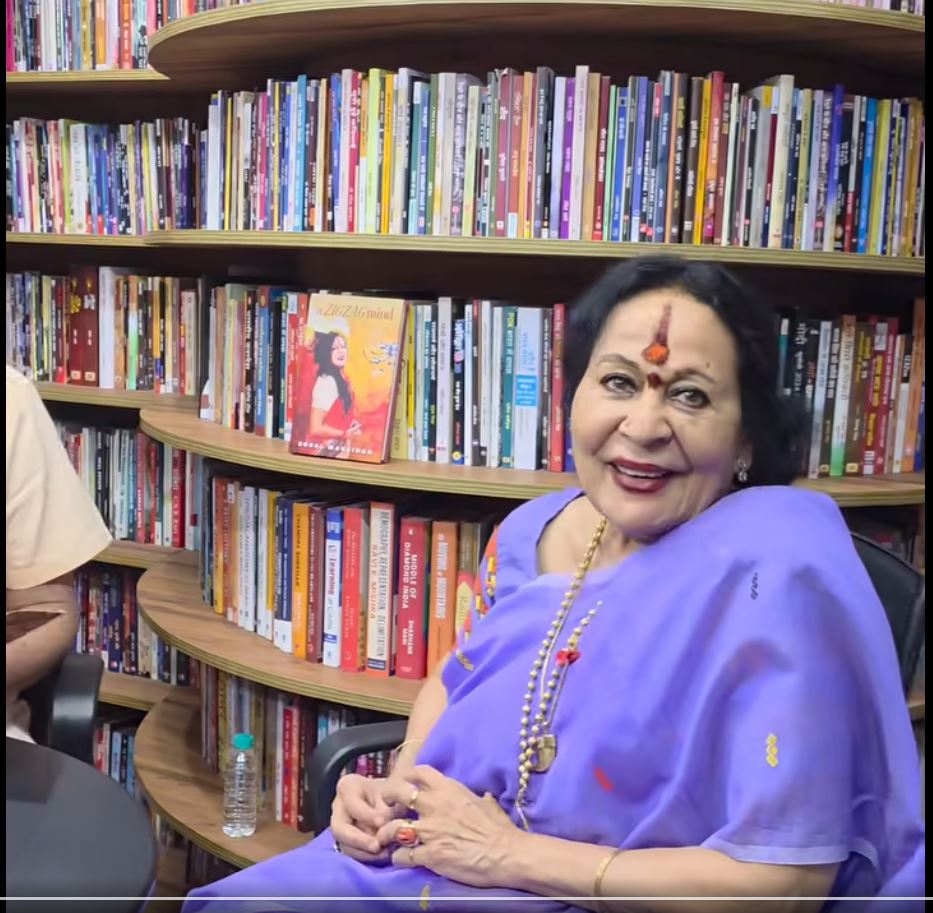
On her Facebook page in recent months, Dr Sonal Mansingh — Padma Vibhushan, former Member of Parliament (Rajya Sabha), and one of the most formidable voices in Indian classical arts — has posted two statements that deserve far more public attention than they have received. Together, they amount to a coherent cultural manifesto.
The first: that India should create an Indian Heritage Service (IHS) — a dedicated all-India administrative cadre, on the model of the Indian Administrative Service (IAS) and Indian Police Service (IPS) — to nurture, protect and develop Indian heritage and classical culture.
The second: that successive Indian governments have failed classical dance by never awarding the Bharat Ratna — India's highest civilian honour — to any practitioner of Indian classical dance, despite the form's antiquity, its global reach, and the extraordinary lives devoted to it.
Both arguments are historically grounded, institutionally important, and long overdue for serious national debate. The Aandaal Project — a UK-based CIC dedicated to Tamil heritage and classical culture — supports both positions without reservation. This essay examines why.
I. Who is Dr Sonal Mansingh?
Before engaging with her arguments, it is worth understanding who is making them — because the weight of an argument in cultural policy is inseparable from the life that produced it.
Sonal Mansingh was born on 30 April 1944 in Bombay (now Mumbai) into a family of considerable public distinction: her maternal grandfather, Mangaldas Pakvasa, was a freedom fighter and one of independent India's first five Governors; her mother Poornima Pakvasa received the Padma Vibhushan in 2002 for social work. The family background combined Gandhian values, a respect for Indian culture, and a commitment to public life.
She began learning Manipuri at age four, Bharatanatyam at age seven. At eighteen, defying her family's opposition, she went to Bangalore to study under Professor U.S. Krishna Rao and Chandrabhaga Devi of the Pandanallur tradition. Her Odissi training began in 1965 under the incomparable Guru Kelucharan Mohapatra in Cuttack — one of the architects of Odissi's 20th-century revival.
In 1974, she survived a near-fatal car accident on a West German autobahn that fractured twelve vertebrae. German physicians told her she would never walk again. Within eight months, she was dancing. This episode is not biographical colour — it is essential to understanding the nature of her commitment to her art.
In 1977, she founded the Centre for Indian Classical Dances (CICD) in New Delhi, an institution that has trained thousands of students and produced hundreds of stage productions across four decades. She was awarded the Padma Bhushan in 1992 (the youngest recipient at the time) and the Padma Vibhushan in 2003 — making her the first Indian woman dancer to receive this distinction. She served as Chairperson of the Sangeet Natak Akademi (India's national performing arts academy) from 2003 to 2005, and as a Member of Parliament (Rajya Sabha) from 2018 to 2024, nominated by the President of India for her contributions to arts and culture. In June 2025, she received the Srimanta Sankardeva Award from the Government of Assam. At 81, she continues to perform, choreograph, write, and argue for India's cultural heritage with undiminished force.
She has performed, lectured and conducted workshops in ninety countries. She has survived an emergency, a near-fatal accident, decades of political opposition, and administrative turbulence. She has consistently put the welfare of classical dance ahead of personal convenience.
When Dr Sonal Mansingh speaks about what India owes its classical arts, she speaks from this position.
II. The Indian Heritage Service: Why It Is Needed
"If there can be an Indian Police Service, Indian Administrative Service or Indian Foreign Service, why can there not be an Indian Heritage Service?" — Dr Sonal Mansingh, Facebook post (shared and widely circulated, 2025–26)
The argument is elegant in its simplicity. India has built world-class administrative infrastructure for policing, revenue collection, foreign affairs, forests, and railways. Each of these domains is served by a dedicated cadre of trained professionals — people who have passed rigorous examinations, undergone specialised training, and committed their careers to that domain.
India's cultural and heritage sector has no equivalent. The Ministry of Culture is staffed primarily by generalist IAS officers on rotation — competent administrators who may have no background in classical arts, no knowledge of the Natyashastra, no familiarity with the Nattuvanar tradition or the Agama Shastra or the principles of temple architecture. They arrive, they manage budgets, they move on. The institutional knowledge that would make them effective does not accumulate.
What the Heritage Service Gap Costs India
Consider the current state of India's classical arts institutions:
The Sangeet Natak Akademi, established in 1952 as India's apex body for performing arts, has been repeatedly shaken by political appointments, bureaucratic paralysis and funding shortfalls. The Indira Gandhi National Centre for the Arts, designed as a world-class research and documentation institution, operates chronically below capacity due to administrative churn. The Kalakshetra Foundation — India's most internationally recognised Bharatanatyam institution, designated an Institution of National Importance by Parliament in 1994 — has struggled with governance disruptions in successive years. Across dozens of state academies and Lalit Kala institutions, similar patterns obtain: underfunding, administrative turnover, and the absence of leadership with genuine expertise.
This is not a criticism of individuals. It is a structural problem. The current system asks generalist administrators to make high-stakes decisions about art forms that require decades of immersion to understand. The result is predictable: caution, conservatism, and the tendency to fund the visible and the familiar rather than the endangered and the essential.
The Precedent: How India Built the IAS
When independent India inherited the Indian Civil Service from the British, the founding fathers chose — controversially — to retain the principle of a dedicated, specially trained cadre for administration. The IAS was designed not merely to manage but to develop domain expertise over long careers. An IAS officer who specialises in urban development, irrigation, or education builds genuine expertise over decades. The cadre system enables this accumulation.
The same principle could — and should — apply to heritage and culture. An Indian Heritage Service would recruit through a dedicated examination that tests knowledge of Indian art history, classical music and dance traditions, temple architecture, manuscript preservation, intangible cultural heritage, and cultural economics. Its officers would be posted to cultural institutions, heritage sites, state academies and international cultural missions. They would build careers in the sector. They would develop genuine expertise. They would stay.
Comparable models exist internationally. France's Corps des Administrateurs of the Ministry of Culture trains specialists in cultural administration. China's Ministry of Culture has a dedicated civil service track with deep domain knowledge requirements. UNESCO's world heritage management frameworks explicitly call for specialised heritage administration as a condition of effective conservation.
The Economic Case
Heritage and classical culture are not merely aesthetic concerns — they are economic ones. India's cultural tourism sector, its arts export economy (Indian classical dance has students in over 60 countries), and its soft-power projection through festivals, diaspora institutions and cultural diplomacy all depend on the quality of institutional support for classical arts.
The UK — a country whose cultural heritage sector The Aandaal Project knows well — invests in dedicated heritage professionals through bodies like Historic England, Arts Council England and the National Heritage Lottery Fund. These institutions are staffed by people who have spent careers in the domain. India's comparable institutions are staffed by people who are, on average, there for two to three years before moving to their next posting.
The economic returns on dedicated heritage administration are measurable. UNESCO's own research consistently shows that heritage-sector investment generates a return of between 5:1 and 7:1 in broader economic terms, through tourism, creative industries, educational value and community identity. For India — with one of the richest and most diverse cultural heritages in human civilisation — the failure to invest in professional heritage administration is not merely a cultural loss. It is an economic one.
Support from Institutional Voices
Sonal Mansingh is not alone in this argument. Former Culture Secretary Govind Mohan — who served as Secretary, Ministry of Culture from 2021 to 2024 before becoming Home Secretary — acknowledged in multiple forums that the Ministry of Culture suffered from the absence of long-term institutional knowledge among its administration. The Report of the High Level Committee on Culture (submitted to the Ministry of Culture, 2022) recommended creating a dedicated cultural cadre within the existing civil services framework. Cultural economists at the Indira Gandhi National Open University (IGNOU) have written extensively on the governance gap in India's heritage sector. The concept of an Indian Heritage Service has been raised in Rajya Sabha debates — including by Sonal Mansingh herself during her tenure as MP.
What has been missing is political will. Dr Mansingh's Facebook statement gives renewed public voice to a cause that deserves to move from recommendation to legislation.
III. The Bharat Ratna and Classical Dance: An Inexplicable Omission
"No classical dancer has ever received the Bharat Ratna. Successive governments have honoured sportspeople, politicians, scientists, and singers — but the temple of classical Indian dance, with its 2,000-year lineage, has been left without this recognition." — Dr Sonal Mansingh, Facebook statement, 2025–26
The Bharat Ratna — India's highest civilian honour — was established in 1954. As of 2026, it has been awarded 53 times to 53 individuals. The list includes politicians, scientists, musicians, sportspeople, social workers, and one industrialist. It does not include a single practitioner of Indian classical dance.
Let us be precise about what this omission means.
The Full Record
Among classical musicians, the record is somewhat better: M.S. Subbulakshmi received the Bharat Ratna in 1998 — the first musician to do so. Bismillah Khan received it in 2001. Ravi Shankar received it in 1999. Lata Mangeshkar received it in 2001. Bhimsen Joshi received it in 2008.
No classical dancer has ever been included in this group.
Consider who has not been recognised: Rukmini Devi Arundale — who rescued Bharatanatyam from social extinction, renamed it, founded Kalakshetra (an Institution of National Importance), and declined the Presidency of India to continue her cultural work — received the Padma Bhushan (1956) and the Sangeet Natak Akademi Fellowship (1967), but never the Bharat Ratna. She died in 1986 without it.
Balasaraswati — regarded by many as the greatest Bharatanatyam dancer of the 20th century, the last authentic link to the Devadasi tradition, a UNESCO Honorary Member — received the Padma Vibhushan (1977) and the Sangeet Natak Akademi Fellowship, but never the Bharat Ratna.
Kelucharan Mohapatra — the man who, more than any other single individual, gave Odissi its modern form, training a generation of masters including Sonal Mansingh — received the Padma Vibhushan (1994) and the Sangeet Natak Akademi Fellowship (2000), but never the Bharat Ratna. He died in 2004 without it.
Birju Maharaj — the defining figure of Kathak in the 20th century, a dancer, teacher, choreographer, musician and guru whose influence on Indian classical dance is comparable to Shankar's on sitar — received the Padma Vibhushan (1986) and the Sangeet Natak Akademi Fellowship (1994), but never the Bharat Ratna. He died in 2022 without it.
Yamini Krishnamurthy, Mrinalini Sarabhai, Sitara Devi — the list of classical dance masters who have died without the Bharat Ratna is long and distinguished.
Sonal Mansingh herself — who at 81 is the active representative of this entire tradition, a Rajya Sabha MP, an IIT Kharagpur visiting faculty, a performer in 90 countries — holds the Padma Vibhushan, the second-highest civilian honour. The Bharat Ratna remains beyond her reach, as it has remained beyond every classical dancer in independent India's history.
Why This Matters Beyond Symbolism
Some might argue that awards are symbols, and that the art itself is what matters. This misunderstands how institutional recognition shapes cultural outcomes in India.
The Bharat Ratna is not merely a medal. It is a signal — to governments, institutions, educators, parents, students and funding bodies — of what the Indian state values. When cricket (2014, Sachin Tendulkar) receives the Bharat Ratna before any classical dancer, it sends an unmistakable message about cultural hierarchy. When the award is given to industrialists, politicians, and agriculturalists — all legitimately — without ever acknowledging the custodians of a 2,000-year performing arts tradition, it communicates a structural indifference to that tradition.
The consequences are practical. Parents in Indian households observe what the state honours when deciding whether to encourage children toward classical dance. Young performers observe it when deciding whether to commit to a classical arts career. State governments observe it when allocating cultural budgets. The absence of Bharat Ratna recognition for classical dance has contributed to the chronic underfunding, understaffing and social undervaluation of the art form over seven decades.
The International Comparison
India's failure to honour classical dance at its highest level stands in stark contrast to how comparable civilisations treat their classical performing arts. Japan designates Living National Treasures — official recognition of individuals who embody irreplaceable traditional arts, with state support and stipends attached. The system has been instrumental in preserving forms like Noh, Kabuki and Bunraku. South Korea has an identical system for its intangible cultural heritage holders. France has the Grand Prix du Patrimoine and the Ordre des Arts et des Lettres, which have repeatedly honoured classical performing arts at the highest levels. China designates intangible cultural heritage representatives at national level with full state support.
India's classical dance forms — Bharatanatyam, Odissi, Kathak, Kuchipudi, Manipuri, Mohiniyattam, Sattriya, Kathakali — are among the most sophisticated performing art traditions in human civilisation. They encode in movement the cosmology, mythology, philosophy and aesthetic theory of one of humanity's oldest continuous cultures. They are transmitted through guru-shishya lineages that require, in serious cases, ten to twenty years of immersive training. The number of practitioners who can sustain the tradition at the highest level is, at any given time, small. India has not yet found a way to recognise this at its highest institutional level.
IV. The Connection to The Aandaal Project
The arguments Dr Mansingh makes on her Facebook page resonate with particular force for those involved in The Aandaal Project — a UK Community Interest Company building toward a heritage and cultural destination in Chennai that will celebrate Tamil and Indian classical civilisation.
The Aandaal Project has already published tributes to Rukmini Devi Arundale and Narthaki Nataraj — two figures who represent, in different ways, the continuity and transformation of Bharatanatyam across the 20th and 21st centuries. The Project's Guru Support Network honours the living teachers and cultural custodians of Tamil civilisation.
The core vision of The Aandaal Project is precisely what Dr Mansingh is arguing for at the national policy level: that Indian classical arts deserve institutional infrastructure commensurate with their civilisational importance. A dedicated Heritage Disneyland in Chennai — with performance venues, research institutions, artist support networks, and cultural tourism infrastructure — is, in effect, a large-scale application of the same principle that Dr Mansingh is arguing for in government: that heritage needs professional, sustained, expert attention, not occasional goodwill from rotating administrators.
The Aandaal Project supports an Indian Heritage Service. It supports Bharat Ratna recognition for the masters of Indian classical dance — starting, most urgently, with Dr Sonal Mansingh herself. We call on all supporters of Indian cultural heritage to amplify this demand.
V. The Case for a Bharat Ratna for Sonal Mansingh
Let us make the case directly.
The Bharat Ratna is awarded for "exceptional service towards advancement of Art, Literature and Science, and in recognition of Public Service of the highest order." Dr Sonal Mansingh's career satisfies every element of this formulation:
The Case in Brief
Art: 64 years of performance across Bharatanatyam, Odissi, Kuchipudi, Manipuri and Chhau; 90 countries toured; hundreds of original choreographic works including Gita-Govinda, Draupadi, Manavata, Mera Bharat and Bhava-Ganga. Training in Sanskrit, Hindustani and Carnatic music. A Master's degree in Bharatanatyam from Tilak Maharashtra Vidyapeeth, completed at age 77.
Institution-building: Founder of the Centre for Indian Classical Dances (1977), which has trained thousands. Chairperson of the Sangeet Natak Akademi (2003–2005). Trustee of the Indira Gandhi National Centre for the Arts. Visiting faculty, IIT Kharagpur (2023). National Film Award-winning documentary of her life (2017).
Public Service: Member of Parliament, Rajya Sabha, nominated by the President of India (2018–2024). 73% attendance record; 100 debates; 92 parliamentary questions on culture, women's welfare and arts policy. Named one of PM Modi's Navratnas for the Swachh Bharat Abhiyan. Consistent advocacy for classical arts at national policy level over decades.
Social impact: Refused to perform for the Indira Gandhi Emergency government (1975) — one of the few artists to take this principled stand. Consistently used her platform to advocate for the freedom and dignity of artists. Trained Tihar Jail inmates in dance as social rehabilitation (Manavata, 1998).
No living figure in Indian classical performing arts combines these qualities — the artistic mastery, the institutional leadership, the parliamentary public service, and the six decades of principled cultural advocacy — to a comparable degree. If the Bharat Ratna is to have any meaning for Indian classical dance, the case for Dr Sonal Mansingh is the strongest it has ever been.
VI. Who Else Supports These Positions?
The arguments Dr Mansingh makes are not isolated. Here is the broader ecosystem of support:
Throughout her career, Rukmini Devi argued that the Indian state must treat classical arts as a national infrastructure priority, not a welfare supplement. Her decision to decline the Presidency to continue work at Kalakshetra was the clearest statement of this position any Indian cultural figure has ever made.
India's foremost scholar of Indian classical arts and Founder-Director of the IGNCA, Vatsyayan spent decades arguing for institutional reform in Indian cultural administration. Her multi-volume work on the Natyashastra and classical Indian aesthetics forms the scholarly foundation for exactly the kind of specialised knowledge an Indian Heritage Service would require.
As Director of Kalakshetra and later Chairperson of the Central Board of Film Certification, Samson has repeatedly spoken about the need for arts administrators with genuine domain expertise. Her 2013 resignation from the Film Certification Board on grounds of government interference was a high-profile instance of the institutional problems Dr Mansingh is addressing.
Recipient of the Padma Shri (2019) and one of India's most celebrated contemporary Bharatanatyam dancers, Nataraj represents the ongoing vitality of the tradition and the continuing need for institutional support that Dr Mansingh advocates.
In multiple writings and speeches, Tharoor has argued that India's cultural heritage is among its most powerful national assets and requires sustained institutional investment rather than benign neglect. His arguments about colonial destruction of Indian cultural institutions provide historical context for the current governance gap.
IIT Kharagpur's appointment of Sonal Mansingh as Distinguished Visiting Faculty (2023) — under NEP 2020's mandate to integrate Indian knowledge systems into technical education — is an institutional endorsement of exactly the kind of interdisciplinary approach to heritage that an Indian Heritage Service would require.
VII. What Needs to Happen
The Aandaal Project proposes the following as practical steps, aligned with Dr Mansingh's arguments:
1. Establish the Indian Heritage Service
The Government of India should constitute a working group — including cultural economists, classical arts practitioners, heritage managers and policy experts — to design the architecture of an Indian Heritage Service. The service should recruit through a dedicated UPSC examination, incorporate mandatory training in art history, classical performance traditions, heritage management and cultural economics, and create a career pathway that keeps experienced administrators in the cultural sector rather than rotating them out every two to three years.
2. Award the Bharat Ratna to a Classical Dancer
The selection committee for the Bharat Ratna should formally consider Dr Sonal Mansingh in the next award cycle. The historical absence of this recognition from classical dance is an omission that diminishes the award as much as it diminishes the art form. The case is overwhelming. The time is now.
3. Establish Living National Treasure Designations
On the Japanese model, India should identify and formally designate the living custodians of endangered classical art forms — not merely with awards, but with state support, documentation mandates and transmission programmes. The number of masters at the highest level in some classical forms is already critically low. A designation system would both recognise them and resource the documentation of their knowledge.
4. Strengthen Cultural Diplomacy Infrastructure
Indian embassies and High Commissions should have dedicated cultural attachés with genuine domain expertise — not generalist diplomats who manage cultural programming as an add-on. The Indian Council for Cultural Relations (ICCR) should be staffed, at senior level, by officers from an Indian Heritage Service cadre.
VIII. The Aandaal Project and Tamil Classical Heritage
The Tamil dimension of this argument is particularly close to the heart of The Aandaal Project.
Bharatanatyam is, in its deepest roots, a Tamil art form. Its name derives from the Natyashastra — attributed to the sage Bharata — and the Tamil word natam (dance). Its earliest practitioners were the Devadasis of Tamil Nadu's great temples. Its 20th-century revival was led overwhelmingly by Tamil figures: Rukmini Devi Arundale (Madurai-born), E. Krishna Iyer (Chennai-based legal reformer and dancer), the Tanjore Quartet (composers of the Bharatanatyam repertoire), Balasaraswati (the last great Devadasi practitioner), T. Balasaraswati's teacher Papanasam Sivan, and the Natyacharyas of Pandanallur, Vazhuvoor, and other Tamil Nadu schools.
The Tiruppavai of Aandaal — the central inspiration of The Aandaal Project — is itself a dance-text. Its thirty pasurams have been set to dance by Bharatanatyam practitioners across generations. The devotional energy that Aandaal channelled in the 9th century CE found its physical expression, centuries later, in exactly the classical dance tradition that Sonal Mansingh now defends.
When The Aandaal Project eventually opens its cultural campus in Chennai — with its Arena for classical performance, its Heritage Institutions, its Aandaal Promenades and its Guru Support Network — it will be, in part, a permanent embodiment of the vision Dr Mansingh articulates: that Indian classical arts deserve a physical home, professional administration, and the highest level of national recognition.
IX. A Note on Civilisational Stakes
There is a tendency, in policy discussions of this kind, to frame the argument in economic terms — as if the case for heritage must justify itself through tourism revenue and soft-power indices before it can be taken seriously. The Aandaal Project does not dismiss this framing: the economic case is real and important, and we have made it above.
But we also want to say something more direct.
Indian classical dance is one of the greatest achievements of human civilisation. The Natyashastra — the foundational text, composed perhaps 2,000 years ago — is a treatise of astonishing sophistication: a unified theory of performance, aesthetics, music, gesture, emotion and cosmology that has no equivalent in any other civilisation. The dance forms that it generated — Bharatanatyam, Odissi, Kathak, Kuchipudi, and the rest — encode in physical movement the myths, values and spiritual philosophy of a culture that has been continuous for four thousand years.
These forms are transmitted person to person, body to body, through guru-shishya lineages that require a decade or more of total immersion. The knowledge cannot be fully captured in books or recordings. When a lineage breaks, it is gone. The generation currently active — Sonal Mansingh, Malavika Sarukkai, Alarmel Valli, Priyadarsini Govind, Geeta Chandran — is the generation that stands between this living tradition and the risk of irreversible loss.
The argument for an Indian Heritage Service is, ultimately, the argument that India should not let this happen by accident. The argument for Bharat Ratna recognition of classical dance is the argument that India should say, clearly and formally, that this tradition is among its greatest national achievements.
Dr Sonal Mansingh has been making both arguments for decades. It is past time for India to listen.
Celebrate Tamil and Indian Classical Heritage
The Aandaal Project honours the artists, scholars and gurus who carry India's living traditions. Join our community, earn free ANDAL Credits, and help build the future of Tamil heritage.
🎭 Explore Tamil Artists 🪙 Book ANDAL Coins 🙏 Guru NetworkSources and Further Reading
- Dr Sonal Mansingh, Facebook page (facebook.com/sonal.mansingh.5) — statements on Indian Heritage Service and Bharat Ratna for classical dance, 2025–26.
- Grokipedia, "Sonal Mansingh" — comprehensive biography with sourced references, grokipedia.com/page/Sonal_Mansingh, accessed June 2026.
- Britannica, "Sonal Mansingh," britannica.com/biography/Sonal-Mansingh, accessed June 2026.
- Wikipedia, "Sonal Mansingh," en.wikipedia.org/wiki/Sonal_Mansingh, accessed June 2026.
- PRS India, "Sonal Mansingh — Parliamentary Record," prsindia.org/mptrack/rajya-sabha/sonal-mansingh, accessed June 2026.
- PIB, "Renowned Indian classical dancer Sonal Mansingh honoured with Srimanta Sankardeva Award," pib.gov.in, June 2025.
- News Careers360, "Sonal Mansingh appointed visiting faculty of IIT Kharagpur," October 2023.
- Confederation of Young Leaders, "Hon'ble Dr Sonal Mansingh" — biography, cylinternational.com, accessed June 2026.
- The Statesman, "Bhava-Ganga: Sonal Mansingh's dance-drama," March 2025.
- Andal.io, "Rukmini Devi Arundale: Madurai-Born Visionary," andal.io/heritage/rukmini-devi-arundale-kalakshetra-bharatanatyam, April 2026.
- India Today, "From the archives 1979: When Sonal Mansingh felt bitter about official overseas tours," August 2022.
- UNESCO Intangible Cultural Heritage Programme — documentation of Odissi and Bharatanatyam traditions.
- Sujata Prasad, "Sonal Mansingh: A Life Like No Other," Roli Books, 2017.
- Parliament of India, Rajya Sabha debates — Sonal Mansingh's interventions on arts policy, 2018–2024.
- Kapila Vatsyayan, "Bharata: The Natyashastra," National Book Trust, 2nd ed., 2001.
Related Heritage Profiles on andal.io
Sonal Mansingh — Full Scholarly Profile: Bharatanatyam, Odissi and the Scholarship of Classical Indian Dance · Rukmini Devi Arundale: The Madurai-born visionary who gave Bharatanatyam its name · Narthaki Nataraj: Bharatanatyam and the expanding tradition · Swami Paramarthananda: The teacher who made Vedanta accessible · 🙏 Guru Support Network